A first answer, three weeks after launch
Google launched the Suncatcher prototype on October 1. The weeks since were commissioning: powering up the host and the TPU trays, checking subsystems, running early machine learning tests on the ground's schedule rather than the satellite's.
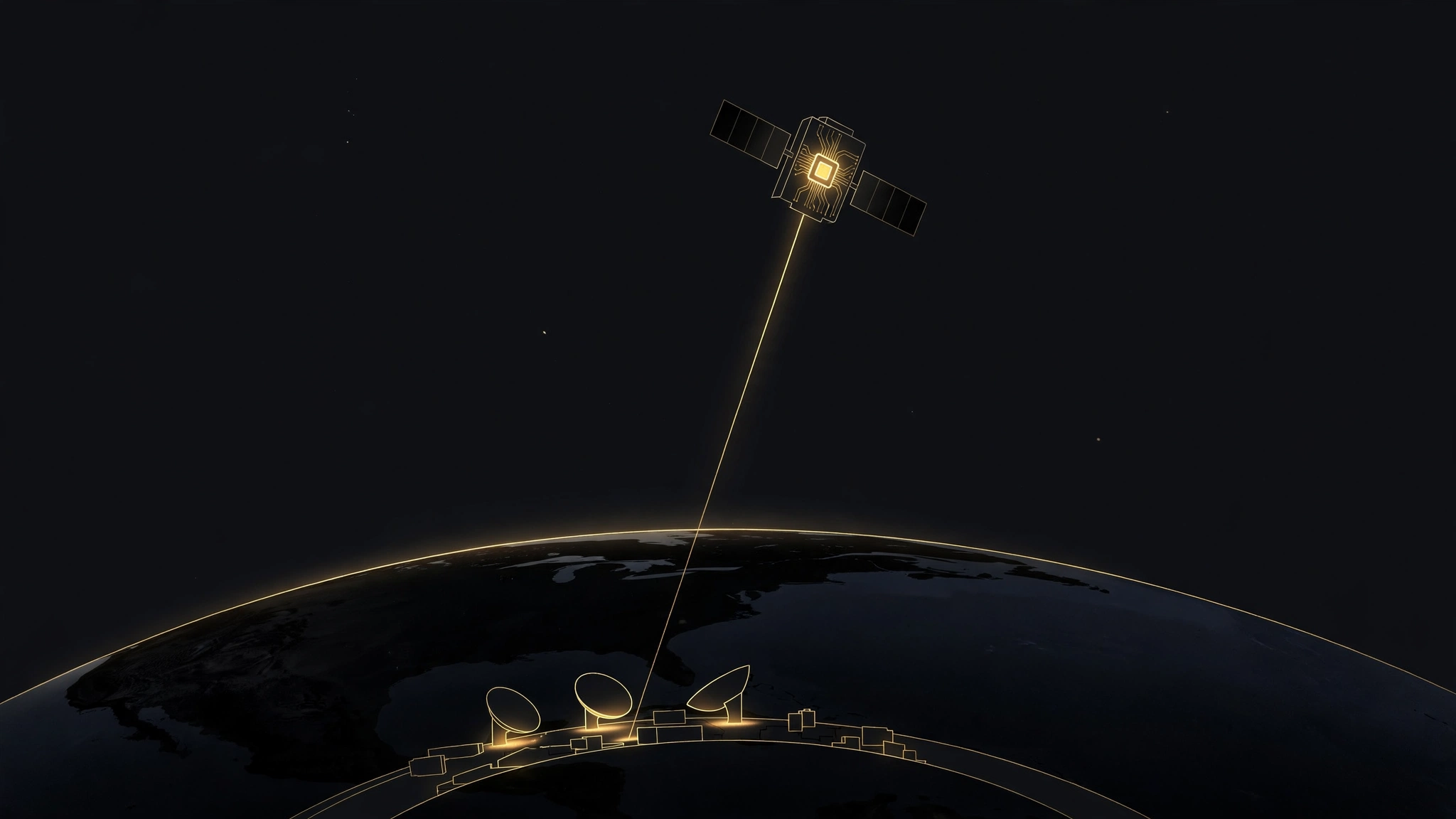
This week the team sent the first real prompt. During a ground-station pass, engineers uplinked a request to the onboard Gemma 4 model: write a haiku about being in space. The satellite passed over Svalbard, Norway, and downlinked the answer. "Blue marble below / Data streams in silent grace / Starlight feeds my core."
Google calls this the first-ever AI response from a data center class TPU in orbit. As a claim, it is narrow and, on the record published so far, accurate. A spokesperson told TechCrunch the satellite is operating nominally. The team followed the haiku with limericks and with telemetry prompts, asking the spacecraft to report the status of its own payload systems. Those telemetry answers are the more useful output of the two, even if the poem is the one that travels.
Four chips aboard, one awake
The prototype carries four TPUs. It can run one of them at a time.
TechCrunch reports that the spacecraft can generate up to 1 kW of power and carries four TPUs, although power constraints allow only one to operate at a time for about 20 minutes. Google has not published a detailed power budget for the demonstration.
The current operating limit is straightforward: despite carrying four TPUs, the prototype can operate only one at a time, for roughly 20 minutes per run. That makes this a constrained research platform, not a continuously available orbital compute service. Communication with the ground also depends on satellite passes and the available link windows.
That is not a criticism of the engineering. It is the scale of the thing being demonstrated, and it is worth stating plainly because "AI data center in space" suggests something larger — racks, sustained load, customers. None of that is being claimed by Google's own post, which describes a research moonshot and a commissioning milestone. The distance between one chip answering a poem and a data center is where the project's actual problems sit.
What the haiku does not test
The tests that matter most are still ahead. Google says the next phase will evaluate TPU performance under thermal stress and radiation exposure in orbit. Until those tests produce results, the demonstration establishes successful operation and communications, not long-duration reliability.
A haiku is close to the lightest workload a language model can be given. It confirms the chain works end to end: the chip powered on, the model loaded, inference ran, the radio link carried a prompt up and an answer down. It says little about the two questions Suncatcher exists to answer.
The first is heat. In orbit there is no air to carry heat away; a chip under sustained load has to shed it by radiation, slowly. Google's next tests put the TPUs under thermal stress, which is where short 20-minute runs stop being a power footnote and start being the central constraint.
Radiation can cause bit flips in memory, potentially corrupting data without immediately triggering conventional monitoring. Google has previously tested its TPUs in particle accelerators on Earth, but those tests cannot fully substitute for extended exposure in orbit. The company now needs to establish how reliably the hardware behaves in the actual space environment, over time.
Google's stated next milestone is two interconnected satellites in 2027. The proposed pair would move the project beyond a single spacecraft and toward testing whether workloads can be distributed between satellites. That remains a planned research milestone, dependent on the results of the current testing sequence, not a scheduled commercial deployment.
The practical angle
For anyone planning compute, nothing here changes a decision this year or next. There is no capacity to buy, no workload to move, and no price to compare against a terrestrial data center. What the milestone does establish is narrower but meaningful: Google has launched a data-center-class TPU, powered it in orbit, run an onboard model and successfully returned an AI-generated response to Earth. The remaining questions concern sustained operation, reliability, economics and whether the architecture can scale beyond a single experimental spacecraft.
Read the haiku as a receipt. The hardware survived the trip and switched on. The bill for everything after that has not come due yet.
Sources
- [1] Google, "Google receives response from Project Suncatcher prototype satellite in space", blog.google, October 30, 2026 (primary — read first-hand: the "Hello World" milestone wording, "first-ever AI response from a data center class TPU in orbit", commissioning including powering up the host and TPU trays and early machine learning tests, the haiku text, the Svalbard downlink, limerick and telemetry prompts, the next-phase thermal-stress and radiation wording, and the twin interconnected satellites in 2027 milestone)Read source
- [2] TechCrunch, "Google's first data center satellite is online and writing poetry", October 30, 2026 (reporting — read first-hand: four TPUs aboard, up to 1 kW of electricity generated, only one TPU operable at a time for about 20 minutes, a spokesperson saying the satellite is operating nominally, the Falcon 9 launch alongside more than 100 other spacecraft, and Google's earlier particle-accelerator radiation testing)Read source