
The state is the round
Strip the investor list down to proportions and this is not a conventional venture round. Of the $620 million, $280 million is one Korean government fund. Another $110 million is all of the international money combined, from six firms. Existing shareholders supplied $125 million.
The disclosed breakdown includes $280 million from Korea's National Growth Fund, $110 million from international investors and $125 million in follow-on funding from existing shareholders. Those categories total $515 million, leaving $105 million that needs to be reconciled against the full financing breakdown before the investor mix can be described as complete.
The National Growth Fund's stated objective is to expand AI computing infrastructure and strengthen Korea's semiconductor ecosystem. Its $280 million commitment gives a policy-driven investor a substantial position in a round that also includes international firms and existing shareholders. That makes the financing more than a conventional venture-capital story, although the disclosed information does not establish how much the state's participation affected the valuation or whether the company could have raised the same amount without it.
The fund's stated industrial-policy objectives may make its investment rationale different from that of a purely commercial investor. Whether that translates into more patient capital, or better support through a difficult production ramp, remains to be seen.
The card, in numbers
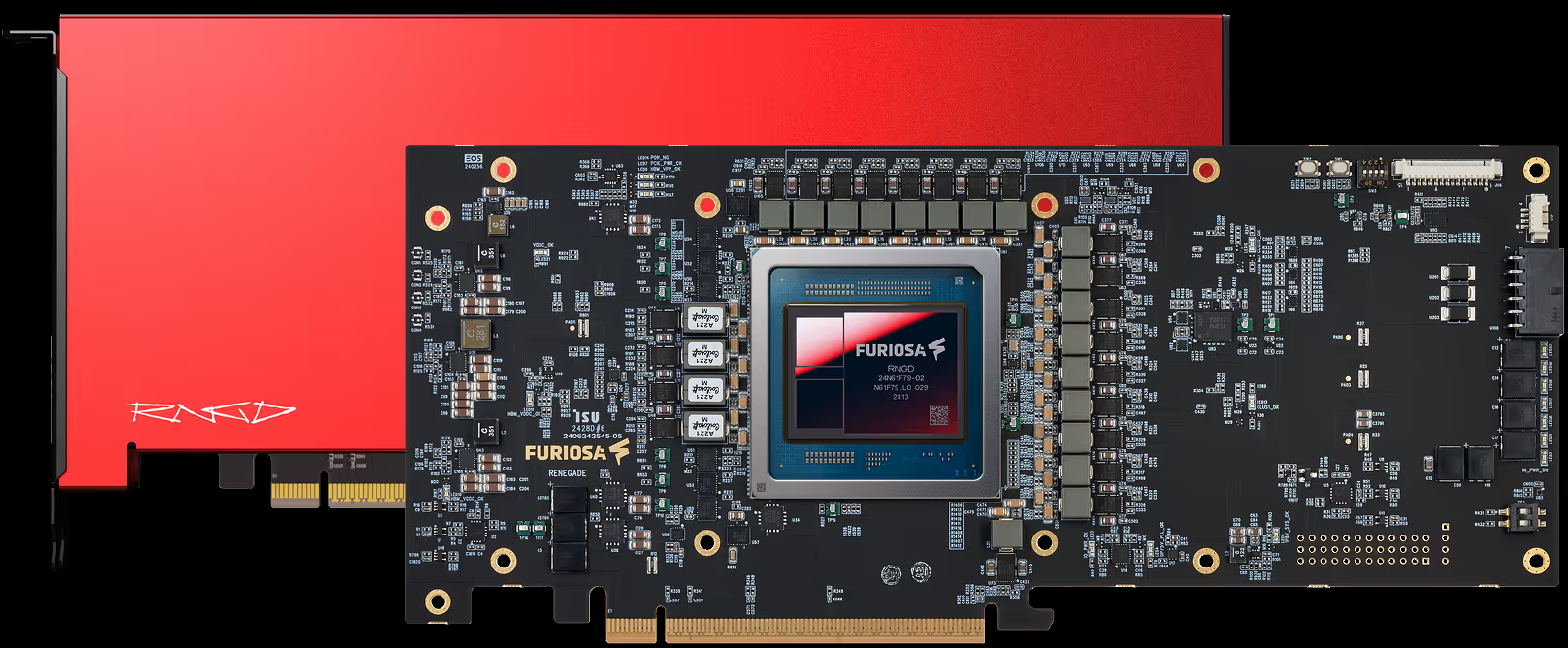
RNGD, pronounced "renegade," is a second-generation inference accelerator built on FuriosaAI's Tensor Contraction Processor design and made on TSMC's 5nm process. The official specifications are 512 TFLOPS in FP8, 48 GB of HBM3 memory at 1.5 TB/s, a PCIe Gen5 interface and a thermal design power of 180 watts, air-cooled. Eight cards make the company's NXT server: 4U, 3 kW total, 4 PFLOPS of FP8 and 384 GB of HBM3, sized to fit the power and cooling budgets of existing enterprise racks without a retrofit.
The design choice worth noticing is what the card is not. FuriosaAI positions RNGD as an inference accelerator rather than a general-purpose training platform. Its 48 GB of HBM3 and stated performance profile target serving workloads, not the largest frontier-model training jobs. It is aimed at a specific, repeatable job: serving open models to many users at a capped power draw, which the company frames as up to about 100 tokens per second per user. That is a narrower claim than "Nvidia challenger," and a more defensible one.
Read the efficiency claim against its own footnote
FuriosaAI's headline claim is that RNGD can match the RTX PRO 6000's throughput at the same card count while serving up to twice as many users per kilowatt under its tested conditions. The product page carries the method, and the method narrows the headline. The comparison runs one model, Qwen3-32B in FP8, with Furiosa's current SDK against the Nvidia card on vLLM. It was measured on four-card systems and then scaled to eight-card server power envelopes: 3.0 kW for the Furiosa server against 6.5 kW for the Nvidia configuration. In the long-context chart, the throughput-per-kilowatt ratio at 37 tokens per second per user is 1.66 times, not two. The "up to two times" figure is the top of a range across serving thresholds.
This is better disclosure than most challenger chips offer, and it still leaves the central question open. The test is the vendor's, on the vendor's chosen model, against a workstation-class Nvidia card rather than Nvidia's data-centre line. The company also reports that its October SDK release lifted token generation per watt by up to 138% on one model against its own previous release, which tells you how much of the current comparison sits in software that is still moving. An efficiency lead measured this way is a reason to run an evaluation. It is not yet a result a buyer can take from someone else's data sheet.
There is one piece of outside-the-company evidence, and it is a deployment rather than a benchmark. Samsung SDS put RNGD into a commercial service it sells. LG runs its own EXAONE models on it. Upstage serves live search traffic on it. These deployments are meaningful evidence that RNGD has moved beyond a product announcement into real workloads. But without disclosed unit counts, contract values or workload shares, they do not establish the commercial scale of that adoption.
What the money has to buy
The announcement sets a production target of 20,000 cards in 2026 and more than 40,000 in 2027, with the company saying it has secured the necessary memory and manufacturing capacity to expand output. Those targets describe planned supply, not confirmed shipments or customer orders. The release does not disclose how many cards are already committed, how many have shipped, or the revenue attached to them.
The $2.9 billion valuation implies expectations that extend beyond the announced production targets. FuriosaAI is planning to more than double output in 2027 and is developing a third-generation chip with Broadcom and other partners, but it has not disclosed a launch date for that design. The valuation therefore rests partly on future execution that cannot yet be measured against reported revenue or customer volumes.
That may prove right. Inference is the volume business of AI computing, it is power-constrained everywhere, and a credible 180-watt card with production customers is a scarce asset. But the distance between this announcement and that outcome is measured in the two numbers the release does not contain: how many of the 20,000 cards are already committed to customers, and what they are being paid for them. The next disclosure that matters from FuriosaAI is not another round. It is a production figure for 2027 that was committed rather than planned, or a customer willing to say how much of its inference traffic the card now carries.
Sources
- [1] FuriosaAI, "FuriosaAI closes $620 million Series D to scale efficient, production-ready AI inference" (company blog, October 29, 2026, 06:47 UTC) — the round and valuation, the National Growth Fund's KRW 370 billion, the 20,000-card plan and secured capacity to more than double in 2027, RNGD and NXT server specifications, the RTX PRO 6000 comparison, Samsung SDS and LG deployments, the Gen 3 design with Broadcom, and the SDK 2026.4 figuresRead source
- [2] FuriosaAI, "FuriosaAI Secures $620 Million Series D to Meet Surging Enterprise AI Inference Demand and Accelerate Next-Gen Silicon" (BusinessWire, October 28, 2026, 23:57 UTC) — KRW 820 billion, international investors' $110 million total, existing shareholders' $125 million, KDB's $22 million, UAMCO's $30 million, the Export-Import Bank of Korea's first direct startup investment, 20,000 units in 2026 and over 40,000 in 2027, Samsung SDS's July service launch, LG's EXAONE deployments and Upstage's live search summarisationRead source
- [3] FuriosaAI, RNGD PCIe Card product page (official, accessed October 29, 2026) — headline specifications and the full methodology footnote for the token-throughput-per-kilowatt comparison (Qwen3-32B FP8, SDK 2026.4 against vLLM 0.28.0, four-card measurements scaled to 3.0 kW and 6.5 kW eight-card envelopes, ×1.66 at 37 tokens/s per user in the long-context chart); source of the mid-article product imageRead source
- [4] FuriosaAI Developer Center, RNGD hardware specification (official documentation, accessed October 29, 2026) — TSMC 5nm, 512 TFLOPS FP8, 48 GB HBM3 at 1.5 TB/s, PCIe Gen5 x16, 180W TDPRead source
- [5] AI Affairs, "FuriosaAI raises 820 billion won above target at 3.8 trillion won valuation" (October 29, 2026), reporting MoneyToday and The Asia Business Daily — the January KRW 450–750 billion target range, the pre-money KRW 3 trillion figure, existing shareholders' KRW 170 billion, and the National Growth Fund committee's May approvalRead source
- [6] Bloomberg reporting carried by KuCoin News, "South Korean AI chip startup FuriosaAI's valuation surges to $2.9 billion following new funding round" (October 29, 2026) — the previous valuation of about $735 million and the roughly fourfold step-upRead source