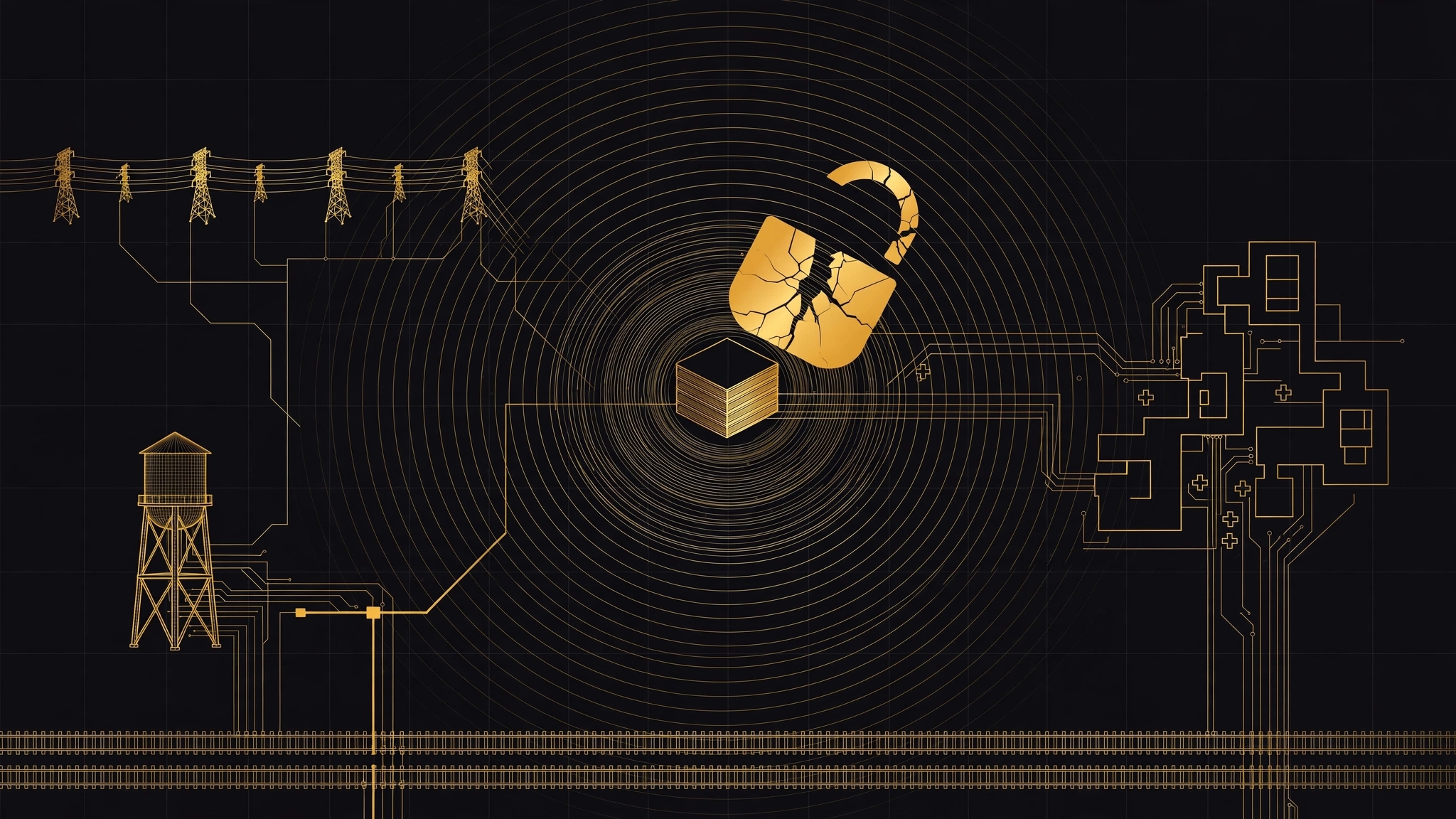
A date, attached to a specific kind of attack
Annual reviews from security agencies usually deal in weather, not forecasts: the climate is worsening, the storms are stronger. This one attaches a date and a mechanism. The National Cyber Security Centre judges it highly likely that by 2028 a ransomware attack involving AI-powered malware will land on Britain's critical national infrastructure, the networks behind power, water, transport, health and food supply. Over the same period, it says, hostile actors' use of AI will enhance the scale and efficiency of what they already do.
Read the judgment at the strength it is written. "Highly likely" is an assessment phrase, not a report of an attack already observed. The NCSC is forecasting that AI-powered malware will be used in a ransomware attack against UK critical infrastructure by 2028. Its wider assessment also makes an important distinction: AI is expected to accelerate existing attack methods, not necessarily conduct entire operations autonomously. For infrastructure operators, the warning is that existing weaknesses may become much easier to find and exploit.
The sentence that does the work
The most useful line in Richard Horne's prepared launch remarks is the one that challenges the science-fiction version of this story. He is expected to say that the rise in cyber incidents is coming "not because AI has invented new ways to attack us, but because vulnerabilities that have been tolerated for far too long can now be discovered and exploited at a scale that was once unimaginable."
The distinction is consistent with the Annual Review's technical assessment. The NCSC says AI's greatest impact will come from accelerating and scaling existing tactics, techniques and procedures rather than generating new attack vectors.
That is consistent with the NCSC's own standing guidance. Its frontier-AI page puts it plainly: attacks that once required specialist skills can increasingly be automated using AI, which "does not fundamentally change cyber risk, but it does increase the speed and scale at which existing weaknesses can be found and exploited." The agency's position, in other words, is that AI is an accelerant applied to a backlog. The backlog is the scandal in the sentence: Horne says organizations and their supply chains have got away with "doing tech on the cheap" for decades, and his prepared closing asks leaders to be ready to explain, after an incident, why they saw the warning signs and "still didn't make the right choices" — his examples are food not on shelves and lights not on.
A more specific warning, with a June predecessor
The 2028 date did not first appear on Tuesday. In his RUSI Annual Security Lecture on June 17, Richard Horne quoted the NCSC's assessment that attackers would highly likely use AI cyber capabilities against known vulnerabilities in legacy technology across critical national infrastructure by 2028.
That lecture also supplied the incident base behind the warning: more than 200 incidents affecting the infrastructure and its supporting ecosystem managed in the year to May 2026, about 75% of them believed to be linked to state actors.
Tuesday's Annual Review adds a more specific scenario. It separately assesses that AI-powered malware is highly likely to be used in a ransomware attack on UK critical national infrastructure by 2028. The June assessment described the wider vulnerability-exploitation threat; the November review identifies ransomware as a specific likely application. These are related assessments, not evidence that an attack has already happened or that the NCSC has formally raised its probability rating.
Who is named, and what is not claimed
Horne's prepared remarks name China as the state that "highly likely has the intent and is best positioned" to use AI against UK critical infrastructure, describe sustained Russian attempts to penetrate UK military networks, and cite Iranian operations globally. Reuters notes that Moscow, Beijing and Tehran have repeatedly denied similar accusations in the past, and nothing in the review reporting identifies a specific AI malware sample, a named campaign, or a foiled plot. The practical read for an operator is not the attribution. It is the deadline logic: patch and segment the legacy systems the June assessment pointed at, because the agency is now saying, in writing, that the window before automated exploitation and AI-assisted ransomware converge on them is roughly two years, and that the excuse of not having been warned has been pre-emptively retired.
Sources
- [1] National Cyber Security Centre — "Cyber chief: UK facing AI-powered attacks on critical infrastructure within two years," launch announcement, November 3, 2026 (read first-hand — AI-powered malware highly likely to be used in a ransomware attack on Britain's critical national infrastructure by 2028; AI adoption by hostile actors "highly likely" to increase the scale and efficiency of their operations within the next two years; Horne's launch speech framed throughout as upcoming — "is set to say," "is expected to say" — with the prepared remarks reproduced verbatim, including "not because AI has invented new ways to attack us," the "unprecedented rise" warning, "doing tech on the cheap," and the closing "food isn't on shelves, lights aren't on, businesses have gone under" warning)Read source
- [2] National Cyber Security Centre — NCSC Annual Review 2026, collection page (read first-hand — the review of the NCSC's tenth year, covering 1 September 2025 to 31 August 2026; the launch announcement links to it as the Annual Review 2026, whose report is titled State of the Cyber Nation)Read source
- [3] Reuters (Michael Holden), "UK must expect AI-powered attack on critical infrastructure within two years, report says," November 3, 2026, 00:02 UTC (the report that surfaced the review — read first-hand in full via a Reuters syndication copy; the by-2028 AI-powered-malware ransomware judgment, the scale-and-efficiency warning, Horne's prepared remarks, the China/Russia/Iran passages, and the note that Moscow, Beijing and Tehran have repeatedly denied similar accusations)Read source
- [4] National Cyber Security Centre, transcript: "Richard Horne speaking at the RUSI Annual Security Lecture," June 17, 2026 (read first-hand — the assessment that by 2028 it is highly likely AI cyber capabilities will be used by attackers against known vulnerabilities in legacy technology in critical national infrastructure; more than 200 CNI incidents managed between June 2025 and May 2026, 75% believed linked to state actors)Read source
- [5] Royal United Services Institute, "Hostile States Behind 75% of Cyber Attacks on UK Infrastructure — NCSC CEO," June 2026 (read first-hand — summary of the same lecture and its figures, and the pointer to the NCSC frontier-AI resources)Read source
- [6] National Cyber Security Centre, "Frontier AI: what you need to know" (read first-hand — the agency's standing position that AI automation "does not fundamentally change cyber risk, but it does increase the speed and scale at which existing weaknesses can be found and exploited")Read source