
One pilot is already running
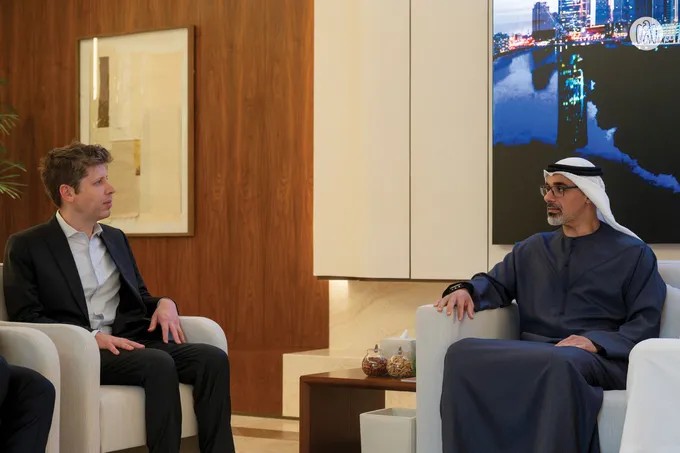
Most sovereign AI announcements are a signing, a photograph and a round number. Abu Dhabi's November 2 announcement has the signing and the photograph, but no financial figure. It has something more concrete: the Abu Dhabi Media Office says the first pilot under its new government agreement is already in production.
The pilot belongs to the Machine-Readable Government initiative, which the Media Office describes as the world's first AI-native Machine-Readable Government initiative. That superlative is the government's own claim. The underlying work is more straightforward: a defined set of government policies and regulations is translated into machine-readable form, allowing AI systems to assist officials with routine regulatory compliance assessments, including checks related to permits and certificates.
The first pilot is with the Abu Dhabi Agriculture and Food Safety Authority (ADAFSA), focused on food imports. According to the announcement, AI processing uses OpenAI's UAE inference residency, with real-time model computation running on GPUs inside UAE data centers.
One production pilot on one category of imports is a modest thing, and a different kind of thing from a memorandum: a pilot in production has users, inputs and wrong answers that someone has to handle; a signing has a press release.
The safeguard is the interesting part
The release specifies one design choice worth taking seriously, because it is the choice most government AI deployments leave vague. Each assessment is traceable to the governing rule, and government officials retain oversight and accountability for final decisions.
Traceability could give an official a basis to explain a machine-assisted assessment by pointing to the rule behind it. That matters when an importer questions why a shipment failed a compliance check.
But traceability is not, by itself, an appeal process. The announcement does not describe how applicants can challenge an assessment, who reviews disputed cases, or whether a human reviewer must reconsider the underlying evidence. Those are important parts of accountability that remain unanswered.
The announcement does not provide the information needed to assess the pilot's performance: how many regulations have been converted, how often assessments are wrong, how long a check takes compared with the manual process, or what route an applicant follows when disputing a result.
The Media Office says the pilot is already in production. That establishes the status Abu Dhabi is reporting, not the system's accuracy, scale or effectiveness. Those are the figures that will determine whether Machine-Readable Government becomes a meaningful change in public administration rather than a new label for AI-assisted compliance checks.
The other agreements have different starting points
ADNOC, G42 through its subsidiary Inception42, and OpenAI signed a separate agreement to deploy OpenAI Frontier across ADNOC's operations. ADNOC says the partnership will begin with two applications: integrating subsurface, facilities and economic data to produce field development master plans in hours rather than months, and connecting operational and commercial intelligence to value crude while it remains in the ground.
ADNOC's own announcement provides some existing deployment context. It says ChatGPT Enterprise has already been rolled out to more than 40,000 employees, with adoption exceeding 97%. The company also reports more than 200 AI applications and 70 robotics use cases, either deployed or under development. These are ADNOC's figures, not independently audited deployment statistics.
The partnership will use OpenAI's GPT models and G42's sovereign AI infrastructure in the UAE. ADNOC says human experts will retain oversight of consequential decisions.
Mubadala, Inception42 and OpenAI also signed an agreement covering investment analysis, opportunity identification and risk assessment. Separately, Inception42 and OpenAI signed a five-year agreement to support frontier AI adoption across government, enterprise and education, including enterprise solutions for large UAE organizations.
Inception42 is a party to three of the four agreements. That makes it a central local implementation partner across the government, energy and wider adoption initiatives. The Media Office does not disclose financial values or detailed deployment milestones for these agreements.
Without a value or a deadline, none of the three can be scored yet — they are commitments to begin, announced on a day when the fourth agreement could already point to a pilot the government says is running.
What to watch
The useful follow-up questions are narrow. Does the machine-readable set grow beyond food imports, and does Abu Dhabi publish the list of rules it covers? Does any figure for accuracy or processing time appear, from the government or from an auditor outside it? And does the traceability promise survive contact with a disputed assessment, which is the first real test of any system that checks compliance?
Governments elsewhere are buying the same first-check pattern from the same small set of model companies. Abu Dhabi's version will be worth copying, or worth citing as a warning, on evidence that has not been published yet. For now, the milestone is a claim worth crediting as reported; the label still has to earn itself.
Sources
- [1] Abu Dhabi Media Office — “Khaled bin Mohamed bin Zayed meets Sam Altman and witnesses signing of agreements with OpenAI,” November 2, 2026 (all four agreements; the Machine-Readable Government initiative's method, traceability and official-accountability wording; the ADAFSA food-import pilot stated to be in production; UAE inference residency and in-country GPU computation; the five-year Inception42 agreement; Altman's quoted statement; read first-hand)Read source
- [2] ADNOC — “ADNOC Signs Landmark Partnership Agreement with OpenAI and G42, Becoming First Energy Company to Deploy OpenAI Frontier Technology,” November 2, 2026 (ADNOC's own release, read first-hand in full: two initial applications — field master planning as a single integrated decision and valuing every barrel while it is still in the ground; ChatGPT Enterprise rolled out to more than 40,000 employees with adoption exceeding 97%; more than 200 AI applications and 70 robotics use cases deployed or under development; OpenAI Frontier deployed on G42's sovereign AI infrastructure in the UAE with human experts retaining oversight of consequential decisions)Read source
- [3] FourWeekMBA — “Abu Dhabi Signs 4 OpenAI Deals in AI-Native Government Push,” November 2, 2026 (independent walk-through of the same Media Office release; party-per-agreement count; explicit note that the release gives no contract values, user counts or timetable beyond the five-year term)Read source