A design, not a product
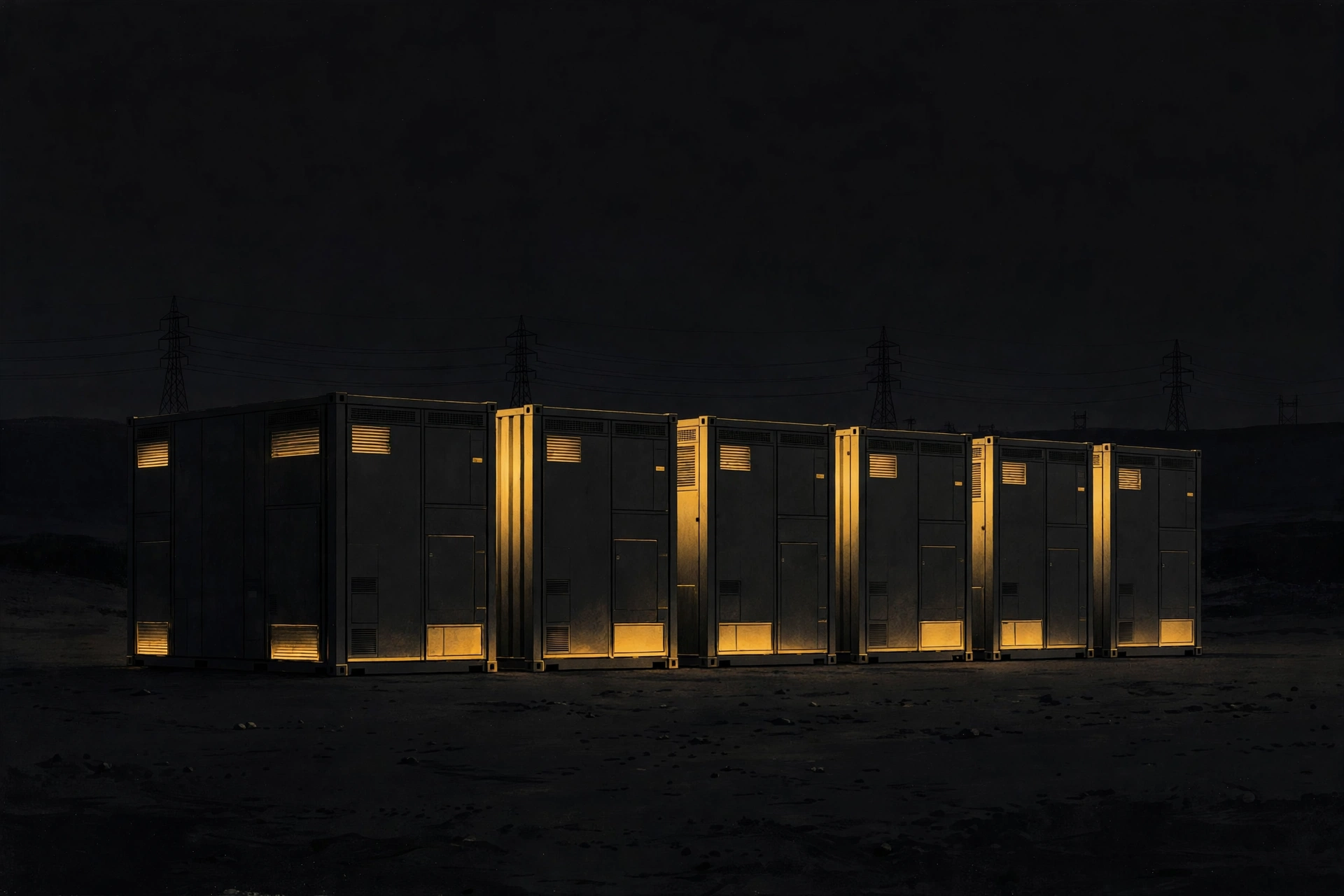
Start with what changed hands today: a reference design. NVIDIA is not shipping containerised data centres. It has published a design that partners are expected to manufacture — 17 named partner entries, from Dell Technologies and HPE to Crusoe and Vertiv — in which the integration work that normally happens on a construction site, computing, networking, cabling, rack-level power and liquid cooling, assembled and tested as one system, happens in a factory instead.
That work is slow when it is done on site. It depends on scarce specialist labour, it proceeds rack by rack, and it sits in series behind the building itself. Moving it into a factory is meant to take it off the site's critical path and let it run in parallel with site work. Huang's framing was about revenue timing: "An AI factory creates value when it starts producing tokens — not when construction is complete." On the narrow claim, he has a point. A validated container is a better starting position than a warehouse of parts.
The condition is the announcement
The 14 days begins when a container reaches a site whose power, cooling and networking are already in place. NVIDIA's release states the boundary itself: the partners' factory work "takes place separately from site preparation."
Site preparation is where AI capacity currently goes to wait. This week's record is specific. Microsoft terminated its anchor agreement at Nscale's Loughton project, where grid power may not arrive until the 2030s. Microsoft did not publicly give a reason for the termination. The project illustrates the uncertainty surrounding power availability; it is not proof that grid delays caused Microsoft's decision. We covered the Loughton exit, and what is and is not known about its reasons, [here](https://alfw.ai/article/microsoft-nscale-loughton-exit/). Anthropic has been reported unable to get as much capacity as it wants from cloud partners that increasingly see it as a competitor. The scarce input in AI infrastructure in October 2026 is not racks, cabling or integration labour. It is electricity delivered to a fence line, and DSX POD assumes that input.
So the honest way to hold the number is as two clocks. The first clock, integration and onsite deployment, is the one NVIDIA says it is compressing, from its own six-month baseline to as little as 14 days, if partners perform as designed. The second clock, everything that has to happen before a container can be connected, is untouched by this announcement, and in much of Europe and North America it runs in years of grid queues, permits and substation work. DSX POD is a proposal to make the fast part faster.
What would settle it
Deliveries in early 2027 are the first evidence that counts. A named customer, a stated capacity and a full timeline, from site start to first production token, would let the 14 days be weighed properly. The claimed timeline has not yet been demonstrated in a disclosed commercial deployment. Until a pod's power draw and price are public, DSX POD cannot be compared with a conventional build on cost at all, only on calendar, and only on the last segment of the calendar.
The platform efficiency figures need the same treatment. "Up to 100%" less cooling water and "up to 30%" less power are NVIDIA-stated maximum improvements for the broader DSX AI Factory Platform, under conditions the announcement does not specify, not measurements taken from a shipped POD. NVIDIA's companion platform announcement ties the near-zero water figure to liquid-cooled designs that reject heat with dry coolers, and the power figure to DSX MaxLPS, a platform component for dynamic power allocation. Neither figure establishes that a complete facility needs no water, and neither has been measured on a commercially deployed DSX POD.
Also at the keynote
The DSX POD announcement was the hardware headline of a wider keynote. NVIDIA also introduced the OpenShell Reference Architecture, a design for running AI agents inside a policy-controlled, kernel-level sandbox; said it had made its first commercial phone call on T-Mobile's live network with Nokia, using its AI-RAN platform; and described the week's European tour as nearly $10 billion committed across the continent, working with more than 12,000 partners. Those are NVIDIA's own descriptions of its European activities, not independently audited totals. Each of those deserves its own check when there are documents to check. Today, the document with the number in it is the DSX POD release, and the number has a condition attached.
Sources
- [1] NVIDIA press release, 'NVIDIA Introduces DSX POD AI Factories to Accelerate Europe's Infrastructure Deployment', GlobeNewswire, Berlin, 21 October 2026 — the reference-design definition, the six-months-to-14-days claim and its prepared-site wording, the 17-entry partner list, early-2027 worldwide availability, and the forward-looking statements disclaimer. Full wire text read via the CRWE World mirror of the same release and corroborated against Morningstar, Seeking Alpha and Unite.AI copiesRead source
- [2] NVIDIA Blog, 'GTC Berlin 2026: Live Updates From NVIDIA CEO Jensen Huang's Keynote', published 21 October 2026, updated 10:47 UTC — the DSX POD announcement in the keynote, the DSX platform 'up to 100%' water and 'up to 30%' power claims, OpenShell, the T-Mobile/Nokia AI-RAN call, and NVIDIA's description of nearly $10 billion committed across Europe with more than 12,000 partnersRead source
- [3] Unite.AI, 'NVIDIA Says DSX POD Cuts AI Factory Deployment From Months to Weeks', 21 October 2026 — including its account of NVIDIA's companion DSX platform announcement: the up-to-30% power figure tied to DSX MaxLPS, and near-zero facility cooling-water consumption tied to liquid-cooled designs with dry-cooler heat rejectionRead source
- [4] Context: ALFW's coverage of Microsoft's termination of its anchor agreement at the Nscale Loughton project, 18 October 2026Read source