Start with the arithmetic, because it is the easiest part to check. NVIDIA calls Alpamayo 2 Edge a 2B-parameter model, in the model card's own opening line and throughout its technical blog. The same card then breaks the model down: a 2.45B backbone, made of a 1.96B language model, a 0.41B SigLIP2 vision encoder and a 0.08B projector, plus a 0.2B diffusion action expert on top. That adds up to 2.65B. The card does not say what the 2B label counts. The gap is not trivial: the difference between the label and the listed total is roughly a third of the advertised size.
None of this makes the model large. A reasoning driving model that fits an in-car computer at all is a substantial piece of engineering, and it should be reported as one. But size is the headline claim of an edge model, so the headline number should be the listed one.
What the model actually does
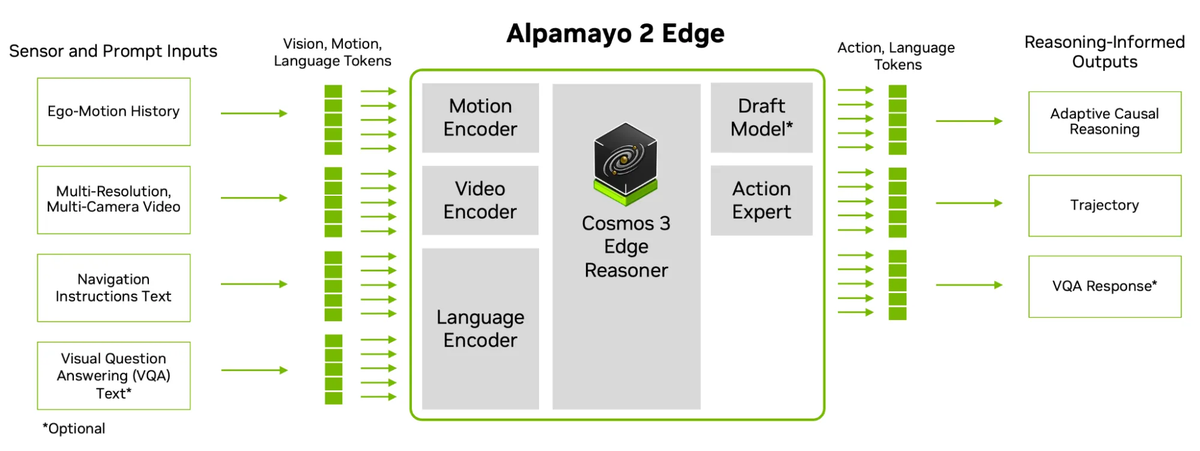
Edge takes surround-camera video from six cameras, the car's recent motion and a navigation instruction, and returns a predicted trajectory of 64 waypoints covering the next 6.4 seconds, together with a Chain-of-Causation explanation of the decision. It was trained on roughly 115,000 hours of driving video and, per NVIDIA's technical blog, about 3.7 million reasoning traces generated by its 34B sibling, Alpamayo 2 Super, then post-trained with closed-loop reinforcement learning in simulation.
The blog's account of its adaptive reasoning is the design's most distinctive feature. In routine driving the model emits a special NOMINAL token instead of a full reasoning trace, and only writes out its reasoning when a scene calls for it. That matters because every reasoning token is time, and time is the one budget an in-car model cannot borrow against.
The 60x, read with its conditions attached
NVIDIA's comparison chart leads with closed-loop driving: 15.15 km between at-fault incidents for Edge, against 0.25 km for Alibaba's 4B Qwen-Drive-1.0, presented as roughly 60x. The number is a simulator result on one metric. Where it was measured is the qualification. The test is AlpaSim, NVIDIA's own simulator, over 875 scenarios from NVIDIA's PhysicalAI-AV-NuRec dataset, and the rival's 0.25 km figure is from NVIDIA's run of Qwen-Drive-1.0. The comparison gives no real-world safety estimate.
The supporting numbers are less dramatic and more informative. Open-loop trajectory error is 0.53 m for Edge against 1.68 m for Qwen-Drive-1.0 in NVIDIA's chart, a solid lead without the multiplier. On LingoQA, a reasoning benchmark, Edge scores 75.2 on its card, behind Alpamayo 2 Super at 79.2 in NVIDIA's reporting. Its nuReasoning numeric score is 48.67. A model can post a large closed-loop lead in simulation and a smaller one on reasoning benchmarks, and on NVIDIA's own figures, this one does both.
Real-time, after the recipe
The second number that needs its conditions is the latency. NVIDIA reports 160 to 190 milliseconds from camera input to trajectory on DRIVE AGX Thor-X, for its optimized pipeline. Its blog is explicit about how that figure is obtained: the downloaded BF16 weights run as a PyTorch model, and to run at real-time on Thor the model "must be further inference-optimized" through a recipe that calibrates FP8 scales, exports ONNX graphs and builds TensorRT engines. The model card's own testing section is narrower still: tested on one H100 80GB, other GPU architectures not yet validated, at least 16 GB of memory recommended — a recommendation that does not by itself establish performance on a 16 GB card.
So the summary is two statements, not one. The optimized Thor pipeline is the configuration NVIDIA measured at the quoted latency. The artifact a developer downloads today is validated on a data center card. Partner results, including Embedl's claim of 10 Hz on AGX Thor in under 48 hours, are vendor-reported in NVIDIA's post, not independently tested.
Sources
- [1] NVIDIA, Alpamayo 2 Edge model card, Hugging FaceRead source
- [2] NVIDIA Technical Blog, "Running AV Reasoning Models Within Onboard Compute and Latency Limits"Read source
- [3] MarkTechPost, "NVIDIA Releases Alpamayo 2 Edge: A 2B Reasoning VLA for DRIVE Thor," November 22, 2026Read source