
What the 55.1% actually covers
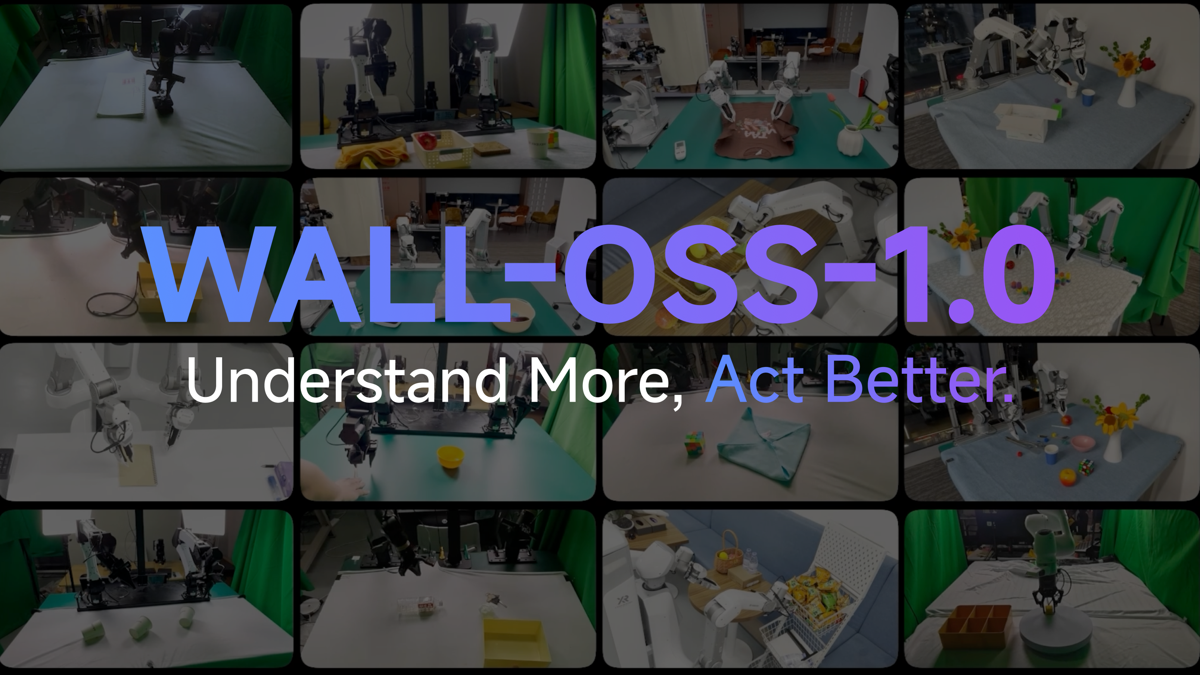
The 312 tasks were freely selected by evaluators and covered unfamiliar objects, tool use, bimanual coordination and multi-step manipulation. The zero-shot claim is specific: no demonstrations and no fine-tuning for those tasks. The release does not say the tasks were absent from the model's training data, and it does not publish the test protocol.
Read the other half of the number too. 55.1% means the robot was unsuccessful on about 45% of the tasks in this evaluation. That is a research result, not a deployment figure, and the release does not present it as one.
Every evaluation in the announcement is X Square Robot's own, and the release cites no independent replication. The 312-task test has no published protocol in the release and no named external evaluators. The same applies to ManipArena, where WALL-OSS-1.0 scored 1,101 of 1,500 points and a 50.67% success rate against π0.5's 24.0%, and to the X2Real simulation, where it scored 67.55 against Lingbot-VLA-2.0's 40.94 with all models fine-tuned on the same simulation data. One result does sit on a public board: the 4B Lite variant's 42.59 on the RoboDojo simulation leaderboard ranked first among policies without agent systems as of November 5, 2026. That is a dated snapshot of one leaderboard, for the Lite variant, not the flagship.
Native pretraining is the actual bet
The release contrasts WALL-OSS-1.0 with the common pattern it describes: many existing vision-language-action models start from a pretrained vision-language model and introduce robot actions through later training. WALL-OSS-1.0 trains the three streams together from a Qwen3.5 base, and its training objectives go beyond imitating demonstrations to understanding actions, evaluating proposed behavior and correcting errors. Trajectories are annotated at four levels — task, subtask, action and segment — and the release presents that annotation as what lets the XR Harness agent layer direct the model in plain language, breaking "clean up the table" into fruit collection, object organization and plate stacking.
Whether native pretraining caused the reported gap over the baselines is a separate question from whether the gap is real. An independent rerun could check the performance. Isolating the cause would take a controlled comparison that holds the data, the action tokenizer and the evaluation constant — which only the company is positioned to run.
The deployment story is narrower than the headline
The one deployment example in the release is parcel sorting for a leading logistics customer, and it is not the zero-shot model at work: WALL-OSS-1.0 serves as the pretrained foundation for a task-specific sorting policy adapted to that workflow. The transfer figure is genuinely interesting — the adapted policy kept more than 90% of its original-site sorting speed and success rate at new sites in the company's cross-site evaluation, while a policy trained without the pretraining lost more than 90% of its success rate — but both sides of that comparison are also the company's.
Access is similarly provisional. XR Harness has a developer preview. WALL-API-1.0 is an announcement, with no pricing in the release. The flagship's parameter count is not stated; only Lite (4B) and Nano (2B) get numbers, plus two further variants, Gen and AR, described without sizes or dates. And the open-source promise that would let anyone check any of this — code and weights — has no date and no license attached to version 1.0 in the release.
What would settle it
Three things, in order: the weights actually landing, with a license; a third party rerunning the 312-task style evaluation, or ManipArena, on the released checkpoint; and API pricing for WALL-API-1.0, which answers a separate purchasing question. Until the first of those happens, WALL-OSS-1.0 is a well-documented claim from one company, with one public leaderboard placing for its 4B Lite variant.
Sources
- [1] X Square Robot, "X Square Robot Introduces WALL-OSS-1.0: Understand More, Act Better — A Native Foundation Model for the Physical World", GlobeNewswire, November 23, 2026Read source
- [2] WALL-OSS-1.0 technical blog (linked from the release; not separately relied on for figures)Read source