
Adoption Rose 10 Points. Spending Multiplied.
The share of companies paying for AI rose from 55% to 65% in a year. Spending grew much faster: Menlo estimates deployment spending reached 5.4 times its previous-year level on an annualized basis. Menlo reads this as headroom: power users are spending heavily, and the long tail has yet to start. The same figures support a less comfortable reading. A market whose growth depends on existing customers spending five times more, rather than on new customers arriving, is a market whose growth rate is set by a minority of budgets.
The average is doing the heavy lifting
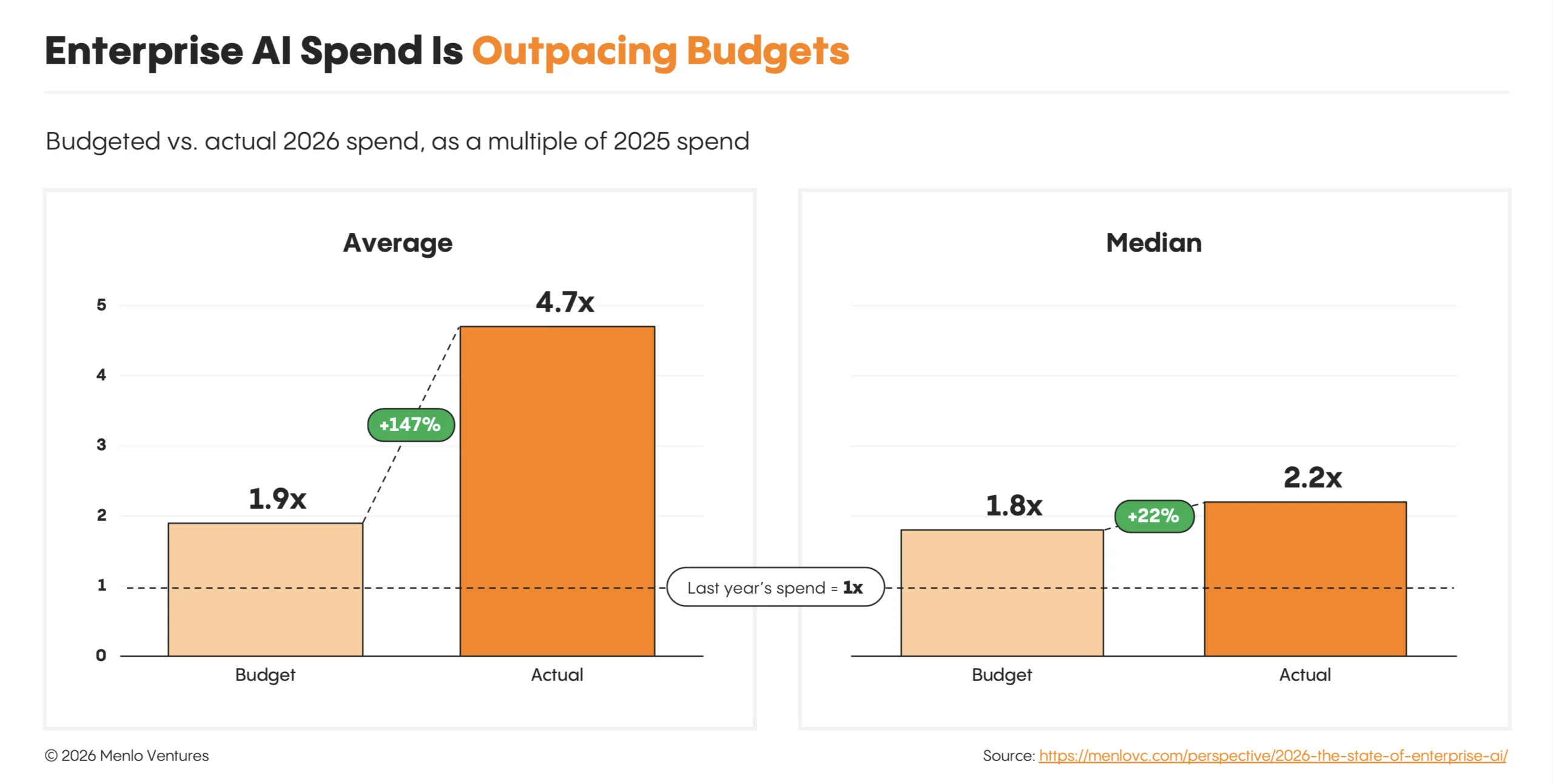
Reported spending averaged 4.7 times last year's level, against a planned 1.9 times. The median company looks different: 2.2 times last year's spending, against a planned 1.8 times. Menlo is candid about why the two diverge, crediting a "fat head" of power users whose spending grew far faster than most enterprises'. Both stories are in the report. The one traveling in headlines is the average, which is the one a minority of companies produced. Anyone benchmarking their own AI budget against the 4.7 figure is comparing themselves to the heaviest users in the sample, not to the typical firm.
Three labs take 69 cents of each dollar
Anthropic, OpenAI and Google command an estimated $122.7 billion of deployment spending, 69% of the total, up from 50% last year; Menlo says their spending grew 7.5 times against 3.3 times for everyone else. Inside enterprise LLM API spending specifically, Anthropic holds an estimated 55% share, OpenAI 31% and Google 9%. Together, Anthropic and OpenAI account for 86% of this API market; adding Google brings the three companies to 95%. The labs also sell the leading applications: their first-party apps total $40.0 billion, and Claude Code and Codex alone account for $24.0 billion, 70% of all coding spend. Near-frontier models from xAI, Moonshot, DeepSeek and Z AI, which Menlo notes approach frontier performance at a fraction of the price, hold under 5% of API spend between them.
The biggest customer is now a machine
On OpenRouter, the model gateway Menlo uses for token data, agents account for 80% of token volume, equivalent to 130.9 trillion tokens per week, according to the report. Agent traffic overtook human-driven traffic in early February 2026 and has grown 37 times since, compared with five times for human usage. Menlo's own methodology note carries the limit: OpenRouter's users skew toward individual developers and startups rather than the enterprise buyers in its survey. The 80% is a real measurement of one large gateway. Coverage that repeats it as a share of all AI usage has dropped the platform, and the caveat, on the way through.
Open models get the tokens, not the money
Open-source models rose from 11% to 19% of token share while their share of spending fell from 6% to 4%. The mechanism is price: Menlo puts the average open-source token at $0.13 per million, down 3.3 times in a year, against a blended $0.70 per million for closed models. Chinese models account for 89% of open-source spend, led by Kimi at 61%, with DeepSeek, GLM and Qwen behind it; Meta's Llama is the largest Western entry at 7%. Usage and revenue are moving in opposite directions, which is precisely why a self-hosted deployment can be large in production and nearly invisible in the spending data.
Where the money comes from
Menlo attributes 55% of incremental AI spending to net-new budgets. Software budgets supplied 22%, and most of that stayed inside the incumbent column: 13 points went to incumbents converting their own licenses into AI products, while 9 points, $12.6 billion, moved to AI-native vendors. On an annualized basis, Menlo's $176.8 billion deployment estimate is equivalent to more than 30% of public-cloud revenue, compared with approximately 6% a year earlier. The feared raid on existing software budgets is, on these figures, still small. The spending is additive, which also means it is the first line exposed when budgets tighten.
What the report does not measure
The report counts spending, adoption and token volumes. It does not audit what the spending returned. Menlo's market totals are modeled estimates, not a direct measurement of company spending. Its bottom-up model incorporates a Morning Consult survey of nearly 400 U.S. enterprise decision-makers responsible for more than $4 billion in AI spending, fielded September 8–26, 2026, alongside public filings and third-party reports. Menlo presents revenue as annualized run rates and reclassifies prior-year figures to match this year's categories. Menlo also has financial interests in several companies covered by the report. It marks portfolio companies with asterisks, including Anthropic and OpenRouter, which feature in two important parts of the analysis: enterprise model spending and token-usage data. Readers should account for that relationship when interpreting the estimates. None of that makes the direction wrong; the concentration, the agent shift and the budget overshoot are consistent with what the labs report themselves. It does mean the decimal point in $176.8 billion carries more confidence than the method behind it can supply.
Sources
- [1] Menlo Ventures, "2026: The State of Enterprise AI" (primary source, read in full at Gate 1)Read source
- [2] Menlo Ventures press release via GlobeNewswire, November 3, 2026Read source