A new GPU generation after Ponte Vecchio
Intel has not introduced a new commercial data-centre AI GPU generation since Ponte Vecchio, unveiled in 2021. The two follow-ups it planned never reached customers: Rialto Bridge was cancelled in 2023, and Falcon Shores was kept as an internal test chip. Crescent Island, announced at last year's OCP summit as an interim inference part, is the product that is supposed to end that gap.
On 12 October it stopped being a codename. The card is the GPU D270, the first entry in a new GPU D-Series brand, separate from the Data Center GPU Max name Ponte Vecchio used. Intel also locked down the two numbers it had left open since Hot Chips: a theoretical peak of 1.3 PFLOPS of FP8 matrix compute, and 1.5 TB/s of memory bandwidth, from 32 Xe3P cores and 256 XMX engines in a 350W, air-cooled, double-wide PCIe 5.0 card.
The memory number needs its asterisk
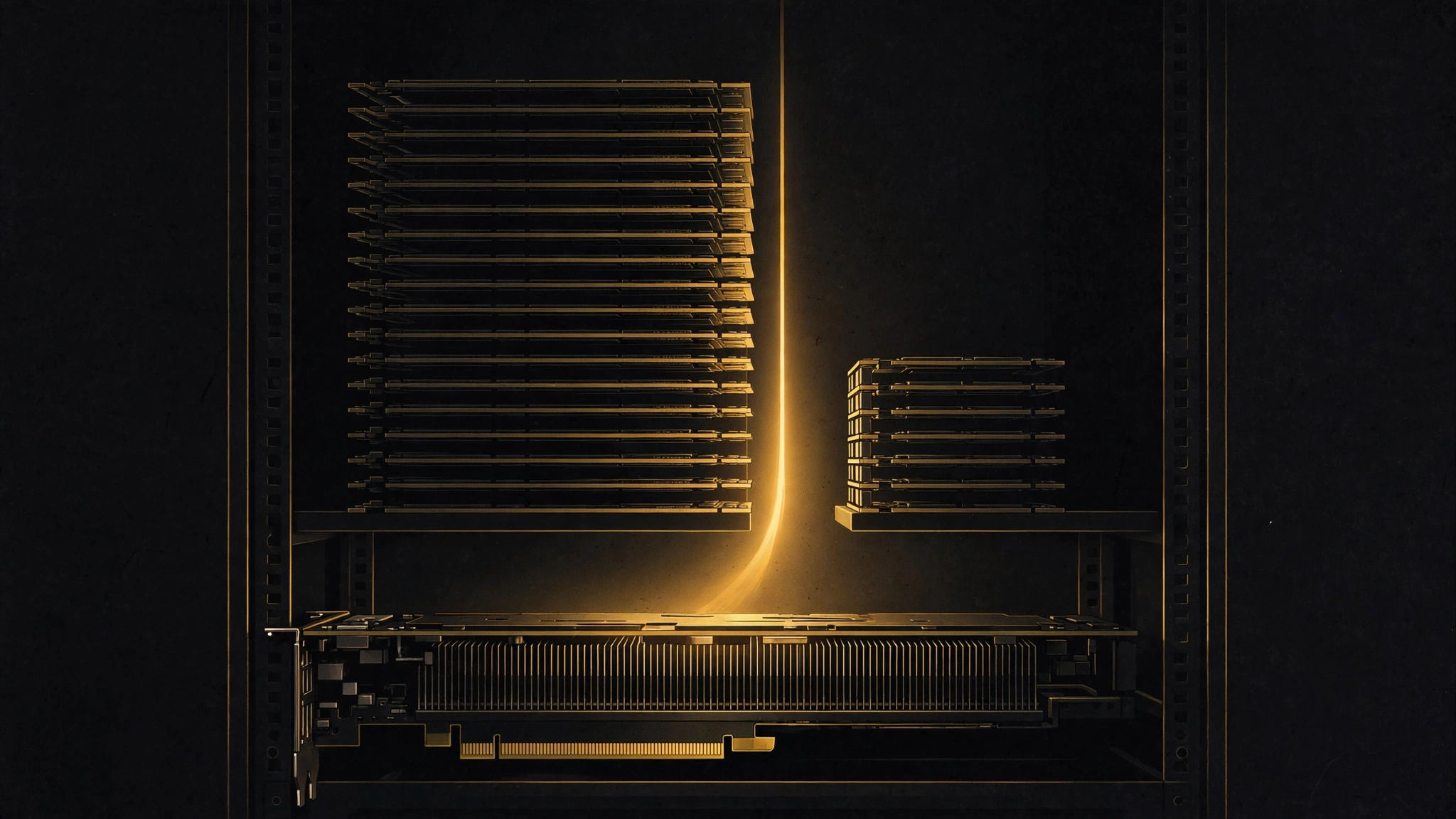
Every headline version of this launch leads with 480GB, and the number is real, just not in the way a quick reader would take it. Intel's own branded card is specified with 160GB of LPDDR5X. The 480GB figure is the maximum supported for partner-built configurations, using higher-capacity memory chips — a distinction Intel itself states in a footnote. Which card a buyer can actually order, from whom, and at what price are all still open questions, because no partner configuration, price or date accompanied the announcement.
The memory choice underneath the headline is the actual strategy. Flagship accelerators from Nvidia and AMD use HBM, which is fast, scarce and expensive. Intel used LPDDR5X instead: far more capacity per card, at a lower cost, with 1.5 TB/s of bandwidth as the ceiling that choice imposes. For inference work where a model and its conversation context have to sit in memory, capacity can matter more than raw bandwidth. For work that constantly moves data, the ceiling will show. Intel says a single D270 can support models with up to 300 billion parameters and an eight-card system can exceed one trillion. Read that as a statement about capacity, not speed, and with care: 300 billion parameters would need roughly 300GB just for weights at one byte per parameter, so the claim is not 300B at FP8 on every D270 card configuration. Intel published no independent benchmark alongside it.
Slower on paper, on purpose
Against AMD's MI350P PCIe card, Intel's stated 1.3 PFLOPS FP8 matrix peak is about 43% below AMD's 2.3 PFLOPS MXFP8 specification — and FP8 and MXFP8 specifications are not automatically equivalent as end-to-end workload measures. The other half of that comparison is power: 350W and ordinary air cooling, against up to 600W for AMD's top configuration. Intel is positioning the D270 at the inference racks that cannot, or will not, be rebuilt around liquid cooling and scarce memory, and arguing on cost per token rather than a throughput chart.
That argument may even be right. It just cannot be checked yet. Peak figures are vendor arithmetic, not workload results, and the two numbers that would settle the comparison, price and tokens per dollar in a real deployment, do not exist in public. A 350W card with three times a rival's memory is a strong proposition at one price and an unremarkable one at another.
What is actually available today
Samples. Intel says customer sampling is underway, according to 12 October reporting, with server makers and other partners. It has not announced a commercial release date or a price, and the 480GB configuration is a supported partner design option, not necessarily an orderable product. Reporting from the summit puts general availability in 2027. Buyers who need inference capacity this year will buy it from Nvidia or AMD, at whatever those vendors charge, which is precisely the market condition Intel says this card exists to change.
So read the D270 as a dated marker, not a launch. Intel has committed to a name, a spec sheet and a memory strategy that differs from both rivals in a way buyers can reason about. After two cancelled successors, committing in public is itself a step. The next step is the one Intel has stumbled on before: shipping, at a price, on a date it names in advance.
Dated note (13 October 2026): all specifications above are Intel-reported figures as published at the OCP Global Summit on 12 October 2026. Memory capacities are 160GB specified for Intel's branded card and up to 480GB supported for partner configurations, as stated on 12–13 October 2026. Price and general availability had not been announced as of 13 October 2026; if Intel names either, add a dated update here rather than editing the text above.
Sources
- [1] Intel — October 12, 2026 OCP announcement and GPU D270 product page (primary source for the 160GB/480GB footnote, FP8 and bandwidth claims): intel.com
- [2] ServeTheHome, "Intel's Crescent Island AI Server GPU Gets a Name and Specs: Meet the Intel GPU D-Series", 12–13 October 2026Read source
- [3] StorageReview, "Intel GPU D-Series Packs 480GB LPDDR5X and 1.3 PFLOPS FP8 into a 350W PCIe Card", October 2026Read source
- [4] VideoCardz, "Intel GPU D270 is Xe3P Crescent Island card with 480GB LPDDR5X memory", October 2026Read source