
The work starts after the merge
Google's starting point is its own framing: coding agents let teams build and ship new features fast, but, as the post puts it, their job ends the moment a pull request merges. What follows is the slower work the post lists: patching vulnerabilities, speeding up checkout, and diagnosing signup drop-offs buried in noisy feedback. Stitch Loop is Google Labs' attempt to assign that work to a long-running agent.
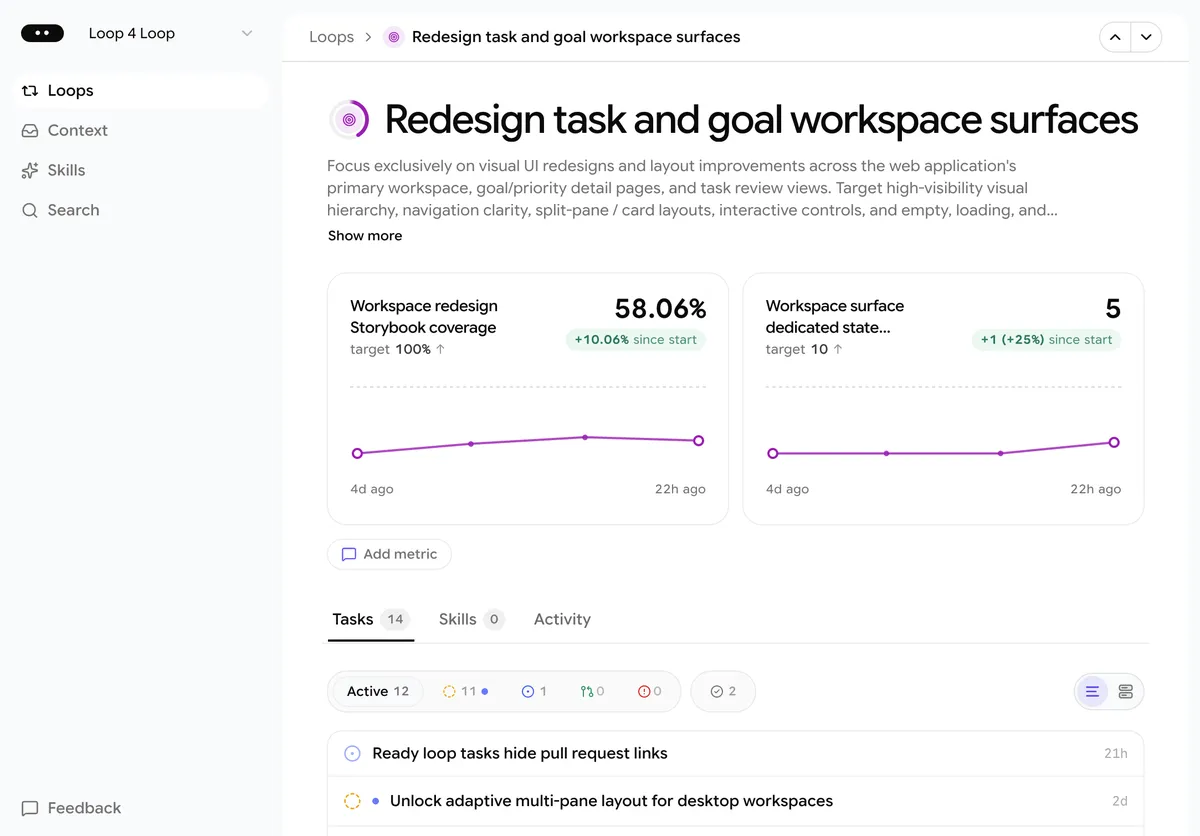
The setup asks for a lot of access. A team connects GitHub, then adds product context: logs, user behavior and feedback, through more than 180 integrations, custom MCP servers or local CLI uploads. In return the agent runs what Google calls evergreen loops, each aimed at a measurable outcome. A loop surfaces an opportunity with evidence from the product, proposes one or more solutions with tradeoffs and scoping, and, once a person chooses a direction, writes code in an isolated cloud sandbox and opens a pull request. Afterward it watches live data to see whether the change helped, and keeps watching in case the metric slips back.
Two human decisions, not one
Nothing merges on the agent's say-so, and the human role starts earlier than the final review. A person chooses a direction before any code is written; the agent then writes the code in its sandbox and opens a pull request, which, when relevant, includes screenshots and videos of the work; and nothing merges until a person reviews that pull request. Google states the gate plainly: "You always have the final call."
The security loop is the most concrete of the three defaults: per Google, it pairs Gemini 4 Carbon's cyber capabilities with CodeMender, DeepMind's autonomous code-security agent, scans a codebase, flags each issue with evidence and opens a PR with a proposed fix. The announcement describes the latency and accessibility loops in less detail. Teams can also build custom loops, and other coding agents can pull Stitch Loop's product context through its CLI and MCP, which makes it a context layer as much as an agent.
The division of labor is specific: the agent proposes, a person chooses, the agent builds, a person approves. The productivity question that leaves open is unglamorous: does reviewing a steady stream of machine-written PRs, with tradeoff notes at the proposal stage and screenshots or videos where relevant, actually save a small team time, or does it convert maintenance work into review work?
What the announcement does not contain
There are no numbers about performance. Google's post does not say how many vulnerabilities the security loop finds, how many of its proposed fixes teams accept, or whether any product's latency or conversion measurably improved under a loop. The Reflect step says the agent learns from positive and negative results. How it would separate the effect of its own change from ordinary swings in traffic and behavior is the hard part of that promise, and the post leaves it unanswered.
Access and cost are equally open. Stitch Loop is an experiment. The waitlist opened globally on November 18, eligible AI Ultra users get priority, priority is not a guarantee of admission, and there is no price and no date for wider availability. A team deciding today is not choosing a tool; it is applying to test one, and, if accepted, connecting the code and data its chosen setup uses, the combination a security review would normally treat as sensitive.
None of that makes the idea wrong. Post-launch maintenance is real work, and an agent scoped to it, gated by human decisions at both ends, is a more credible pitch than an agent that claims the whole product job. But the distance between the pitch and the proof is the story here: a workflow description, a waitlist, and a vendor's own account of what its agent will do once someone is allowed to use it.
Sources
- [1] Google, "Stitch Loop: Continuous product optimization for teams," Google Blog, November 18, 2026Read source
- [2] The Neuron, "Everything That Happened in AI Today — Thursday, November 19, 2026" (secondary corroboration of the launch date; label-only, no URL)