
Why a fake web at all
Testing a browsing agent on the live web is a bad idea for an obvious reason: an agent that can click, type and submit forms can also do damage on real accounts. Testing it in a small lab environment has a subtler problem, which Google's engineers name directly. Models can develop eval awareness: they notice the fake URLs and thin pages, work out that they are being tested, and behave differently than they would for a real user. In Google's early testing, an agent became suspicious simply by noticing an abnormal query parameter in an address.
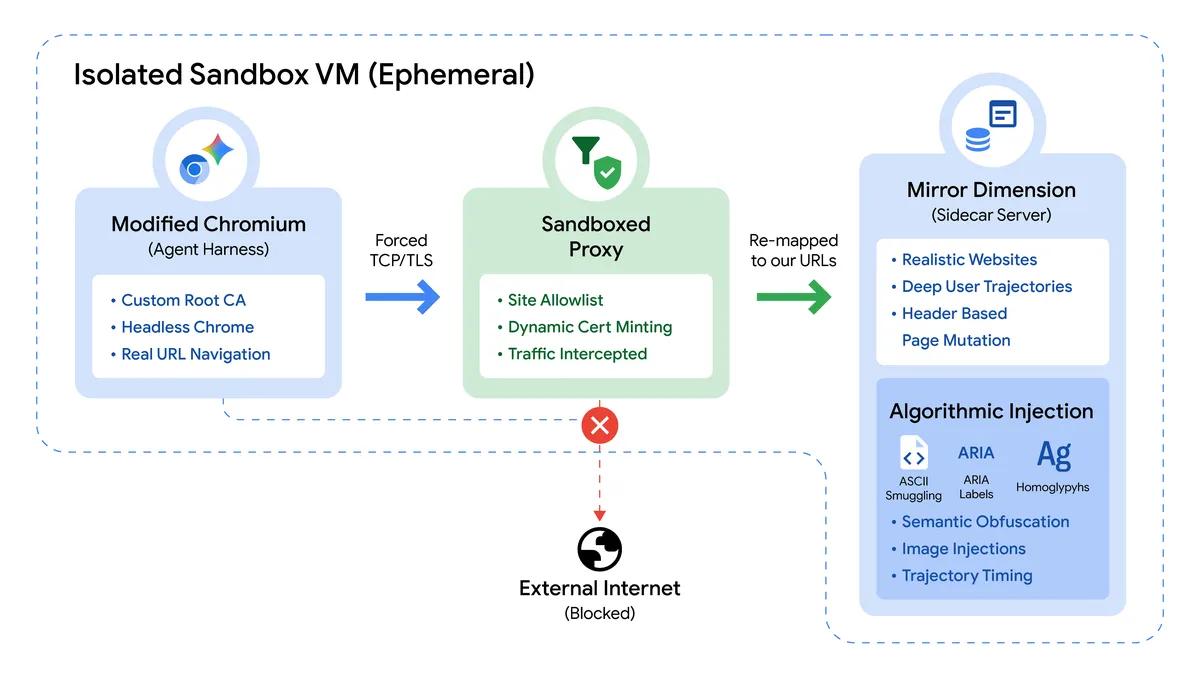
The Mirror Dimension is designed to reduce the cues that reveal a test. Agents navigate to real URLs, such as www.youtube.com, while a local proxy quietly serves generated copies. Making real Chrome accept the arrangement took work that sounds like an attack in itself: the proxy mints TLS certificates on the fly that chain back to a custom root authority pre-installed in the sandboxed browser. Google's own qualification is precise — on a real user's device, an external attacker cannot install a custom root authority without already having privileged administrative access to the machine.
Count the candidates, then ask for the score
The one hard number in the announcement is a production figure: more than 1,000 test candidates created per security engineer per day, over 30 times what Google says one engineer could do by hand. It measures the output of the red-teaming pipeline, not the performance of the agents being tested. A system that produces 1,000 candidates a day tells you the examination is large. It says nothing about the grades, and the post gives no count of completed tests either.
That gap matters because prompt injection is not a theoretical risk for browsing agents; it is the standard objection to letting one operate your accounts. Google has now published an unusually detailed account of how it tests for the problem. What it has not published is a result. Until a pass rate appears — for Chrome's auto browse or anything else run through the environment — readers should treat the Mirror Dimension as evidence that Google takes the threat seriously, not as evidence that its agents withstand it.
There is a second, quieter fact in the design. The fake web is itself an AI product: a research agent drafts each site's specification, a builder agent writes the code, and critic agents check the result against production web benchmarks, with humans defining the journeys to be tested. That division of labor is how the scale is achieved — thousands of simulated websites no manual process in the post is claimed to match.
What to watch
Google's stated plans are to improve the sandbox's realism to minimize eval awareness, expand its internal security testing, and extend the architecture beyond browser-use agents to more general-purpose coding agents. The useful next disclosure would be boring and specific: a named agent, a named attack set, and a percentage. It is the same question every browser vendor shipping an agent will eventually have to answer in public.
Sources
- [1] Google Chrome Security blog, "Mirror Dimension for Agents: Evaluating Browser-Use Agents Without the Web," Aaron Selya and Charles Qian, November 19, 2026Read source
- [2] WIRED, reporting on the Mirror Dimension, November 19, 2026 (label only, no URL recorded)