
The model picker now picks itself
GitHub's October 28 changelog is explicit about the trade. When you select Copilot Fusion in the model picker, "you aren't selecting a specific model. You're choosing a system that routes and orchestrates models for each task." The choice that remains is effort: Standard for everyday work, High for harder tasks, Max for the most demanding ones. Fusion then decides, per prompt, whether one model should answer directly, whether a cheaper model should draft first and face a judge that can escalate it, or whether a draft should be critiqued by other models before the first model revises it.
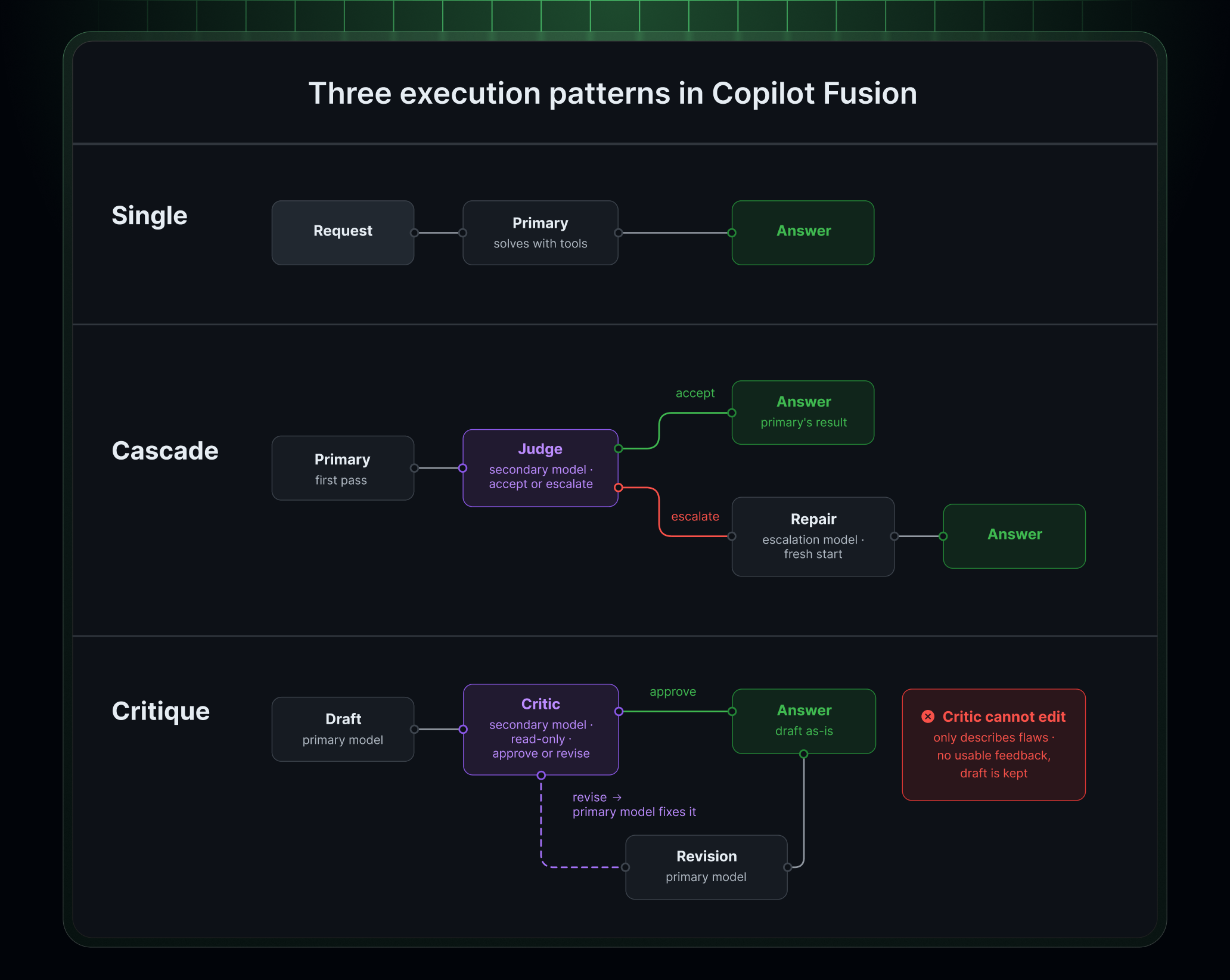
This is a preview graduating, not a new idea appearing. Fusion folds Project HydraFusion's orchestration together with the model picking Copilot already did in its auto mode, and anyone who had switched on auto, HydraFusion or HydraFusion Max is carried over to the matching effort level automatically. GitHub is also selling the problem it says developers actually have. Its changelog carries a testimonial from a principal software engineer at AT&T saying developers would pick a powerful model for a hard task and forget to switch back for routine work afterwards. That is a vendor-selected quote, so treat it as GitHub's framing. The underlying habit is still recognisable to anyone who has watched a team's model bill.
Two points, read in parts
The headline comparison is real, and it was not run by GitHub. Artificial Analysis benchmarked Fusion Max in the Copilot CLI for Coding Agent Index v2.0 and scores it 60, two points below Claude Code running Opus 5.5 Max at 62, at $5.59 per task against $11.42, using 7.2 million tokens per task, roughly half the comparator's count. On this benchmark, Fusion Max comes within two points of Claude Code with Opus 5.5 Max on the composite index, at roughly half the measured API cost per task. That is a substantive result for this test configuration, not evidence that Fusion will deliver equivalent quality at half the cost on every team's workload.
The composite is an average of three tests weighted equally, and the average is where the gap goes to hide. Fusion leads Terminal-Bench 4.0 outright at 71. On FrontierCode, one of the three tests in the index, Fusion scores 51 against 56 for Claude Code with Opus 5.5 Max and 54 for Devin Fusion, the other router in the table. The five-point gap matters because the composite weights FrontierCode equally with the other two tests. On SWE-Atlas-QnA-AA it scores 57. A team whose work looks like terminal tasks gets the headline. A team whose work looks like FrontierCode gets a five-point gap and a lower bill. Those are different purchases, and the single number 60 cannot tell you which one you are making.
Two limits sit on the result itself. Artificial Analysis tested only the Max setting, so Standard and High, the levels most seats will run most days, have no published score in this release. And the thing tested is a moving target: GitHub's docs state plainly that the model pool changes as new models arrive and as GitHub re-evaluates them. The 60 describes the Fusion Max configuration tested by Artificial Analysis on October 28, using a pool it identified as two Anthropic models and two OpenAI models. GitHub's documentation says the available pool can change as models are added and re-evaluated, subject to organizational model policies. Future configurations may therefore perform differently. The published score remains a result for the configuration tested, not a permanent specification of Fusion.
What the saving is, and what it is not
The $5.59 figure is an average API cost per benchmark task. It is not a Copilot invoice. In the product, GitHub bills each model Fusion uses at that model's standard rate, charges nothing extra for Fusion itself, and warns in its docs that High and Max can consume more AI credits than Standard precisely because they may call several models for one task. A cascade that escalates, or a critique round, spends tokens a single-model request would not. Whether routing saves a given team money depends on how often its tasks stay on the cheap path, which the benchmark average cannot answer.
One dated term deserves its date. GitHub's docs say paid Copilot plans receive a 30% discount on model costs incurred through Fusion through November 30, 2026. The discount is not a separate Fusion fee reduction: Fusion itself carries no additional charge, and the underlying models are billed at their standard rates subject to the temporary discount. A team that trials Fusion in November is pricing a discounted router. The comparison worth running is the same workload in December, at standard rates, against the single model the team would otherwise have left selected.
The parts to check before making it a default
Administrators keep real control: they set which models Fusion may draw on, can disable a model for Fusion alone, and can set Fusion as the default under Enterprise managed settings. What individual developers get is visibility after the fact. The docs say the models used are listed by hovering over the effort-level name below a response, and that intermediate drafts may be discarded with only the final response shown. One warning in the docs deserves particular attention: if Fusion discards an intermediate draft, changes that draft has already made in the workspace—including file edits—are not automatically undone. Review the working tree before committing, especially after tasks that invoke multiple models or execution stages.
There is a practical way to treat this launch. Run Fusion Standard on routine work for a week and compare credit use against your previous default model, task type by task type. Keep manual model selection for work where a named model is a requirement rather than a preference, such as a regulated review or a reproduction of an earlier result. And if the index score is the reason for switching, re-check it after GitHub next changes the pool, because the score will have changed with it even if the name on the picker has not.
Sources
- [1] GitHub Changelog, "Route and orchestrate models with GitHub Copilot Fusion", October 28, 2026 (published 09:00 PDT) — general availability, effort levels, execution patterns, the 60 / two-point / half-cost / half-tokens / 40%-less-time claim as GitHub states it, admin controls, per-model billing, 30% limited-time discount, client availability, preview carry-over, AT&T testimonialRead source
- [2] GitHub Docs, "About GitHub Copilot Fusion" — router definition, pattern and effort tables, billing at standard rates with no separate charge, the November 30, 2026 discount end date, High/Max credit warning, model-pool mutability, post-response model visibility, discarded-draft file-edit warning, local-model preview (MAI Code 1.1 Flash, Qwen3.8 Flash Next)Read source
- [3] Artificial Analysis, "GitHub Copilot Fusion orchestrates Anthropic and OpenAI models to balance performance and cost", October 28, 2026 — independent Coding Agent Index v2.0 results: composite 60 vs 62 vs 62, $5.59 vs $11.42 vs $8.00 per task, 7.2M tokens per task, Terminal-Bench 4.0 71, FrontierCode 51 vs 56 vs 54, SWE-Atlas-QnA-AA 57, model pool namedRead source
- [4] The Register, "GitHub powering up four million extra cores to stop its service going down", October 28, 2026 — Universe context and the Fusion quote from GitHub's leadership, read as corroboration only; no figure in this article rests on it aloneRead source