
The announcement, read for numbers
Start with what the release does not contain. There is no registered-user figure. There is no daily or monthly active count. There is no retention number, no waitlist total and no revenue line. The phrase doing the work is in the headline: "Following Strong Early Demand." On the demand claim, the document offers a headline rather than a public measurement.
What the release offers instead is a list of things unnamed users have done: discovered bands with friends, run 30-day fitness challenges, planned date nights, built a trivia game, turned a shared meal plan into a grocery list, and used step-by-step guidance to get through a breakup. These are plausible uses. They are also the kind of evidence a reader cannot check, weigh or compare with any other product in the category.
The checkable part of the announcement is the investor list. IVP led the round. a16z, Forerunner and the Amazon Alexa Fund joined, alongside individual backers whose names are better known than the product's: Shopify's Tobi Lütke, Salesforce's Marc Benioff, Marissa Mayer, Dick Costolo and Alex Pall. In a release with no operating metrics, the investor list is the most concrete evidence offered in support of the company's prospects. It establishes who backed the round, but not what usage data those investors saw or how they justified the valuation.
A pivot, priced a month later
Timing is the second thing to read carefully. TechCrunch, reporting the same announcement, notes that Wabi began as a tool for building apps from prompts. Last month it announced a change of direction: the product would become an AI messenger, a personal agent that builds small interfaces (a restaurant list, a meal plan, a tracker) inside a shared conversation when a group needs one. The company calls that version Wabi 2.0.
According to TechCrunch, the funding announcement came roughly a month after Wabi announced its pivot from prompt-built apps to a shared personal agent. That timing makes the revised product's public traction an important question, but the announcement does not disclose enough operating data for readers to assess it. What the announcement does foreground is founder Eugenia Kuyda's record at Replika, where she built an AI companion people formed attachments to, plus a category attracting substantial investor commitments. TechCrunch places the round alongside Instinct's reported $1 billion raise at a $10 billion valuation and Tolan's $30 million round, though those comparisons do not establish that the companies have similar products, traction or business models.
What the product claims to do differently
Strip away the valuation and the remaining pitch is specific enough to test. Most assistants are built for one person typing into one box. Wabi is built for groups: the agent sits in a shared space, and the mini-apps it creates (the restaurant list a couple checks off together, the running group's route plan, the family's weekly meal plan) persist and can be revisited, rather than disappearing into a chat scroll. It is available on iOS, Android and Mac, with Windows listed as coming soon.
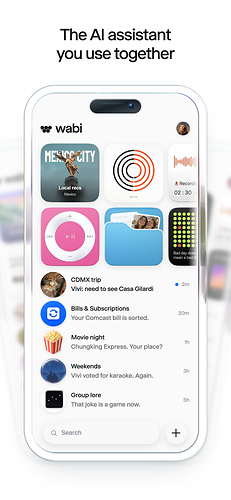
That is the product's stated design difference, and it is something a reader can test directly: download the app, use it in a group chat, and see whether the shared mini-app remains useful enough for members to return. The design can be inspected; its effect on retention remains unquantified in the announcement.
What to watch
Three disclosures would turn this from a priced claim into a measurable one: a user count with a date on it, a retention figure for groups (not individuals), and any paid tier with a price. Until at least one of those appears, the accurate summary of October 29 is narrow. A well-backed founder has raised $55 million for a one-month-old version of her product, at a $1.25 billion valuation, on evidence the public has not been shown.
Sources
- [1] Wabi, "Wabi Raises $55 Million at a $1.25 Billion Valuation, Following Strong Early Demand", PR Newswire (October 29, 2026; read in full October 29, 2026)Read source
- [2] TechCrunch, "Wabi, the AI agent that builds mini apps, now valued at $1.25B after latest round" (October 29, 2026; read in full October 29, 2026) — pivot timeline, Wabi 2.0, Instinct and Tolan contextRead source
- [3] Bloomberg Law, "AI Assistant Startup Wabi Raises Funds at a $1.25 Billion Value" (October 29, 2026) — corroboration of the roundRead source