The part that is already real
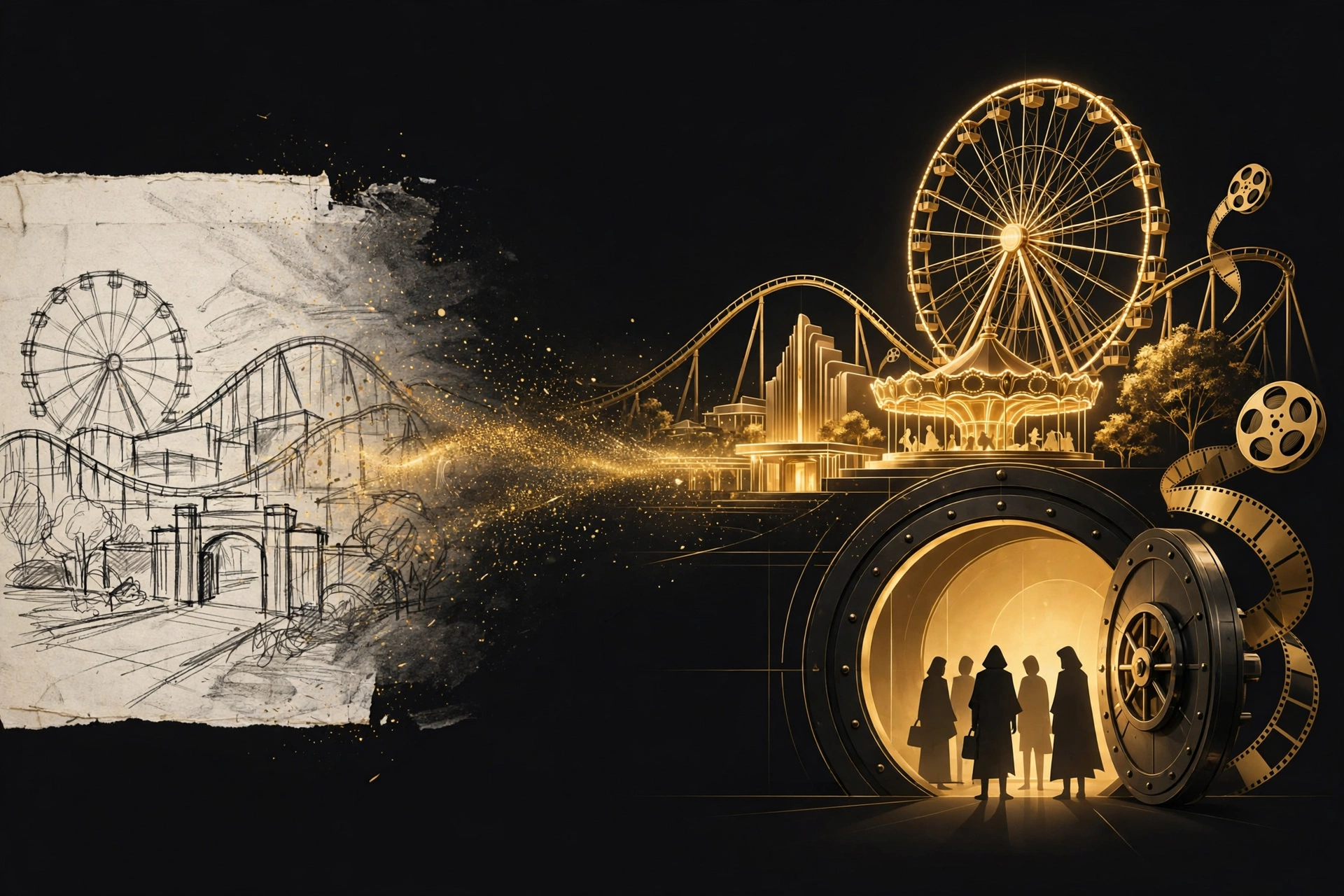
Strip out the titles and the marketing activations, and one piece of this announcement is concrete work rather than intention. Imagineering, the group that designs the parks, is already running Firefly Foundry in its development pipeline — "already using" establishes that the work predates the announcement. The release names two uses: turning a hand-drawn sketch into a fully rendered piece of 2D concept art, and generating creative assets that stay accurate to a franchise's established look.
Notice what the release does with those examples. It identifies concept-art and creative-asset uses, and names no audience-facing production incorporating their outputs: no generated scene in a released film or show, no generated element in a ride guests have ridden, no ESPN segment built from the archive work. The demonstrated work, on the published record, sits in development.
The words doing the heavy lifting
The center of the deal is a phrase. The companies describe the models as producing "commercially safe and production-ready outputs", without specifying how those qualities are assessed. The release does not say what the models are trained on beyond Disney's own properties and "unique world knowledge", does not say how outputs will be checked before use, and does not say which company carries the legal risk if an output turns out not to be safe after all.
That gap is worth naming precisely. Customizing a model on a rights holder's own catalog addresses the provenance of the customization material. It does not by itself answer what the model can be made to produce, or who answers for an output that resembles someone else's work — and the announcement does not establish the underlying model's training either. Readers should not let the word "safe" fill in answers the release does not give.
What Adobe gets, stated plainly
The release is unusually clear about the other side of the trade. Adobe gains the opportunity to amplify its innovation stories through Walt Disney World Resort, Disneyland Resort, Disney Cruise Line, ESPN Edge and StudioLAB, through global marketing activations, industry events, thought leadership and customer storytelling, plus an increased presence across Disney's media platforms. Disney is, among other things, a reference customer of the first rank.
Against that, the commercial terms a reader would need to judge the deal are absent from the release. No figure. No number of years behind "multi-year". No statement of whether the arrangement is exclusive, so there is no basis in the announcement for saying Disney has chosen Adobe over other model providers. The alliance is real, the Imagineering use is real, and the release does not quantify the financial commitment.
Where this leaves the work
For Disney's creative teams, the practical change today is access and support: earlier access to Adobe's newest tools, dedicated engineers, and a custom model line tailored to the characters. What would move this announcement from access story to deployment story is evidence of a different kind: a generated output that has reached an audience, the training and validation terms behind "commercially safe" stated in public, and a financial scale for the commitment. The November 9 release contains none of the three — which is where an honest reader leaves it.
Sources
- [1] Adobe / The Walt Disney Company, "Adobe and The Walt Disney Company Announce Multi-Year Strategic Alliance to Support Disney Innovation with New AI-Powered Tools", Business Wire, November 9, 2026Read source
- [2] PPC Land, "Adobe gains marketing tie-ins with 5 Disney units in multi-year AI alliance", November 9, 2026Read source
- [3] Unite.AI, "Disney and Adobe Announce AI Alliance with Custom Firefly Models", November 9, 2026Read source