What NXP actually shipped
NXP Semiconductors announced a unified robotics platform on November 9, built on what it calls the Neural Axis Architecture: a distributed foundation that connects sensing, real-time control, AI processing and communications across a robotic system. The package has two parts. The first is an open-source, modular Robotics SDK with supported drivers, middleware integration, reference applications, configuration tools and reusable components, including integrations with PX4, Zephyr and ROS 2. The second is a set of reference designs, each built around an NXP processor.
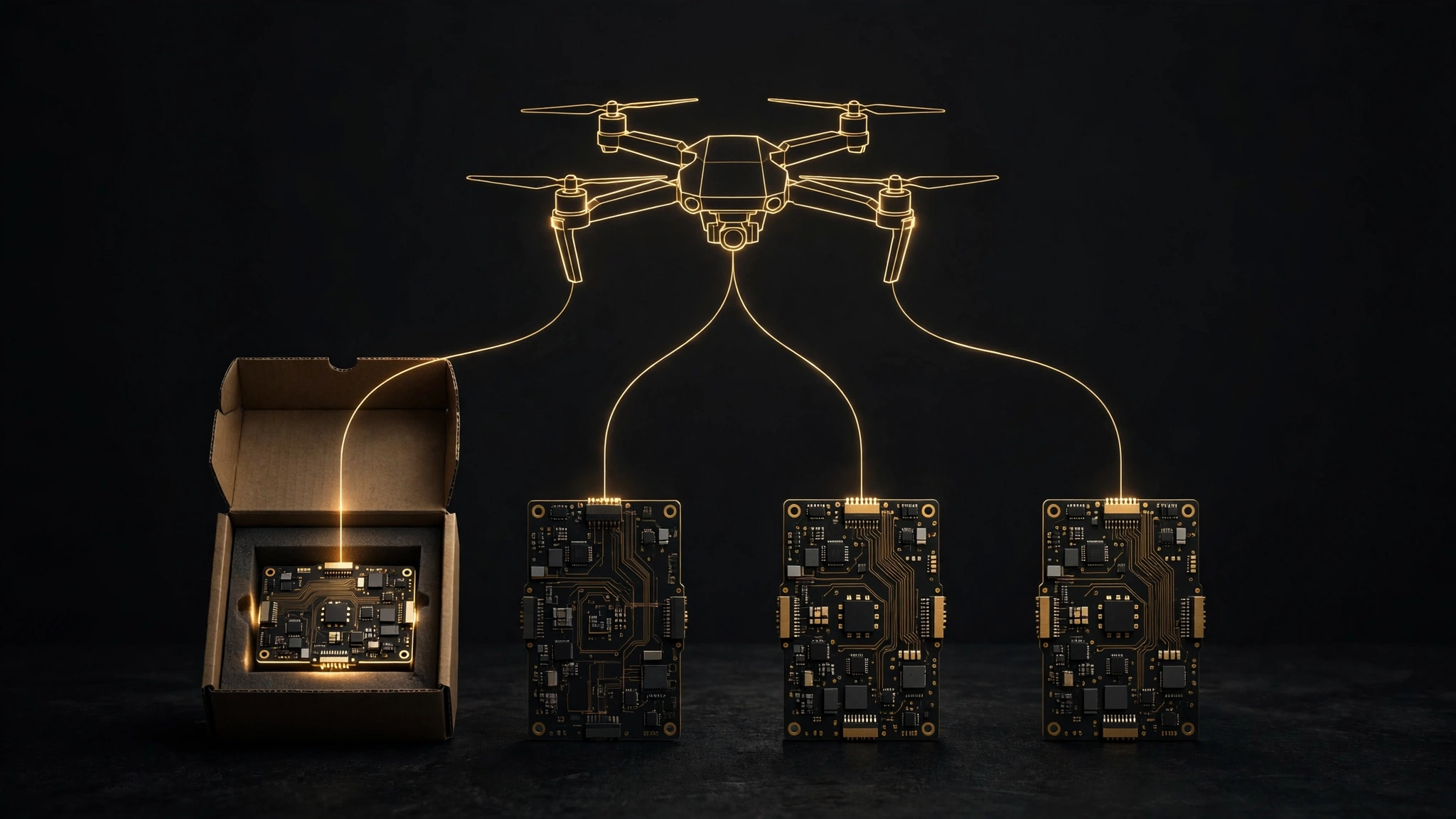
The launch scope is narrower than the platform name suggests. Every reference design in this release is for a drone. The NavQ95 handles autonomy compute and flight control on the i.MX 95 applications processor. The Tropic VMU/FMU handles flight management on the i.MX RT1064 crossover microcontroller. A 100Base-T1 Sensor Node on the MCX N947 handles intelligent sensor networking, and an AM32-compliant electronic speed controller on the MCX A13 handles motor control. For service robots, autonomous mobile robots and other autonomous systems, NXP expects additional enablement in the second half of 2027.
The 30 minutes, read precisely
The claim NXP leads with is that these designs, supported by the SDK, allow developers to deliver "an initial drone functionality within 30 minutes out of the box." Read the qualifier. Initial functionality is not a finished autonomous drone, and NXP does not claim it is. The second time claim in the release is broader and softer: work that can take developers months to integrate and validate is cut "to days or weeks" through pre-integrated software and validated subsystem interoperability. No test setup, baseline system or measurement method is published for either figure, so both numbers are company claims, not results a reader can reproduce from the release.
Read the readiness wording at the right level, too. NXP describes the reference designs as "prototype-ready" and the underlying hardware and software building blocks as "production-ready." Those descriptions apply at different levels; neither establishes that a finished drone has completed product-level qualification. The Modular Drone Platform product page lists orderable part numbers for all four boards, including MR-NAVQ95-KIT for the NavQ95.
What a drone developer gets, and what is missing
For a team already building on NXP silicon, the practical offer is integration work done once by the vendor: one SDK, the interoperability between the compute, flight, sensing and motor subsystems that NXP says it has validated, and a path NXP describes as starting with a single subsystem, such as motor control, and adding perception, flight control and navigation on top. That could reduce integration work; the release provides no measured comparison for how much.
The release provides no pricing or named platform-level certification. It lists no price for the platform or any reference design, and no benchmark in the release compares the NavQ95's AI performance against the compute boards drone developers already use. The trust argument, security, functional safety, real-time control and lifecycle reliability, is stated by NXP's robotics vice president Jerome Legros in the release, but the release names no certification or completed safety assessment for the platform as a whole. Buyers should request the documentation relevant to their intended product.
The schedule is the story
Read carefully, this is a drone development offering in November 2026, with additional enablement for the wider robotics scope expected in the second half of 2027. That does not make the launch empty: NXP says the drone offering is available now, for the teams it fits. It does mean readers should file the headline under drones, and judge the wider platform claim when the service-robot and AMR enablement actually ships.
Sources
- [1] NXP Semiconductors, "NXP Unveils Unified Robotics Platform to Speed Trusted Physical AI Deployment", NXP newsroom, November 9, 2026 — architecture, SDK, four reference designs, the 30-minute and days-or-weeks claims, availability and 2H 2027 wording, read first-hand.Read source
- [2] Same release via GlobeNewswire, November 9, 2026.Read source
- [3] NXP, Modular Drone Platform product page (accessed November 9, 2026) — "prototype-ready reference designs" wording and orderable part numbers, including MR-NAVQ95-KIT.Read source
- [4] Unite.AI, "NXP Launches Modular Robotics Platform for Physical AI Development", November 9, 2026 — SDK software listing detail (ROS 2 Jazzy, CogniPilot Cerebri, NuttX, eIQ Toolkit, Ara SDK).Read source