
The key was the problem, and this does fix that part
Sharing an API key with a third-party tool has always been an awkward arrangement. The key works like a password: whoever holds it can spend against your account, and the tool has to store it, encrypt it and rotate it. Anthropic's announcement leads with that problem, and on that point the fix is genuine. With linked billing, the customer links their Claude organization through a flow Anthropic hosts, no key changes hands, and platforms don't need the customer's API key for linked billing.
The customer-side controls are also real. One approval covers the whole organization. The customer can set a monthly spend limit for each platform or use a default, can watch spend per platform in Console, can draw against an existing Anthropic commitment, and can unlink at any time. For platforms, Anthropic hosts the approval flow and the billing, so a small tool can offer "bring your own Claude account" without building metering and invoicing first. Nineteen platforms support it on day one.
What does not travel with the bill
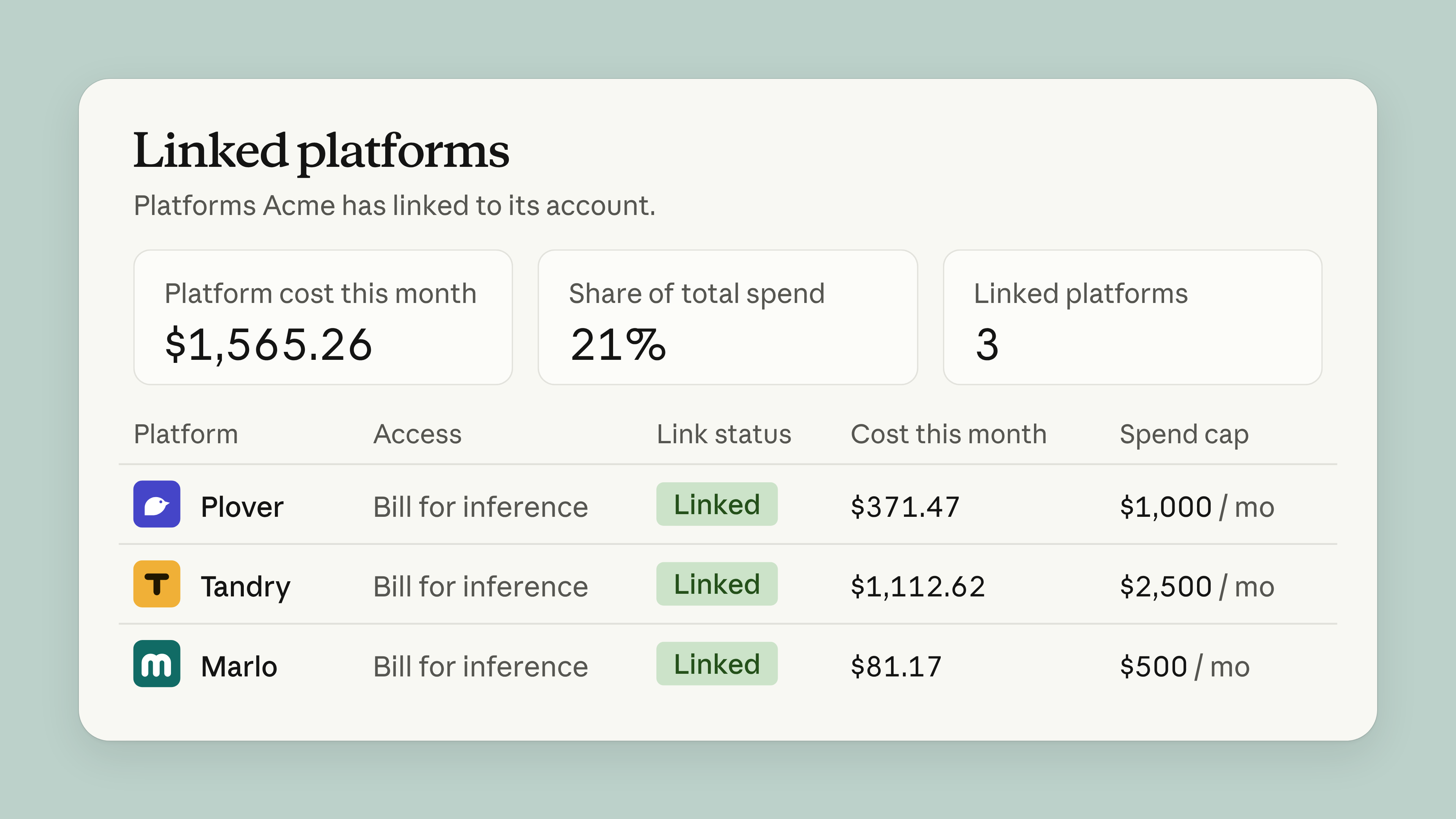
Then there is the sentence in the middle of Anthropic's announcement that deserves more attention than its placement suggests: "Requests run in the platform's organization, so settings in the customer's organization, such as IP allowlists, encryption keys, and data retention, don't apply."
The developer guide states the same boundary in harder terms. The platform's rate limits, model access, service tier, data retention and encryption keys govern the request. The customer's zero data retention arrangement does not apply. Their business associate agreement does not apply. Their customer-managed encryption keys do not apply. The guide then gives the instruction directly: do not link customers that need HIPAA, FERPA, or CMEK coverage for this usage.
That is not a hidden clause; Anthropic published it in both places. But it changes what "pay through your own organization" means. A compliance team that negotiated ZDR or a BAA with Anthropic could easily read the launch headline, "pay for Claude without handing over the key," and assume their terms follow their money. They do not. When the platform chooses customer billing, the bill is the customer's. The request runs under the platform's settings. Railway, one of the launch platforms, put the same split in one line in its own post: only billing is linked, and requests still run in Railway's organization.
The eligibility edges matter too
Linked billing only reaches customers Anthropic bills directly. If your organization pays through the AWS, Google Cloud or Azure marketplace, it cannot be billed this way, and requests aimed at it are refused. The same applies to organizations whose only relationship with Anthropic is a Claude subscription plan. Some credits are excluded as well: the monthly API credits bundled with Max, Ultra and Team plans cannot pay for linked requests, and neither can partner, VC or startup program credits.
Coverage is also partial while it is a beta. Customer billing works on the Messages and Chat Completions endpoints. It does not work on Message Batches, and a customer-billed request cannot use billable code execution features; the platform can omit the feature or pay for that call itself. The concrete behavior when customer billing fails is worth noting: the API rejects the request without automatically charging the platform. That protects the customer's boundary, and it matters to platforms that rely on requests completing. A request that hits a spend limit or an empty credit balance can be refused with a 402 that does not say which of the two caused it.
How to read the launch
As a piece of platform plumbing, this is a sensible direction. Keys are a poor way to move money between companies, and replacing them with an approved, capped, revocable link is a clear improvement on the specific points Anthropic built: no customer key exchange, per-platform spend visibility, and a link that can be revoked at any time. The mistake would be treating it as a compliance upgrade as well as a billing one. It is only a billing one.
So the practical test before approving a link is short. First, are we even eligible: do we pay Anthropic directly? Second, what data will this tool send, and does this usage require our ZDR, BAA or CMEK terms? Having one of those arrangements does not by itself rule out linked billing for other work; but if the answer for this usage is yes, Anthropic's own guide says this beta is not for it, whatever the tool's settings page suggests. Third, set the monthly cap at a number you would be comfortable seeing spent, because the platform, not you, decides request by request who pays.
Sources
- [1] Anthropic, "Linked billing on the Claude Platform," claude.com, published November 17, 2026 (read first-hand in full by ALFW)Read source
- [2] Anthropic, "Linked billing," Claude Platform developer guide, platform.claude.com (eligibility, endpoints, credits, ZDR/BAA/CMEK exclusion, fail-closed billing; read first-hand by ALFW)Read source
- [3] Anthropic, Claude Platform release notes, November 17, 2026 entry, and @ClaudeDevs on X, November 17, 2026, 18:00 UTC (launch timing; via secondary records of the release notes) (label only — no direct URL recorded)