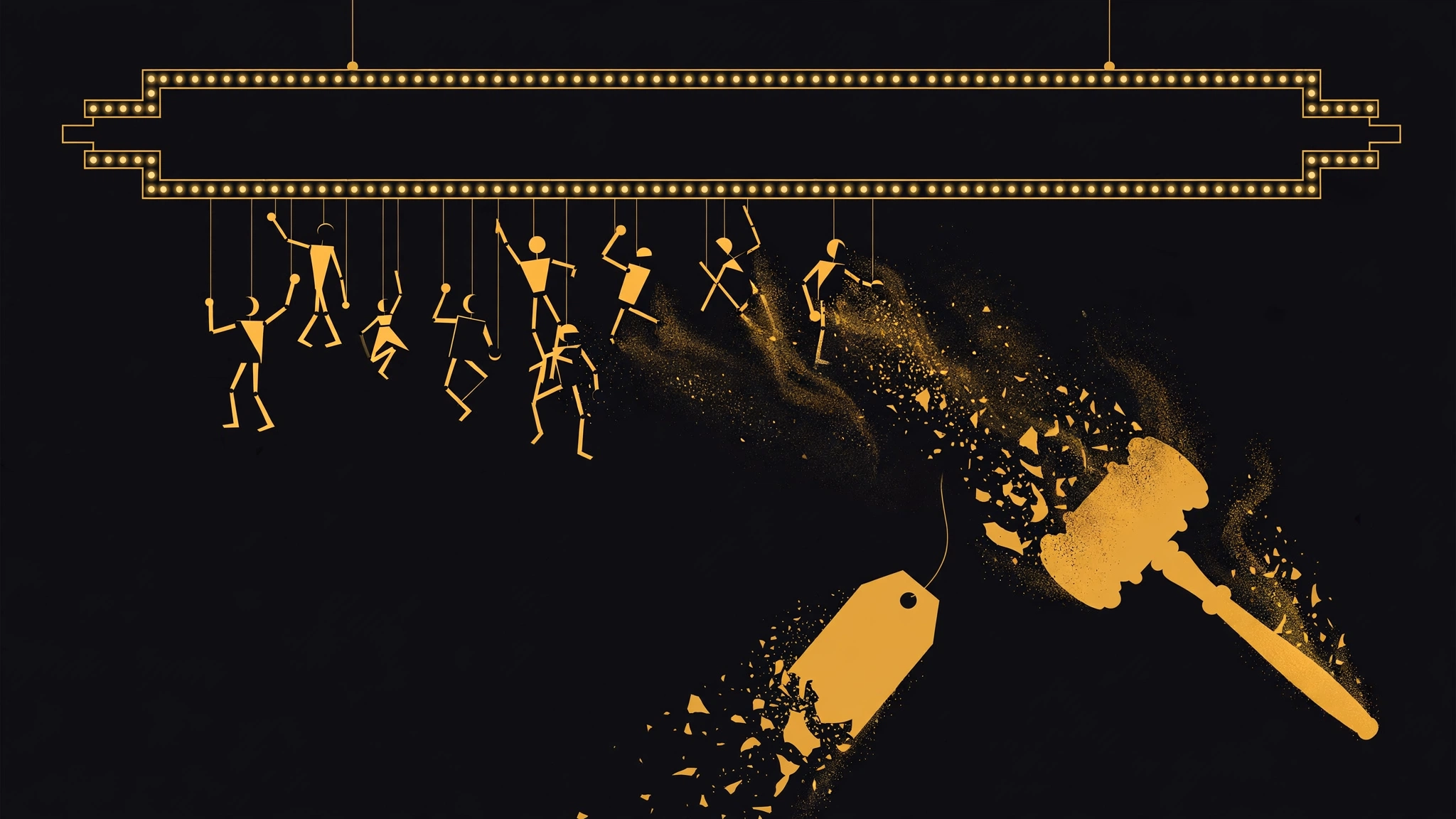
What Disney is actually buying
Start with the number everyone will repeat. Twenty million dollars sounds like a purchase price for Character.AI. It is not.
Under the proposed agreement reported by Reuters and TechCrunch, Disney Worldwide Services would pay $20 million for a non-exclusive, perpetual licence to certain Character.AI intellectual property and certain company claims. Disney would also provide transition services, delivered through former Character.AI employees it has hired; those employees moved to Disney around the time the platform's former chief executive, Karandeep Singh Anand, joined Disney as its chief technology officer in September 2026. Non-exclusive is the operative word. Disney gets the right to use the technology. It does not get sole ownership of it, it does not get the company, and on the current terms it does not get the platform's users.
Character.AI is seeking court approval of bidding procedures that would designate Disney as the stalking-horse bidder, the first bidder in a bankruptcy auction whose offer becomes the floor. If the court approves, the $20 million proposal becomes the opening bid and rivals can bid more; the transaction has not closed. So the $20 million is best read as an opening marker for what one piece of a distressed AI company is worth to a strategic buyer: the licence, not the audience.
The missing buyer is the story
The platform itself has no such marker. Adams was explicit that there is no bid yet for the assets as a going concern. The company hopes the process produces a proposal that keeps Character.AI operating. His fallback was stated just as plainly: if that bid does not arrive, the platform will be wound down.
That gives users a dated window, not a promise. The sale is expected to conclude in late November or early December 2026. Until then the service runs, paid subscriptions stay active and billing is unchanged, according to the company. Anyone whose characters, stories or chat history matter to them should use that window rather than assume a rescue lands. Character.AI confirms in its 12 October user notice that a data-export function exists; users who want to preserve their conversations should use it now, and check separately whether character definitions and other creations are included in the export or need to be copied out by hand.
How a hit product reached a bankruptcy court
Noam Shazeer and Daniel De Freitas, both former Google engineers, founded the company in late 2021 and built one of the first consumer AI products people used for hours at a time. In August 2024, Character.AI entered a reported $2.7 billion licensing-and-talent agreement with Google, and both founders returned to Google. What remained was the consumer platform, which subsequently moved away from developing its own foundation models to concentrate on the consumer product.
Growth was not the problem, at least not on the evidence available. The platform recorded 20 million monthly active users by October 2024, and the company had raised more than $193 million across its rounds. Those figures demonstrate scale, not financial sustainability at the time of filing. Heavy chatbot usage can create substantial inference costs, and the company's legal load added pressure of a different kind: lawsuits after the death of a 14-year-old user in Florida, a Texas investigation into child privacy and safety, settlements, added safety features and an end to open-ended character chats for users under 18. But the company has not disclosed enough financial detail to establish the relative contribution of any of these factors to the bankruptcy.
The company's own statement put the cause in one compressed phrase, legal, regulatory and operational headwinds, and said the board chose a court-supervised sale as the best route to preserve value for stakeholders. Read against the numbers, that is a fair summary. It is also an admission that the remaining business could not carry itself outside a court process.
The lesson other consumer AI apps will read carefully
Character.AI is not an obscure failure. It was, by time spent, one of the most successful consumer AI products ever built, and its technology was valuable enough that Google paid billions to licence it and rehire its creators. But Google's reported $2.7 billion licensing-and-talent agreement in 2024 and Disney's proposed $20 million transaction in 2026 are fundamentally different deals. The latter covers a non-exclusive licence to certain remaining intellectual property and certain claims, plus transition services; it cannot be treated as a direct valuation of the technology Google licensed. What the filing does show is simpler: two years on, the product has to find a buyer or close.
That spread is the real information in this filing. In consumer AI, engagement is not a moat and it is not revenue. It is a cost that scales with love. The companies that survive this phase will be the ones whose users pay enough, per hour of attention, to cover the inference and the legal weight that attention now carries. Character.AI never closed that gap, and no amount of time-on-app could hide it in the end.
Sources
- [1] Character Technologies — bankruptcy press release, 12 October 2026
- [2] Character.AI — user notice / FAQ, 12 October 2026
- [3] Reuters, "Character.AI files for bankruptcy, agrees to sell some assets for $20 million", 12 October 2026Read source
- [4] TechCrunch, "Just 5 years in, interactive chatbot platform Character.AI files for bankruptcy", 13 October 2026Read source
- [5] Fast Company, "Character AI bankrupt: chatbot platform moves to sell to Disney", October 2026Read source