
The efficiency design is real
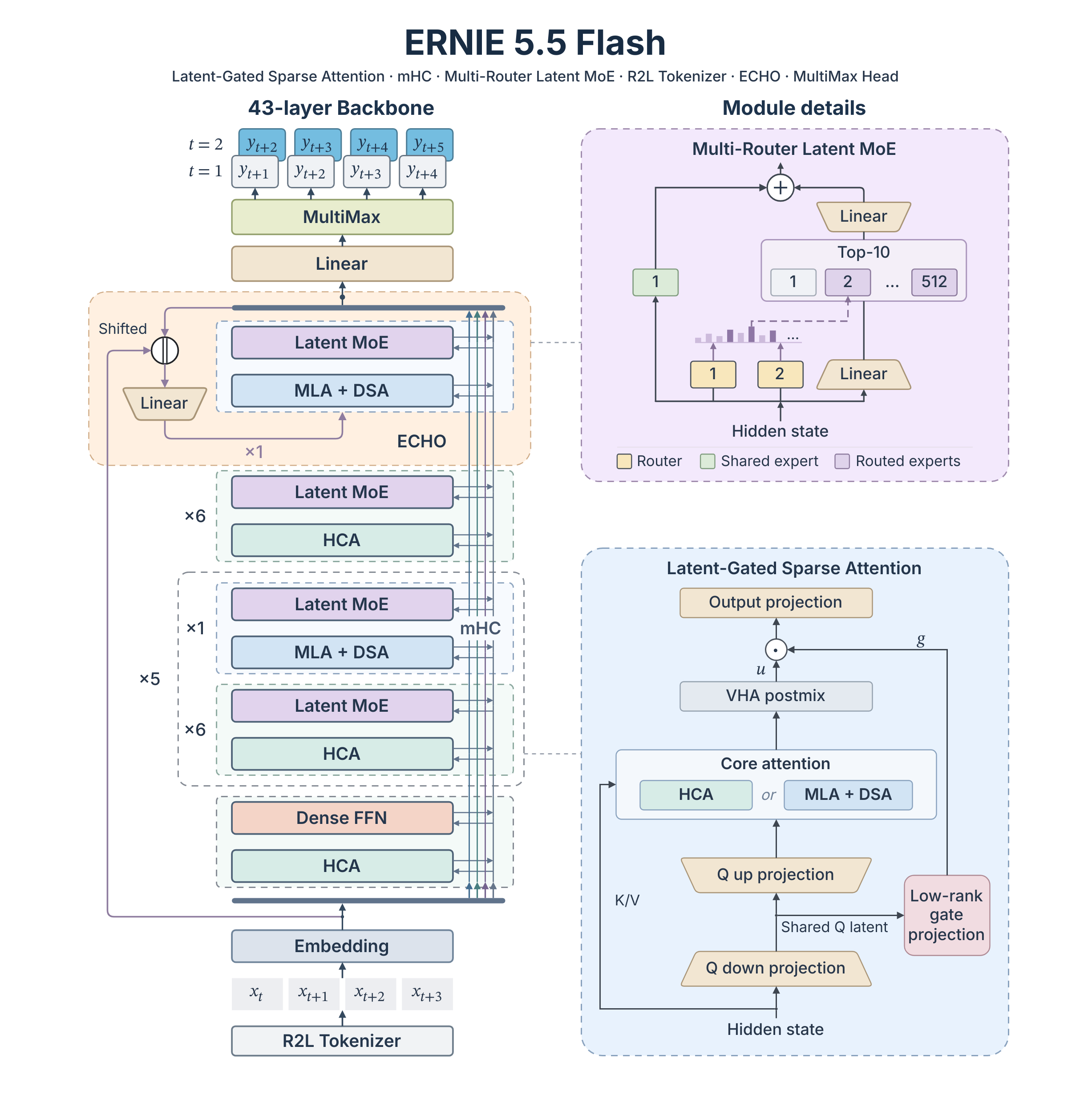
The architecture is aimed at a specific cost problem. A model that activates 14 billion parameters per token still has to hold all 280 billion somewhere, and long contexts make the attention cache the second bill. Compressing most layers to one cache entry per 128 tokens, while keeping six layers that can still retrieve exact earlier tokens, is Baidu's answer to that second bill. The expert design tackles a different cost: data movement between experts. Baidu performs routing and combination in a latent space with half the model's hidden width, reducing the amount of activation data that needs to move between components.
None of that makes the checkpoint small. As a rough calculation from the 280-billion-parameter count, the raw weights would occupy approximately 280 GB at 8-bit precision or 560 GB at 16-bit precision, before runtime overhead, attention cache, and other memory requirements. These are our estimates, not storage figures published by Baidu. Baidu's serving examples include configurations using tensor parallelism of 4 and data parallelism of 4. These are deployment examples, not stated minimum hardware requirements. This is a data-center-scale checkpoint, despite its relatively low active-parameter count. The full weights require substantial memory and deployment infrastructure.
Read the license before the benchmarks
Secondary coverage has called this release open source. Secondary reporting described the ERNIE 4.5 family, released in June 2025, as being distributed under Apache 2.0. We have not independently checked that earlier license agreement. This license is a different document. It grants rights only inside a defined territory that leaves out the EU, the UK and South Korea, and it states that the model, its derivatives and their outputs must not be used, distributed or displayed outside that territory.
Inside the territory, the conditions continue. Commercial use by users with related annual revenue at or below US$50 million is free of license charges, but requires a one-time notice to Baidu and prominent "Powered by ERNIE" attribution. Above US$50 million in related annual revenue, commercial use requires separate prior written authorization from Baidu. The agreement also requires use to stop if the threshold is crossed without that authorization. A further clause prohibits using the model, its derivatives or its outputs to improve another AI system. The license's definition of derivatives also encompasses distillation and training on synthetic data. That makes a common development workflow — using a larger model to generate training material for a smaller model — a potential license violation, rather than an unrestricted benefit of downloading the weights.
A research team inside the territory, working non-commercially, gets something genuinely useful here: a fixed, strong base checkpoint for comparing fine-tuning methods without repeating a 33.5-trillion-token pre-training run. That is the honest core of the release. The problem is the framing around it. Downloadable weights with territorial exclusions, commercial authorization requirements and restrictions on downstream AI training are not equivalent to unrestricted open-source software. This is an accessible checkpoint under a custom license, not an unrestricted commons.
Sources
- [1] Baidu ERNIE Team, ERNIE-5.5-Flash-Base model card, Hugging Face, November 5, 2026 (primary source, read first-hand in full at Gate 1: 280B total parameters, 14B activated per token; 43 layers — 37 Heavily Compressed Attention layers caching one entry per 128 tokens and 6 Multi-head Latent Attention layers keeping full-context access; 512 routed experts, top-10, plus 1 shared expert, in a 2,048-dimensional latent space at half the 4,096 hidden width; pre-trained from scratch on 33.5T tokens, training context up to 128K, fine-tuning and inference context up to 1M; FP8 and BF16 safetensors; the checkpoint at the end of pre-training, before any mid- or post-training, served through the completions endpoint; benchmark table recounted at Gate 1 — 30 comparisons against DeepSeek-V4-Flash-Base, Hy3-preview-Base and MiMo-V2.5-Base under Baidu's own unified pipeline, ERNIE ahead in 24 and behind on ChineseSimpleQA, chain-of-thought BBH, INCLUDE-lite, FullStackBench, HELMET-Rerank and InfiniteBench; MMLU 93.3, HumanEval+ 82.3; serving examples use tensor parallelism 4 in the SGLang example and data parallelism 4 in the vLLM example, given as examples only)Read source
- [2] Baidu, ERNIE 5.5 Flash Base Model License Agreement v1.0, LICENSE file in the same repository, release date November 5, 2026 (primary source, read first-hand in full at Gate 1: §1.11 defines Territory as all geographical areas worldwide other than the European Union, the United Kingdom and South Korea; §5.3 states verbatim: "The Licensed Materials, Derivative Models and their Outputs must not be used, reproduced, modified, distributed or displayed outside the Territory"; §4.2 makes commercial use at or below US$50 million in Annual Revenue of Related Products or Services free of model license charges, with a one-time notice and the §3.2 "Powered by ERNIE" attribution; §4.3 requires separate prior written authorization above US$50 million and suspension of unauthorized use once the threshold is crossed; §5.5 bars using the Licensed Materials, any Derivative Model, or any of their Outputs to improve any other artificial intelligence model or machine-learning system; §1.5(b) counts distillation and training on synthetic data as creating a Derivative Model)Read source
- [3] Unite AI, "Baidu Releases ERNIE 5.5 Flash Base for Further Training," November 5, 2026 (secondary summary; used only as a cross-check on the model card and for the statement that a post-trained version will follow)Read source
- [4] KuCoin / ChainCatcher, "Baidu open-sources the ERNIE 5.5 Flash model," November 5, 2026 (secondary check on the 24-of-30 count; also the source of the ERNIE 4.5 Apache 2.0 comparison, which this article reports as secondary reporting only — the ERNIE 4.5 license agreement was not independently verified at Gate 1)Read source