
One token instead of a paragraph
The design is a deliberate narrowing. A general language model asked to route a support request writes an answer token by token, and the calling software then has to read that answer back into a category. A decision model processes the request and then emits one dedicated control token corresponding to the selected category. The input still has to be processed; what disappears is the sequential generation of a paragraph or multi-token label. Salesforce's example is a customer typing "I can't log in to my account." The model picks "accounts" from a list that also offers engineering and sales, and returns a confidence score that other software can act on immediately.
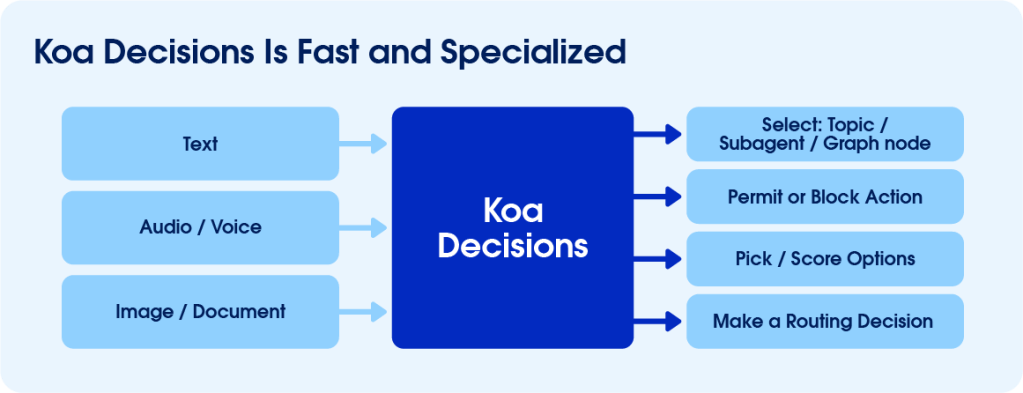
Koa Decisions is built that way on purpose. The preprint behind it, Koa-decision (formerly Koa-action), treats classification, endpointing, Boolean checks and scoring as one family of atomic actions, each reduced to a single-token output through atomic label tokens and supervised fine-tuning. Adding a category does not require retraining: in Salesforce's demo, adding "Returns" to the list lets the model route a returns request straight away. That is the practical break from older custom classifiers, which Salesforce notes could take enterprise teams months to get from idea to production.
Two sets of numbers, only one of them new
The launch post offers a striking comparison: roughly 26 milliseconds for routing requests in Agentforce, against about 1.4 seconds for a general-purpose LLM. But this is a production measurement from the HyperClassifier lineage that Koa Decisions succeeds, not a benchmark of the newly announced Gemma-based product. Salesforce's earlier engineering account identifies HyperClassifier as a GPT-OSS-20B fine-tune. The number demonstrates why Salesforce invested in decision models; it does not establish Koa Decisions' own latency.
In the production intent-routing test, the GPT-OSS-20B implementation of Koa-decision reached 85.5% accuracy and a 0.53-second median response time. Under the paper's identical serving protocol, it was approximately 1.9 to 7.5 times faster at the median than the frontier models tested. The Gemma-4-26B implementation scored 81.43% on the same routing benchmark.
On the same benchmark, GPT-5 scored 83.99% and Gemini-2.5-Pro scored 84.50%, both below the GPT-OSS-20B implementation; GPT-4.1, Claude-4.8-Opus and Gemini-Pro-3.1 scored higher, at 86.03%, 87.73% and 87.05%.
There is one methodological qualification: the Koa implementations were fine-tuned on a separate training corpus before evaluation, while the commercial frontier models were tested zero-shot. The authors say the evaluation datasets were excluded from training, but the comparison is not between untouched base models.
The production routing dataset contains 587 utterances, but Salesforce says it cannot release the underlying data because of privacy and contractual restrictions. The reported accuracy is therefore available for scrutiny in aggregate, not independent reproduction on the original examples.
On a separate voice-endpointing benchmark, the paper reports a 0.53-second median for Koa-decision against 0.55 seconds for Jev, TypeSafe AI's dedicated decision system. The comparison comes with capabilities the authors say distinguish their framework from Jev: multimodal inputs and multi-label outputs. The paper's multimodal evaluation uses text and visual inputs; Salesforce separately identifies image and audio support in the new product announcement.
Those are Salesforce's own tests, run by the team selling the model, on its own production routing task, and they describe framework implementations, not the shipped product. The numbers are still specific enough to check, which puts them ahead of most launch claims.
What is actually new today
Less than the launch framing suggests, and the preprint says so itself. The approach was disclosed in September 2025 and deployed inside Agentforce after that; HyperClassifier has been routing requests in production, and became the default intent model for Agentforce service and employee templates. What November 6 adds is a product name, a new base model in Google's Gemma, image and audio inputs alongside text, and a promise to take the same trick beyond routing into flows, Apex, prompt templates and a developer API.
Salesforce is also candid that it is joining a crowded month. Its own post opens by noting that TypeSafe AI came out of stealth in mid-September with Jev, a model built to pick from a set of options, and that OpenAI made its Decisions API generally available a month later. Kakao released its own decision model, Kanana-2-v-decide, as public weights on the same day as Koa Decisions. The category is real. The implementations differ: downloadable weights in Kakao's case, a Salesforce product with no public weights and no price in this one.
The practical test
For an Agentforce team, the offer is concrete: stop spending frontier-model calls on decisions a small model can make in one step, and keep the large model for writing and reasoning. The demo is public, the routing predecessor is in production, and the preprint gives a team enough detail to form a view before any sales conversation.
What cannot be judged yet is the product beyond routing. Flows, Apex, prompt templates and the API are plans, not availability, and Salesforce's own footnote says pricing and packaging can change and availability varies by region. Until those land with prices attached, Koa Decisions is a newly named product on a well-evidenced routing lineage, with an announced expansion, not the general decision layer the launch post describes.
Sources
- [1] Salesforce, "Less Reasoning. More Doing. Meet Koa Decisions", November 6, 2026 (the launch post, US newsroom edition read first-hand: Koa Decisions as the next version of HyperClassifier, built on Google's Gemma with image and audio support and no exact checkpoint named, the roughly 26-millisecond routing comparison, the Trailhead demo, the planned flows, Apex, prompt-template and API integrations, and the pricing-and-availability footnote)Read source
- [2] Dai et al., "Koa-decision: Fast and Consistent Structured Decision Making with Generative LLMs", arXiv:2609.36115v2 (v2, revised October 10, 2026; v1 was titled Koa-action; the backbone results table, the one-request-at-a-time round-robin serving protocol, the 587-utterance production routing dataset and the voice endpointing comparison with Jev)Read source
- [3] Salesforce Engineering, "Solving Real-Time AI Classification for Agentforce", November 20, 2025 (HyperClassifier as Agentforce's core decision-making engine: intent understanding, routing to action sets and voice endpointing, using single-token prediction)Read source
- [4] Unite.AI, "Salesforce Introduces Koa Decisions with Image and Audio Support", November 6, 2026 (reporting the July 8, 2026 Salesforce deployment account: HyperClassifier fine-tuned on GPT-OSS-20B, classifying across as many as 200 labels, default intent model for Agentforce templates from Spring 2026; and the 26-millisecond production routing measurement attributed to HyperClassifier)Read source
- [5] Salesforce and NVIDIA, "Announcing Koa: Salesforce's First CRM Reasoning Model, Built on NVIDIA Nemotron", September 15, 2026 (the separate Koa reasoning model, built by post-training NVIDIA Nemotron 3 Super)Read source