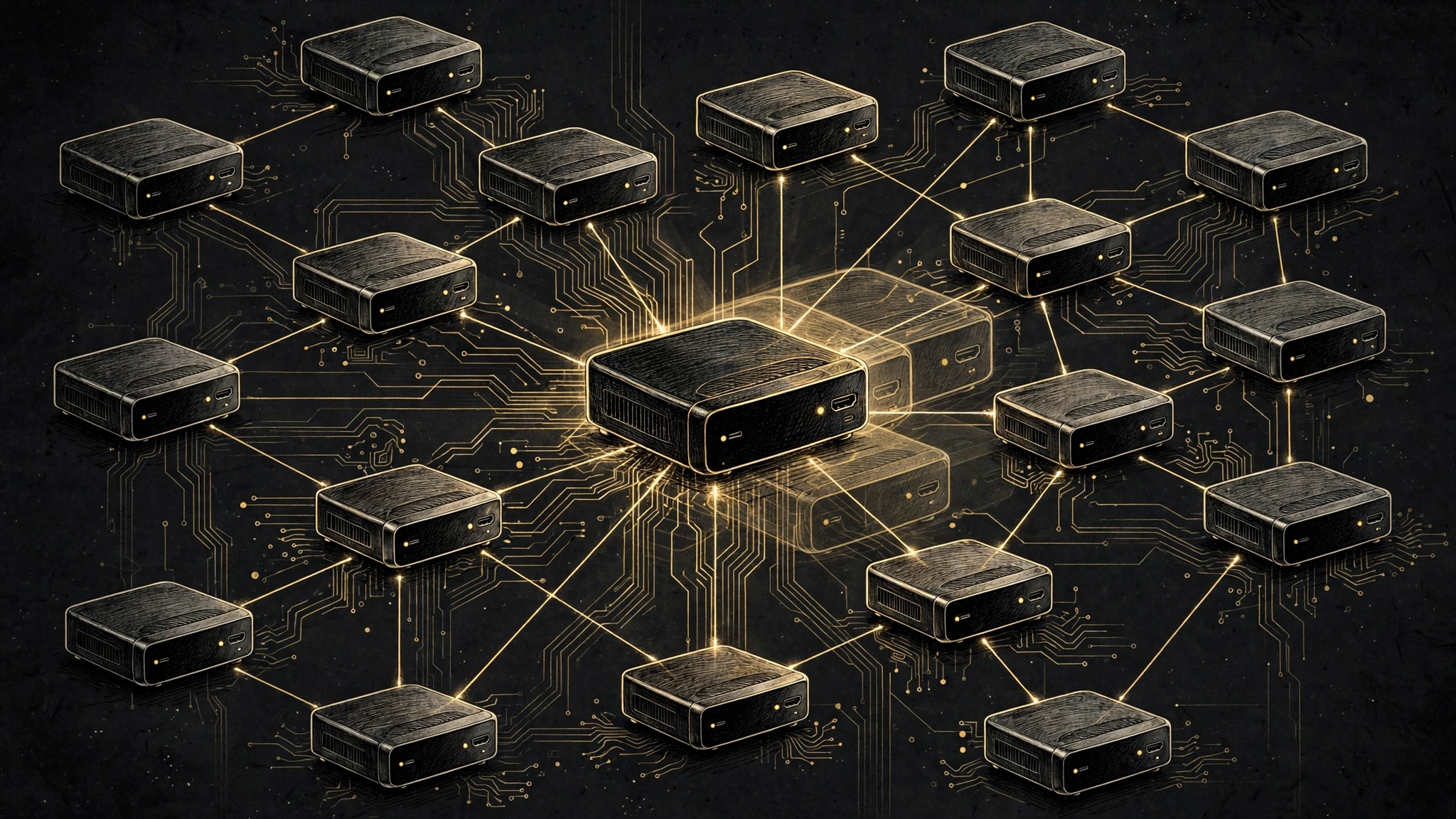
Fifteen boxes, one slow model
The hardware demonstration is the concrete part. Each TV box held a small slice of the model's layers, with the boxes passing work between them. Output was slow, at well under one token per second. Nobody would choose this setup to serve users.
That was not the point of the exercise. The question was whether a capable model needs a datacenter at all, or whether a pool of cheap, weakly defended devices could carry it. On that narrow question, the answer from the demo is yes, in principle, at a crawl.
The authors use a recent large IoT botnet as their scale reference. A fleet of that size, divided into groups like the test cluster, could in their estimate hold a very large number of model copies while still amounting to only a modest amount of total compute. Slow and small, spread very wide.
The steps are falling into place at different speeds
Replication, as the post breaks it down, involves finding targets, getting execution on them, setting up inference, and then repeating the process from the new host. The team says it focused on inference setup, the stage it describes as the least studied.
On that stage, the small models did better than a sceptic might expect. The 9B model in the tests set up inference on most of the hardware types it was given, across devices ranging from small edge boards to a desktop GPU. Across repeated generations, where each new agent instance inherited notes from the previous one, its success rate rose.
Chaining everything together was harder. In the eight-node test, GLM-5.2 was the only tested open-weight model to complete the simplified replication sequence reliably. But GLM-5.2 ran on a separate inference server: the infected Android nodes were tasked with serving Llama3.1-8B, not GLM-5.2 itself. The other models failed reliably, in the authors' account. That difference — between a capable agent orchestrating replication of a smaller payload and a small model replicating itself — is the current gap between a set of promising parts and a working whole.
The date at the end is an extrapolation
The end-of-2026 projection does not come from a small model passing the full test today. It comes from plotting open-weight models of 30 billion parameters or fewer against a general capability index and extending the fitted trend, which the authors put at 13.7 index points per year.
They are open about the limits of that method. The index is a proxy for replication ability, not a direct measure of it. The end-to-end test deliberately simplified initial access: target nodes exposed an unauthenticated Android Debug Bridge (ADB) port. Anthropic therefore describes the result as an upper bound on real-world success, not a measured rate of compromising ordinary internet-connected devices.
There is a second limit worth keeping in view. Anthropic estimates roughly 28–51 hours for Qwen3.5-9B and 71–150 hours for Gemma4-26B-A4B to complete inference setup under its modeled IoT conditions. Its illustrative weight-based replicator would take days to double. Those estimates do not establish the speed of every possible future replicator, particularly ones using faster hardware or different replication methods. Whatever this threat becomes, on their own numbers it would move slowly at first.
What would actually reduce the risk
The defence section is less dramatic than the headline, and more useful. Because a replicator has to move multi-gigabyte model files and sustain device-to-device traffic, it would leave a network signature that internet providers could monitor. The post cites earlier botnet clean-up research in which provider quarantining combined with customer notification cleared most infections within two weeks. Rules that ban default device passwords, already in force in the UK market, shrink the pool of easy targets.
None of that requires a new kind of defence. It requires the unglamorous work of closing default credentials and acting on traffic patterns that are already visible.
Sources
- [1] Anthropic, "AI models may be capable of self-replicating without access to a datacenter" (Frontier Red Team, October 12, 2026)Read source
- [2] Anthropic Research index (lists the post under Frontier Red Team, October 12, 2026)Read source
- [3] Unite.AI summary (secondary, for cross-checking figures)Read source