A shell built differently
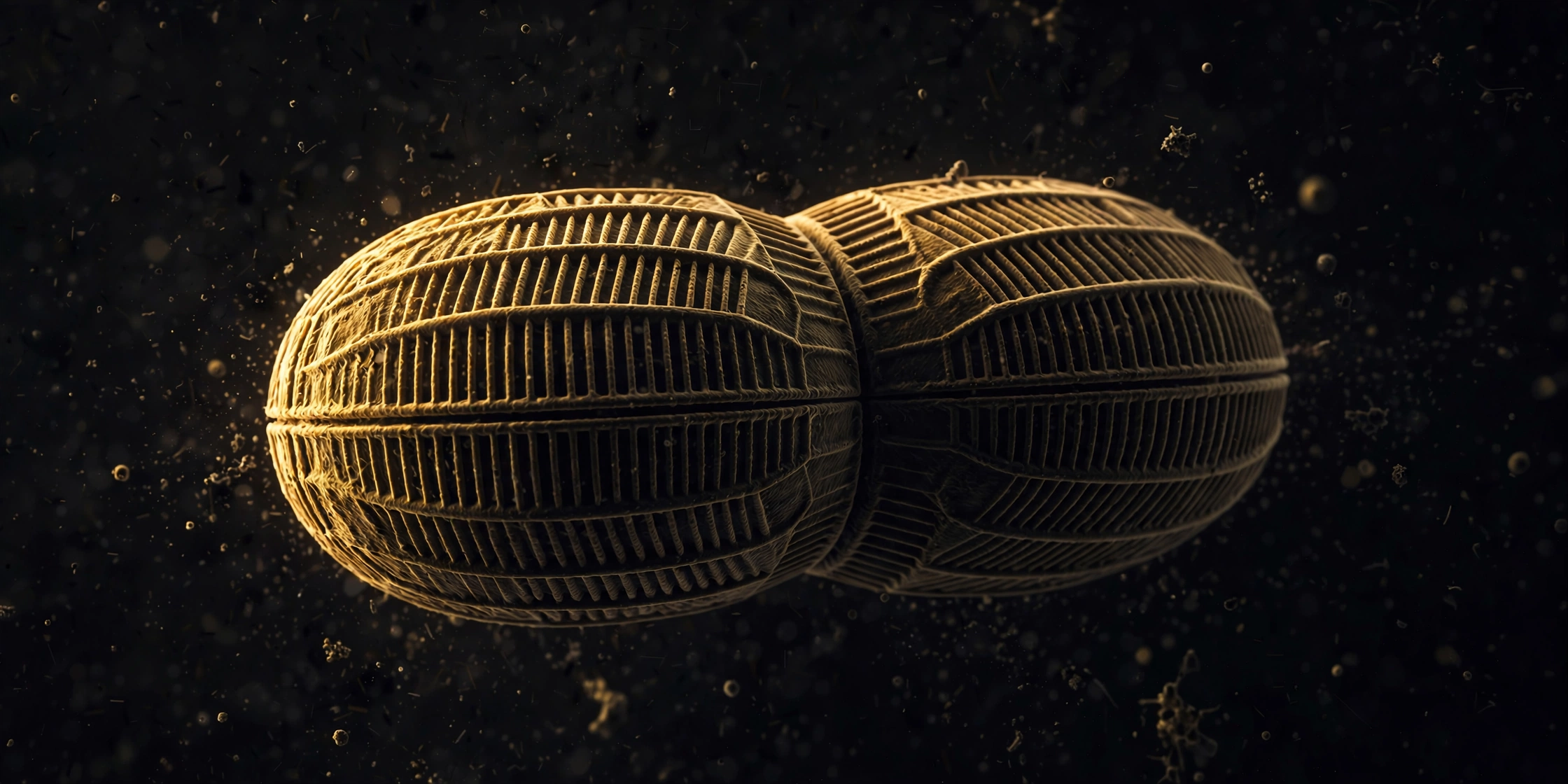
The prokaryotic vault is not a smaller copy of the human one. The mammalian vault uses 78 copies of its major vault protein, arranged as 39 per half, compared with L05's 96 copies of a single phage protein, arranged as 48 per half. Each chain carries seven repeating wall segments rather than nine, and the end caps are flatter. The result is shorter and wider, and because it is more spherical it encloses about 25% more volume. At about 9.5 megadaltons it is among the largest protein shells identified in prokaryotes.
The caps are the structural detail worth pausing on. A wall 48 copies around has to narrow to a point, and it does so in three steps. Within each group of three neighboring copies, one ends at the first tier, one at the second, and one continues to the tip. The copies are identical along the wall and take different shapes only where the cap closes. When the team altered the protein at the points where copies touch, some single changes near the cap prevented the shell from sealing at all, leaving open rosette-like particles instead.
Size, it turns out, is adjustable. The team copied two of the wall's seven repeating segments to give the protein nine, matching the human count. The altered protein still assembled, into larger closed particles with about 20% more enclosed volume. That is a concrete hint about how vaults could have changed size over evolutionary history: duplicate part of the wall, keep the assembly rules.
What Claude actually did, and what it cost
Anthropic is candid about the division of labor, and the candor is the useful part. Claude searched the sequence database, converted protein sequences into DNA designs tailored to the host, and helped optimize the isolation workflow. The team chose to try size-exclusion chromatography despite Claude initially arguing against it; Claude subsequently recommended a specific column and methods that helped make the approach work. Anthropic says the optimized process took about 90 minutes from cells to microscopy grid, compared with roughly three days for the conventional method. Claude also ran the cryo-EM processing software step by step while researchers advised on the decisions. Anthropic says a first full structural model was ready in 34 hours, while the final maps were completed about a week after processing began. The company estimates that producing the first model would normally have taken weeks of manual work with specialized software. Treat that as the lab's own estimate, not a controlled comparison.
The errors are also on the record. A protocol Claude wrote included a growth additive that interferes with getting DNA into cells, which set the project back two weeks. Early in the microscopy processing it skipped a standard step and produced a flawed map blended with its mirror image, after which the team told it to stop improvising. Anthropic says most of the work could be done by a typical lab using existing Claude products, with one exception: the cryo-EM analysis used hundreds of GPUs in parallel, which is not typical academic capacity.
What is not known yet
Start with the largest gap. The function of vault particles remains unknown, in prokaryotes as in humans. Each L05 copy holds a pocket containing a small molecule the team could not identify. Claude noted that the molecule's shape resembles coenzyme A, a common cellular helper molecule. The team has not identified the molecule, however. Anthropic presents the resemblance as a possible early clue to the particle's function, not as evidence that the pocket contains coenzyme A.
The second gap is where the particles were made. Every vault in this work was produced in laboratory E. coli. The team has not yet tested whether these proteins form vaults inside the bacteria and phages where they naturally occur. The work has been submitted to bioRxiv but has not yet been peer-reviewed. Anthropic says it will release the structures and additional data soon; those materials were not yet available through the research post. Independent reproduction and external scrutiny therefore remain outstanding.
Sources
- [1] Anthropic — "Investigating vault particles with Claude," November 4, 2026 (primary source; all figures, funnel counts and caveats read first-hand at Gate 1)Read source
- [2] Athukoralage et al. — "Prokaryotic homologs of the major vault protein form engineerable vault nanocapsules," Anthropic preprint submitted to bioRxiv, 2026 (read first-hand at Gate 1; structures and additional data to be released)Read source