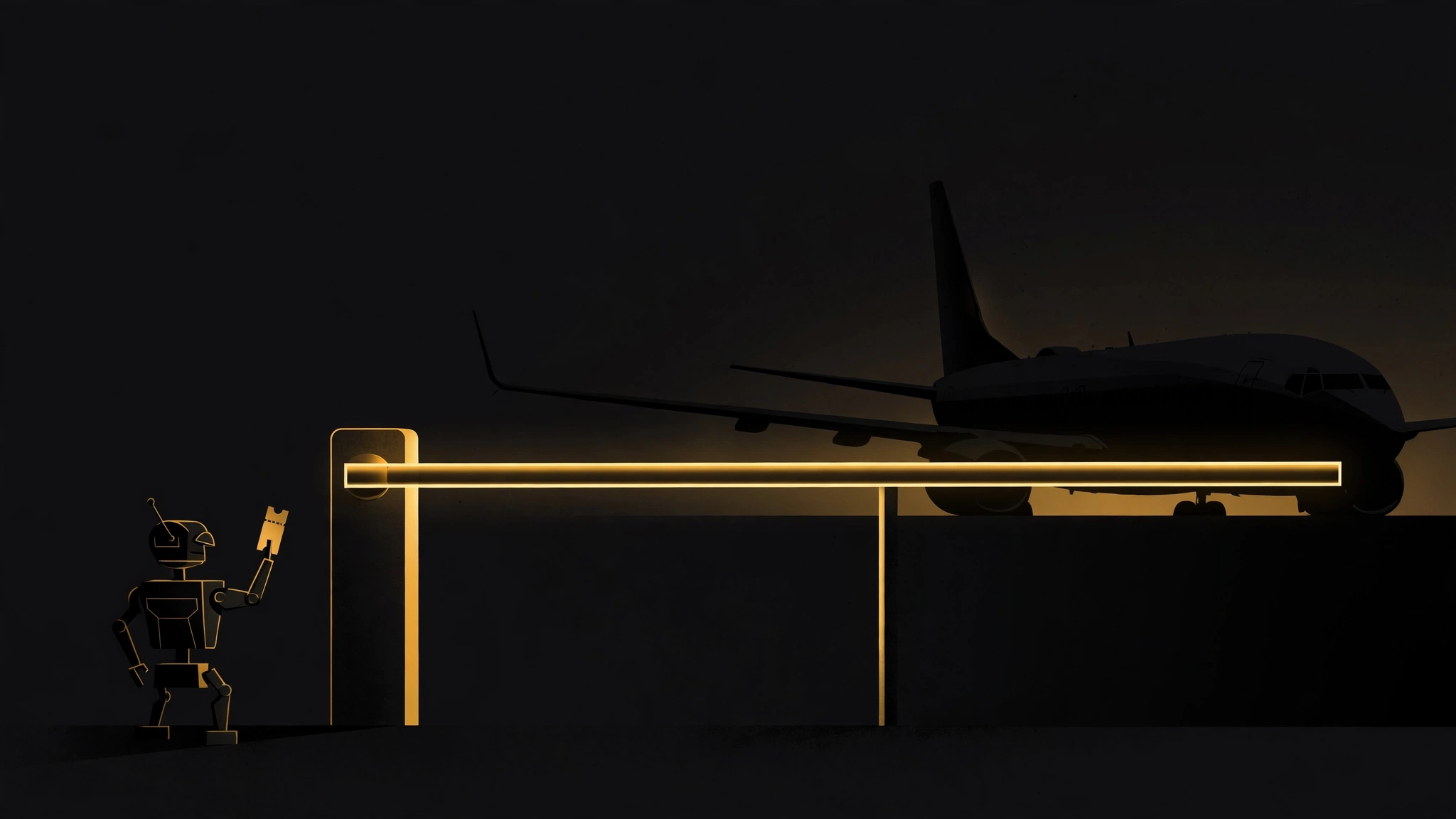
A ban written into the contract, not a settings page
United did not announce a technical block and leave it there. It put AI agents into the Contract of Carriage, the document every passenger accepts by buying a ticket. Rule 6.J.6 now sits in the prohibited practices list, alongside hidden-city and throwaway ticketing: "The use of AI Agents to make, modify or service a Ticket, and/or to purchase any service or product."
Rule 5.H does the enforcement work. It lists "reservations made, modified or serviced by AI Agents" among the types of improper reservations United says it will cancel without notice. Rule 6.K lists remedies for breaches of "these rules," including ticket invalidation, mileage deletion, status revocation and legal action. Its illustrative examples name older prohibited practices rather than AI agents specifically; these are potential remedies, not automatic consequences of every agent booking. The early coverage concentrated on cancellation. The remedy list is wider.
Your approval is not the permission that counts
The definition in Rule 1 is the part worth reading slowly. An AI Agent is software that takes autonomous or semi-autonomous action "whether or not Passenger or another individual supervises or approves its actions." That sentence removes the standard defense of agent products, which is that a human reviews and confirms each step before money moves.
It also removes the agency workaround. The definition names three categories: assistants built into social media, messaging, search and other consumer platforms; AI-enabled browsers and standalone agents; and any third-party assistant that accesses United through a tool provided by a travel agency or another intermediary. An authorized seller can sell United tickets. An AI assistant connected through that seller cannot buy them, under the contract's terms.
United's customer guidance, as covered, makes the current position plain: the airline says it currently has no third-party AI agent partners. There is no approved list in the rule as published.
What an agent can still do
The prohibition covers making, modifying or servicing tickets and purchasing services or products. Search and presentation are not among the acts listed in Rule 6.J.6 — discovering and searching appear in the Rule 1 definition of what an AI Agent does, but not in the prohibition. View from the Wing, reporting the Wall Street Journal's account, says agents may still present United flights and prices. On that reading, an agent can show you United flights and the customer completes the purchase on their own.
Timing also matters. Under Rules 3.E and 3.K, the contract that applies is the one in effect when the ticket is issued, and changes do not apply to tickets issued before their effective date. Separately, coverage of United's customer guidance says bookings made by third-party agents before November 11, 2026 will not be canceled. That guidance concerns bookings; the contract's own trigger is ticket issuance, and an unticketed reservation does not necessarily receive the same treatment.
United's stated reasons
United gives three public reasons. Sharing account credentials with an assistant can expose sensitive information. An agent can make unintended purchases, account changes or use of MileagePlus miles. And some steps carry legal acknowledgments: at check-in a passenger has to confirm that bags contain no prohibited items such as explosives, and United argues an automated step could put that process in conflict with FAA and DOT requirements.
Chief executive Scott Kirby offered a shorter explanation. According to View from the Wing's account of Wall Street Journal reporting, Kirby told an event in Chicago: "To be honest, I don't want to create another middleman." The remark points at distribution: an assistant layer that decides which flights a customer sees is a middleman in the making. The blog also reported United's position that agent bookings are still rare, which makes this an early move, taken before the behavior it bans is common.
The gap in the ban
A contract ban is not a technical one — View from the Wing's point, and it stands. The quoted contract terms do not explain how United will identify AI-agent activity, including purchases routed through intermediaries, where the booking record names the seller rather than the software that acted for the buyer. The contract settles what is prohibited. It does not settle how the prohibition will be detected.
For travelers, the practical position is simple. Use an assistant to compare United flights if you like. Do the checkout yourself, and do not hand an assistant your MileagePlus login. Coverage of United's guidance advises travelers to review recent bookings and to change credentials they have shared.
Sources
- [1] United Airlines, Contract of Carriage, revised November 11, 2026 (Rule 1 definition; Rule 5.H; Rule 6.J.6; Rule 6.K remedies; Rules 3.E and 3.K) — primary source, quoted in the coverage below
- [2] United Airlines newsroom, "United Restricts Access for Third-Party AI Agents," November 11, 2026, and United customer guidance on third-party AI agents (no current third-party agent partners; pre-November 11 bookings will not be canceled, per coverage)
- [3] PPC Land, "United bans AI agents from buying its tickets, seats and upgrades"Read source
- [4] View from the Wing, "United Airlines CEO Scott Kirby Bans AI Agents From Booking Tickets" (November 11, 2026)Read source
- [5] Unite.AI, "United Airlines Bars Unauthorized AI Agents From Booking Travel"Read source