
What changes on December 9
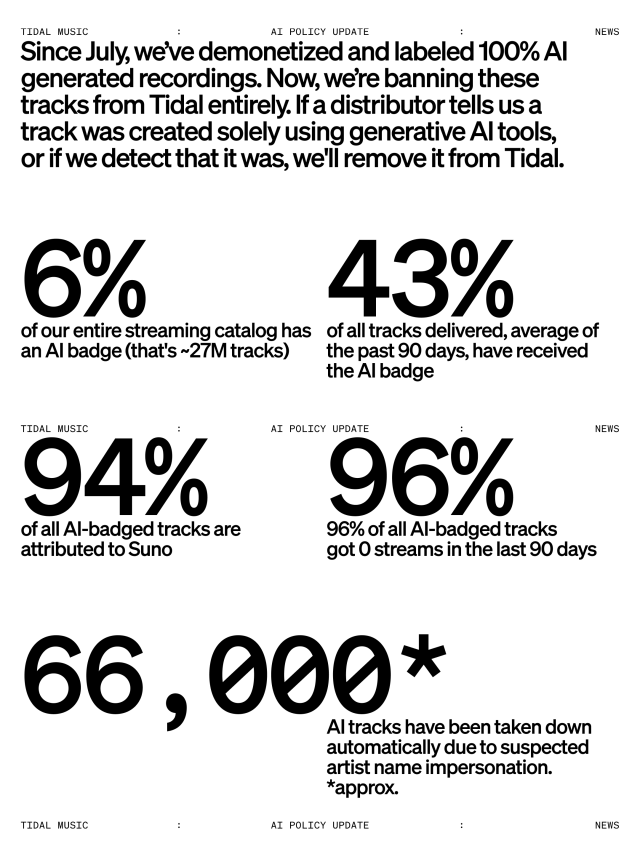
Until now, a wholly AI-generated track could sit on Tidal with a label and no royalties. From December 9 it cannot sit there at all. Tidal will remove the flagged catalog, refuse new deliveries of wholly AI-generated recordings, and reject any delivery whose metadata declares the track was made solely with AI tools. The earlier policy of labeling and demonetizing is replaced by deletion, in Tidal's words because "that's not enough" and "a more drastic change is in order."
One word carries the whole policy: wholly. Tidal says tracks that were "assisted by AI tools, but not the sole outputs" will be allowed. A generator output uploaded as-is goes. Tidal's support page, as reported in a secondary analysis of it, is unusually candid about why the line sits there: detection has limits, and acting only at the extreme end is intended to reduce false positives. The same page concedes that a track that is 99% AI-generated can stay unlabeled, and that the policy may evolve. The boundary is set by what the detector can defend, not by a theory of authorship.
The numbers behind the decision
Read Tidal's figures as a spam problem before reading them as an art problem. When 43% of everything delivered to a streaming service over 90 days is machine-made, on Tidal's own detection figures, and the peak day passes 60%, the catalog stops being a library and becomes an intake queue. Against that inflow sits the listening figure: 96% of the AI-tagged catalog earned no streams at all in three months. That is the combination that lets Tidal take a step its larger rivals have not taken. Deezer has reported a similar pattern, more than half of daily deliveries fully AI-generated on peak days in mid-2026, while keeping those tracks on the service, tagged and out of recommendations.
Two of Tidal's numbers do not line up, and the gap is worth keeping. The catalog statement says about 27 million tracks are tagged today. The platform lead's announcement post says the change "will result in the deletion of 29 million songs." Tidal has not explained the difference, and readers should not have to guess at it.
The detector is the policy
A ban at this scale is only as good as the system deciding what counts as wholly AI-generated, and here the maker's side publishes two very different answers. Ircam Amplify's chief executive put its false-positive rate below 0.02% in comments to Music Business Worldwide, calling it market-leading. IRCAM's product page for the same detector claims 99% accuracy with less than 1% false positives. Both are stated as upper bounds, so both can be true at once. What neither establishes is which figure describes the rate Tidal's catalog will actually be scanned at, and the two bounds lead to very different outcomes.
The arithmetic shows why the distinction matters. If about 27 million tagged tracks are 6.3% of the catalog, the full catalog is roughly 429 million tracks and the untagged part is roughly 402 million. If that untagged catalog were all human-made, and a stated false-positive rate applied across it, then at 0.02% a full-catalog scan could wrongly flag up to about 80,000 tracks, and at 1% up to about 4 million. Those are illustrations of potential flags under stated assumptions, not predictions, and a flag is not a removal: Tidal may apply more than one signal before removing a track. But the range is the point. The fairness of this ban sits somewhere inside a fifty-fold gap between its detector's two published bounds, and Tidal has not said which end it is working to. Independent evidence counsels caution about taking the best figure on trust: a peer-reviewed study published in June 2025, as collected in a secondary analysis, tested an older version of Ircam Amplify's detector on a small 150-track sample of human-made music and found it labeled 4.7% of them as AI-generated. The sample was small and the version old, so it does not establish today's error rate. It does establish that an appeals route matters, and no appeals process was described in Tidal's announcement.
First, with an asterisk
Tidal calls itself the first streaming service to do this, and its platform lead encouraged peers to follow. The claim needs one qualification. Bandcamp banned music created "wholly or in substantial part by AI" in January 2026, a broader test than Tidal's, on a smaller and different kind of platform. Among the large subscription streamers, Spotify still hosts AI music with labels and recommendation limits, and Deezer tags and filters rather than deletes. If Tidal's purge runs without a visible false-positive scandal, the pressure on both to move from labeling to removal grows. If it produces one, the labels start to look like the cautious option.
Sources
- [1] Music Business Worldwide, "Tidal bans fully AI-generated music from its platform," November 24, 2026Read source
- [2] Engadget, "Tidal is banning AI-generated music entirely," November 24, 2026Read source
- [3] iClarified, "Tidal to remove 29 million fully AI-generated tracks," November 25, 2026Read source
- [4] Tidal support page on its AI policy, updated November 24, 2026, as read via secondary analysisRead source
- [5] IRCAM, "Ircam Amplify" product pageRead source
- [6] Prior ALFW coverage: YouTube Music labels and Deezer filtering, October 16, 2026