
Where encryption stops
End-to-end encryption protects a message while it travels. It does nothing at the moment the message arrives and is rendered as readable text on a screen, because the recipient has to be able to read it. An operating-system agent that scans the screen does not need to break any encryption. It reads the same words the recipient reads, and once it has captured them, Signal says, the copy is stored and made accessible to whatever local database or remote server that agent uses. At that point the data is outside Signal's control, and the exposure covers every participant in the conversation, not just the phone's owner.
That is the argument in Signal's post on Friday, which Reuters identifies as written by its president, Meredith Whittaker. Google is integrating Gemini Intelligence into Android, Apple is integrating Onscreen Awareness into Siri AI, and both sit below the app layer, in the operating system itself. Whittaker's phrasing is that the three OS makers are "the oceans in which Signal, and other applications, must swim," and that the agentic turn is making that environment "increasingly hostile to privacy." She calls it an existential threat to Signal's ability to keep its privacy guarantee, a guarantee that until now rested on an open-source codebase and a formally verified encryption protocol.
What changes on your phone
On iOS 27, Signal now prevents screenshots inside the app by default. The control is a new setting called "Block Siri AI," and it can be switched off by anyone who wants screenshots back. Signal is blunt about the trade: turning it off potentially exposes your content, and your contacts' content, to these agents, and breaks the privacy guarantee the app is built around.
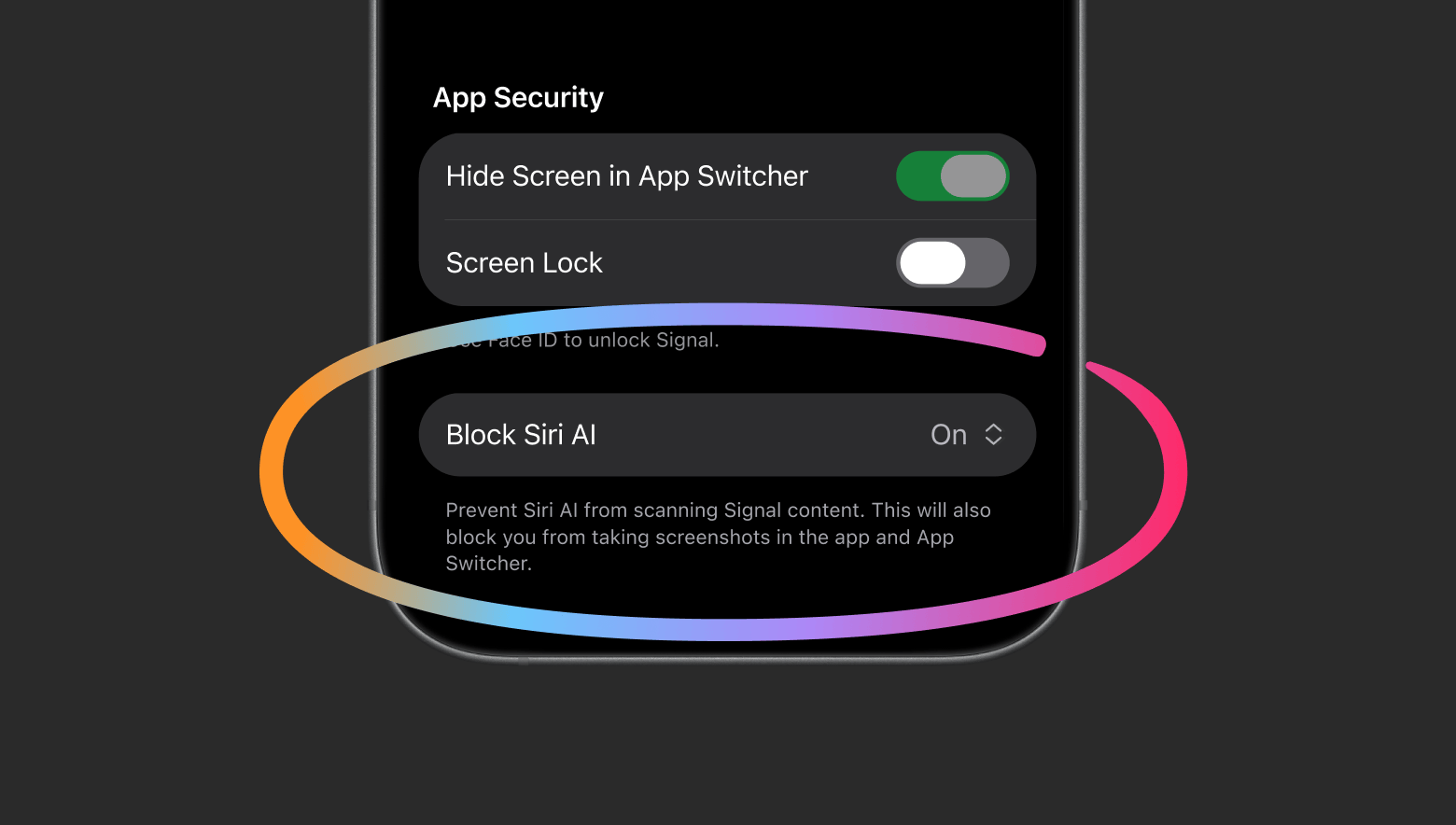
On Android the mechanism is reactive rather than blanket. Signal blocks capture when it detects an AI assistant attempting to read the screen, and coverage of the announcement describes that as automatically turning on its existing "Screen security" setting. The qualification sits in Signal's own sentence: this applies on Android versions where it can detect the attempt. Android's fragmentation means the protection is not uniform, and Signal does not claim otherwise.
On macOS there is no version of this protection. Signal says it is currently unable to implement these measures there, because Apple provides no documented tool for it. Coverage of the announcement points to a manual partial step: add Signal to Excluded Apps under System Settings → Siri, an OS setting the user has to find, not a protection the app can ship.
Windows users have seen this film before. Last year Signal blocked screenshots by default on Windows 11 specifically so Microsoft's Recall feature would not take and store screenshots of Signal messages. The mobile move is the same play, extended to the two phone platforms, a year later and against a broader set of agents.
What the fix does not fix
Signal lists the limits itself, which is worth more than the announcement. Screenshot blocking addresses one capture route. It does not address an agent retrieving content already present on the device through the filesystem. It also cannot govern the other end of a conversation: if the person you are messaging has disabled the protection, an assistant on their phone can potentially read your messages there. And on Android it depends on detection that Signal concedes does not work the same way everywhere.
The post also widens the target beyond the OS vendors. Signal says tools are needed to stop third-party agents, naming Meta's Muse, from reaching app data through the deep permissions users are encouraged to grant during setup. Accessibility settings, it notes, were built to help people use their devices and are now functioning as a skeleton key for agents. That connects this announcement to the Reuters testing ALFW covered earlier this week, which found Muse retrieving Signal messages through notification access on Android and accessibility and screenshot permissions on Mac. Signal is not only defending against the platform owners' assistants. It is describing a permission model in which any sufficiently privileged agent can read an encrypted app's output after decryption.
The actual request
Strip away the rhetoric and Signal is asking for something specific and, on its face, modest: a documented switch. Developers should be able to opt an app out of AI data access and processing across screen reading, filesystem access, notifications and APIs, without breaking the app's core functions. Second, the OS companies should publish documentation and technical specifications for how their agents access and process data. Signal says its developers have spent months running forensic investigations on Android and iOS just to learn what the agents do when they touch app data, because the documentation does not exist.
It also pre-empts the likely industry answer. Confidential computing approaches, Signal says, are not a complete solution, because they leave the extent of any privacy guarantee in the hands of the same providers. The post ends on a limited note of optimism: Signal says it is in conversation with providers including Google and Apple, describes itself as cautiously optimistic, and hopes to have more to share. No provider commitment is announced, and no timeline is given.
What to do with this
If you use Signal on an iPhone running iOS 27, the protection is on by default and the cost is screenshots. If you turn the setting off to keep screenshotting, you are making that decision for everyone in the chat, not only yourself. On Android, check whether Screen security is on rather than assuming the automatic trigger fired on your version. On a Mac, there is nothing inside Signal to switch on; the Excluded Apps step under Siri settings is the partial step the coverage points to.
Signal's argument travels beyond one messaging app: any privacy-sensitive app now sits underneath an OS-level agent whose data access the app cannot fully see or refuse. Whether Apple and Google ship the opt-out will say more about the next phase of on-device AI than any model release this month.
Sources
- [1] Signal blog, "Signal is Serious About Protecting Your Privacy," November 20, 2026Read source
- [2] Reuters via 97.9 WEVE, "Signal restricts screenshots to block AI agents from reading messages," November 20, 2026Read source
- [3] Engadget, "Signal now blocks screenshots by default to stymie AI agents," November 20, 2026Read source