
A skill file is the storefront now
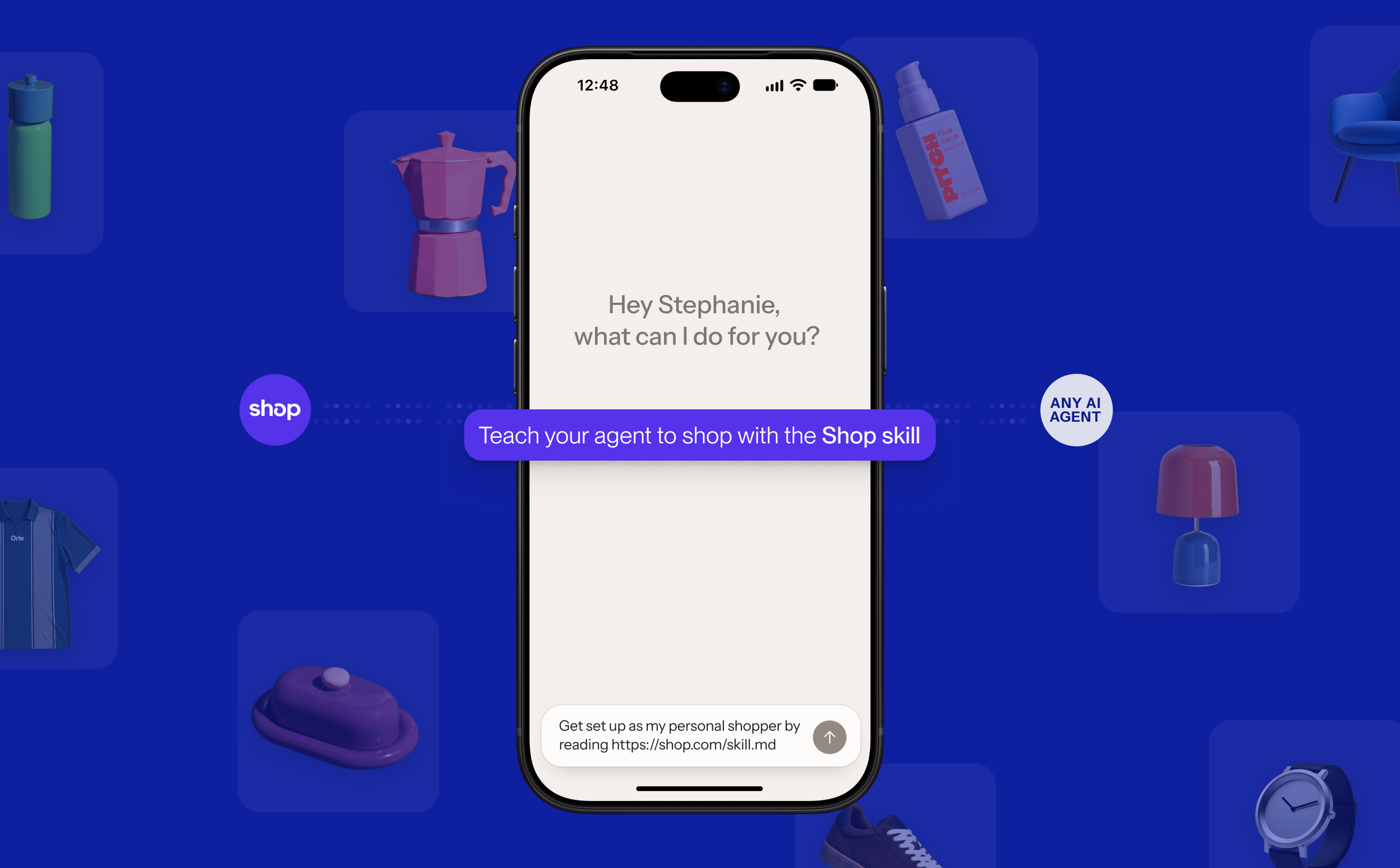
The headline item is small on purpose. shop.md is not an app or a new marketplace. It is a shopping skill — a file a buyer points an AI agent at. Shopify says an agent using it can search more than a billion products in its catalog, check out with Shop Pay and track orders. Anyone can customize the skill to fit their needs. That billion-product figure describes Shopify's catalog reach, not the number of products independently verified as eligible and ready to be recommended through every agent.
The personalization is the part worth reading slowly. The agent does not search cold. Because it is connected to Shop, it knows the buyer's preferences, sizes and order history, and uses those to pick products from Shopify merchants. That is a different proposition from an agent scraping product pages. The recommendation is built from what the buyer already bought, in the sizes they already wear, paid for with credentials the agent never sees.
Paired with it, Shop Pay itself moves inside other companies' agents. Checkout with Shop Pay starts inside Muse from Meta, Claude Duet and Instinct, and three of those agents — Claude Duet, Grok Bot and Instinct — also offer Shop Pay for brands that are not on Shopify at all.
Shopify's security claim is specific: the buyer remains in control of purchases, and their payment card is never shared with the agent. For purchases from merchants outside Shopify, Shop Pay uses tokens from Mastercard, Visa and Discover, with American Express listed as coming soon. This is a payment-security arrangement, not evidence that every agent supports every card network or that the feature is available in every market.
American Express is still listed as coming soon for off-Shopify purchases, and Shopify does not specify the countries where shop.md or agent-based Shop Pay checkout is available. The announcement describes the product capabilities, not a universal geographic rollout. Merchants should confirm market eligibility before treating this as an immediately accessible sales channel.
The gate sits in the admin, not in the agent
The more consequential change is on the merchant side, and it gets less space in the announcement.
Agents get product information from Shopify Catalog. Fall '26 adds an admin view showing whether a store is eligible for that catalog, with links to fixes for anything preventing eligibility. That makes eligibility a potential distribution gate, not simply a ranking factor: products that cannot enter the Catalog may not be available to the agents drawing from it. Shopify's announcement does not spell out how every agent handles ineligible stores, so the exact consequences should not be generalized across all integrations.
Next to it sits the Knowledge base, a new page under Sales channels, then Agentic. Merchants review and publish the facts agents receive about their store: return windows, shipping destinations, gift services. Shopify drafts those facts from the storefront and suggests updates, and states that nothing it drafts reaches an agent without the merchant's sign-off.
That sign-off rule is the honest part of the release, and it cuts both ways. It protects a merchant from an agent inventing a returns policy. It also means the facts an agent repeats are now a publishing task someone has to own, review and keep current — closer to maintaining a second, machine-readable storefront than to ticking a settings box.
Shop Promise shows how far this reaches. The program is free for eligible US stores and puts delivery and returns badges on qualifying products. Shopify says products carrying the badge can rank higher not only in Shop app search but also in the Shopify Catalog data used by shopping agents. Delivery and returns reliability therefore become more than a post-purchase service metric: the Shop Promise badge can also influence product discovery.
What the big numbers do not prove
Two numbers carry the announcement: more than a billion products, and more than 400 million people who, in Shopify's wording, already trust Shop Pay. Both are Shopify's own figures, and both need their qualifiers kept attached.
A billion products is catalog size, not agent sales. Shopify publishes no figure in this announcement for how much buying already happens through agents, how many shoppers have pointed an agent at shop.md, or what share of catalog products are eligible and complete enough to be recommended well. The 400 million figure is framed as trust, not as active Shop Pay shoppers, and it should not be read as an audience that agents can already reach. The announcement also names no countries for shop.md or for Shop Pay inside agents, so availability by market is an open question, not a detail to assume.
The nine-agent connector list deserves the same care in the other direction. ChatGPT, Claude, Claude Duet, Microsoft Copilot, Google Gemini, Grok, Grok Bot, Muse and Perplexity can now connect to a merchant's Shopify to manage products, inventory, orders and performance from a conversation. That is merchant operations, a separate thing from shopper checkout, and the announcement treats them separately even though launch coverage tends to merge them into one "agents can do everything" claim.
The practical order of work
For a Shopify merchant, the announcement rearranges priorities ahead of the November shopping season rather than simply adding another channel to advertise in.
First, check the Catalog eligibility view and address anything Shopify identifies as preventing inclusion. The products agents can discover depend on the information available through Shopify Catalog, although the announcement does not detail how every agent handles ineligible stores.
Second, review the Knowledge base before publishing it. These are the return, shipping and service facts an agent may repeat to a buyer as the merchant's own information. Shopify says nothing it drafts reaches an agent without merchant approval, but that makes keeping the published information accurate an ongoing responsibility.
Third, treat product data — sizes, materials, compatibility and availability — as information an agent needs to interpret correctly, not just copy surrounding a product photograph.
For shoppers, the test is narrower. shop.md is most relevant if you already use Shop and Shop Pay and buy repeatedly from Shopify merchants, where saved preferences, sizes and order history can improve product recommendations. Its discovery catalog is Shopify's, even though separate Shop Pay integrations also support purchases from selected brands outside Shopify.
Shopify has not published country-by-country availability for these agent shopping features, so buyers and merchants should verify access rather than assume the announcement means the channel is available everywhere.
Sources
- [1] Shopify, "Exponential: Shopify's Fall '26 Edition", October 28, 2026 (primary — read first-hand: shop.md searches more than a billion products with Shop Pay checkout and order tracking, using the buyer's preferences, sizes and order history from Shop; Shop Pay checkout starts inside Muse, Claude Duet and Instinct, with Claude Duet, Grok Bot and Instinct also offering it for brands not on Shopify; more than 400 million people already trust Shop Pay; the card is never shared with the agent; off-Shopify agent purchases use tokens from Mastercard, Visa and Discover, with American Express coming soon; connectors work with nine agents; the Catalog eligibility view, the Knowledge base sign-off rule and Shop Promise's Catalog ranking)Read source
- [2] Shopify, Fall '26 Edition page (primary — read first-hand: Shop Pay also available for checkout in Muse, Instinct and Claude Duet; shop.dev tooling notes)Read source
- [3] eCommerceNews Australia, "Shopify unveils AI shopping tools in Fall '26 update", October 29, 2026 (secondary; details not used in this article)Read source
- [4] Ad Hoc News, Shopify Fall '26 stock coverage, October 30, 2026 (secondary; timing only, no figures used)Read source