
The interface is the product
Amazon announced on November 12 that SGLang-Neuron is publicly available. The pitch is continuity. You launch models through SGLang's server interface, call the same generation APIs, and keep the workflow you already have. What changes is underneath: an out-of-tree plugin, selected with a single environment variable, routes execution to AWS Trainium instead of a GPU.
That is a deliberate design. SGLang core continues to provide the API server, the request lifecycle, RadixAttention and prefix-cache bookkeeping. The plugin implements the parts that have to know about Trainium: the models, the attention path, mixture-of-experts support and the graph runner. Trainium support can then be updated on its own release cycle without forking the serving framework, and a team evaluating the switch does not have to relearn its tooling to run the trial.
How the split works
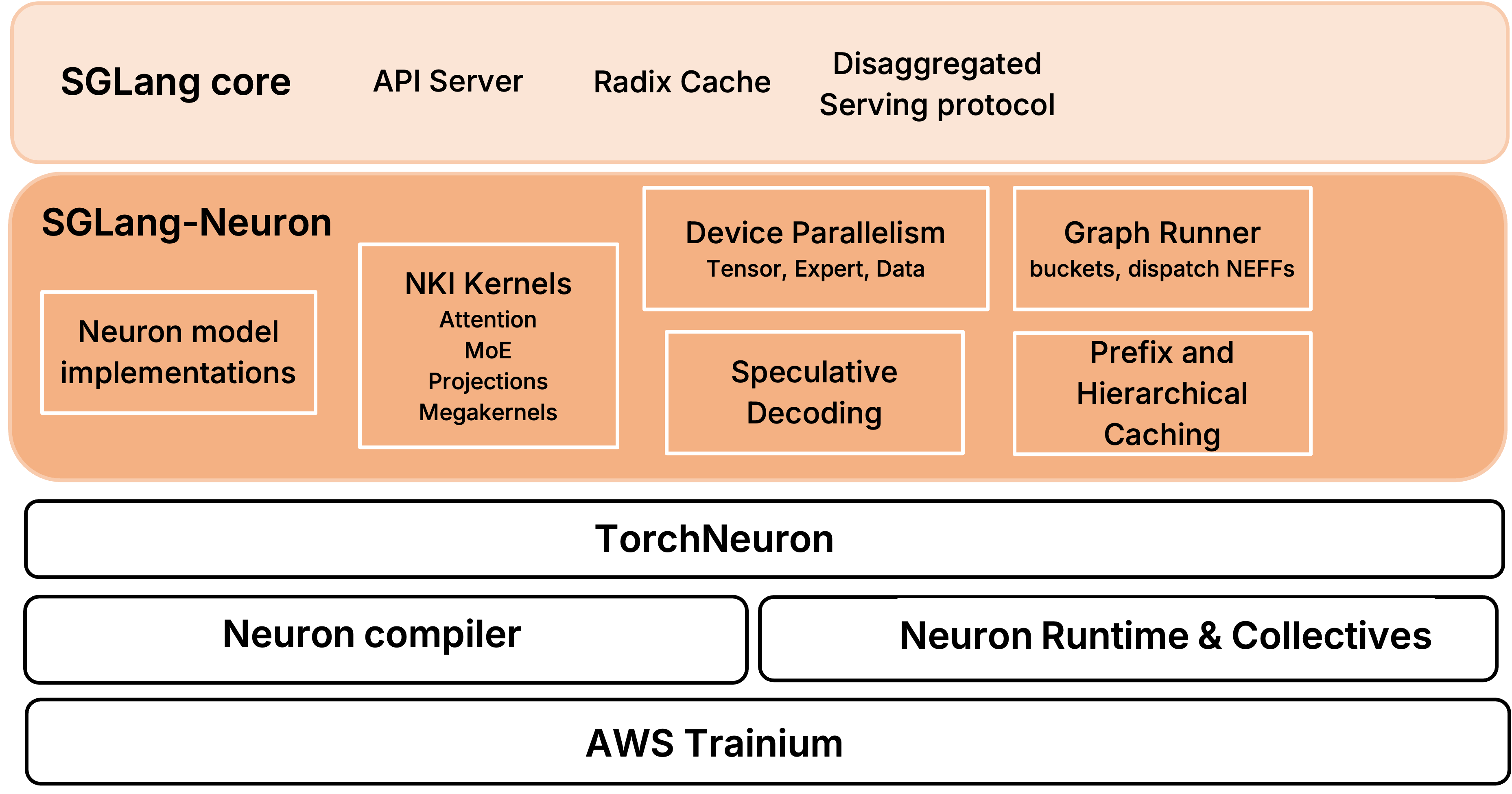
Under the plugin sits TorchNeuron, which registers Trainium as a native PyTorch device. SGLang-Neuron uses standard PyTorch operations for model execution, with kernels written with the Neuron Kernel Interface (NKI) for performance, all compiled through `torch.compile`. The plugin also supports prefill/decode disaggregation: a prefill server computes the prompt's KV cache and hands it to a decode server over Elastic Fabric Adapter using NIXL, while both servers keep SGLang's scheduler and request lifecycle.
The walkthrough in the launch post serves openai/gpt-oss-120b on a Trainium3 EC2 instance from the published container, with tensor and expert parallelism set to 8, an FP8 KV cache, a 10,240-token context window and up to 64 concurrent requests. It ends with a working chat-completions call. The post documents an end-to-end setup and a chat-completions example; ALFW has not run the walkthrough.
The number that is not there
What the post never does is say how fast any of this is. There is no tokens-per-second figure, no latency measurement, no comparison against the same model served on Nvidia hardware, and no cost per token. The one economic claim in the announcement, that Trainium "delivers strong economics for AI training and inference at scale," arrives with no number attached to it.
That absence is the decision-relevant fact. Price-performance is a central question for teams considering a switch, and that is precisely the quantity this launch does not publish. Interface compatibility lowers the cost of running an experiment. It does not substitute for the experiment's results. When the LMSYS team announced the limited beta on October 22, it said plainly that performance work on Trainium was ongoing. Three weeks later the plugin is public. The November launch post supplies no measurements showing how performance has changed since LMSYS described that optimization work as ongoing in October.
None of this makes the release minor. Serving frameworks are where hardware ecosystems are won or lost, and getting a widely used open-source stack running natively on Trainium, through a plugin its maintainers can iterate independently, is the kind of plumbing that has to exist before the economics can be measured in real deployments. But plumbing is what has been demonstrated. The economics remain an assertion, and assertions from the company selling the chips should be priced as such until measurements appear.
What to do with it
If your serving stack already runs on SGLang, the shared interface and published container give you a starting point for a Trainium evaluation: same interface, a published container, and a walkthrough that takes you to a working endpoint. Run your own model, your own prompt mix and your own concurrency, and record throughput and cost per million tokens against your current GPU baseline. That comparison, not the launch post, is the document your decision should rest on. AWS points readers to the repository documentation for the supported models, features and validated configurations.
Sources
- [1] AWS Machine Learning Blog, "Deploy frontier AI models on AWS Trainium with SGLang-Neuron" (November 12, 2026)Read source
- [2] LMSYS Blog, "Announcing the SGLang AWS Trainium Plugin Beta" (October 22, 2026)Read source