One state, no handoffs
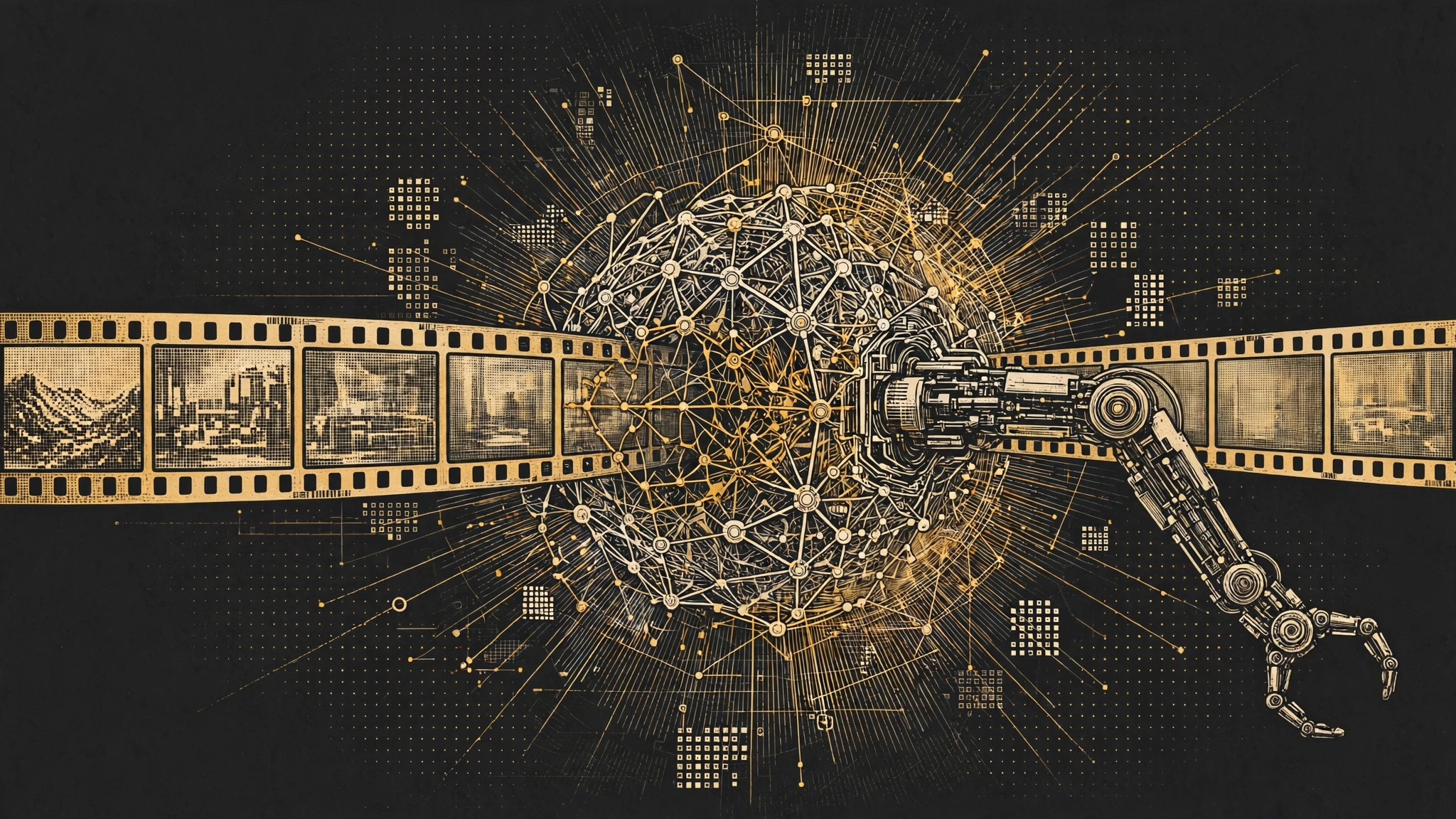
The standard stack today is a pipeline: a planner model thinks, then delegates to specialist models for images or video. Each handoff adds latency, and each specialist only ever sees a narrow request, not the full context. Rho-1 collapses that arrangement. Text, vision, and robotic actions are unified as tokens in a single context window, and every turn reads from and writes to the same state.
Reka's demo makes the argument concrete. One five-turn session: the model draws a coastal lighthouse scene, puts a box around the lighthouse, animates the scene into a video, re-renders that video as a snowstorm while keeping the camera move identical, and then explains in words what changed between the two clips. Normally that spans a generator, a detector, an editor, and a captioning model. Here it is one set of weights. The edit is especially telling: when asked what changed, the model isn't captioning exported frames after the fact. It reads the latent state that produced the change, so the answer is grounded in what it actually generated.
The numbers Reka chose to show
Speed is the claim they pushed hardest. Base Rho-1 generates video at 0.79× real-time (median), with a watchable stream starting in roughly six seconds. A distilled variant cuts the denoising trajectory from 99 steps to 8 "with minimal quality loss," and in Reka's internal testing it returned a 5.3-second clip in about a second, which the company says is faster than any other video model it timed.
Then there is the editing demo: a "Rho-1 Flash" variant revising a snowy-dog prompt five times, with versions landing in roughly one to two seconds each. Treat all of these as directional. They are Reka's own measurements on Reka's own tasks, published alongside a research preview. Nobody has independently timed this yet, and a distilled model that keeps 99-step quality in 8 steps deserves the same skepticism any compression claim gets.
Steering the stream
The part that actually feels new is continuous steering. Rho-1 streams video clip after clip, each picking up exactly where the last left off, so time inside the simulation never stops. A command enters the understanding stream, updates the underlying state, and moments later the generation stream renders the new trajectory. Reka's demo: one opening half-second of shared frames, then a "bank left" command on one branch and "bank right" on the other. The world shifts without a single cut.
The applications they name are sensible, if early: generative environments spun up on demand to test autonomous driving or robot policies, and steerable livestreams where the boundary between viewer and director dissolves. This is the "world model" pitch, and it is also where the copy gets ambitious. Reka calls this kind of unification "the core prerequisite for physical AGI." That is a belief, not a result.
The robotics half of the bet
Because physical actions and future video frames decode from the same latent state, the network predicting future camera observations is the same network dictating joint actuation. No ad-hoc robotics wrapper. To deal with the scarcity of robot training data, Reka pairs this with an inverse dynamics model that infers control signals from ordinary internet video, turning web-scale footage into action-labeled pretraining data.
It is worth noting the corporate footnote: Reka's page says Moonvalley and Reka consolidated their individual talent in vision models and text-to-video to form a joint entity, and this is their first joint model. Moonvalley is a name video-generation watchers know. This release is as much a consolidation announcement as a model announcement.
The limitations section is worth reading
Unusually for a model launch post, Reka published its failure modes. Long-horizon drift: a 30-second stream can keep photorealistic texture while drifting into a structurally incompatible room layout. Object grounding works on static images but not yet across video. Targeted editing, for all the Flash demo's speed, is "nascent" and brittle across diverse prompts. And native video rollouts are capped at 672×384. That last number frames everything above: one-second edits are less impressive when the output is roughly the resolution of a 2006 YouTube clip.
So: a genuine architectural idea, an honest limitations list, and footage too small to ship. The idea worth watching is the collapse of the pipeline into a single state. The model itself is early, preview-stage, with no announced product, API, or pricing. If the 99-step-to-8-step compression holds up under independent testing, that is the number to check first. Resolution can be scaled. A state that never drops the thread cannot be bolted on later.
Sources
- [1] Reka AI Labs — “Rho-1: Collapsing the multimodal stack” (Oct 5, 2026)Read source
- [2] The Decoder — “Reka AI's omni-model Rho-1 handles text, images, video, and robot control in a single model” (Oct 5, 2026)Read source