The vertical is the product
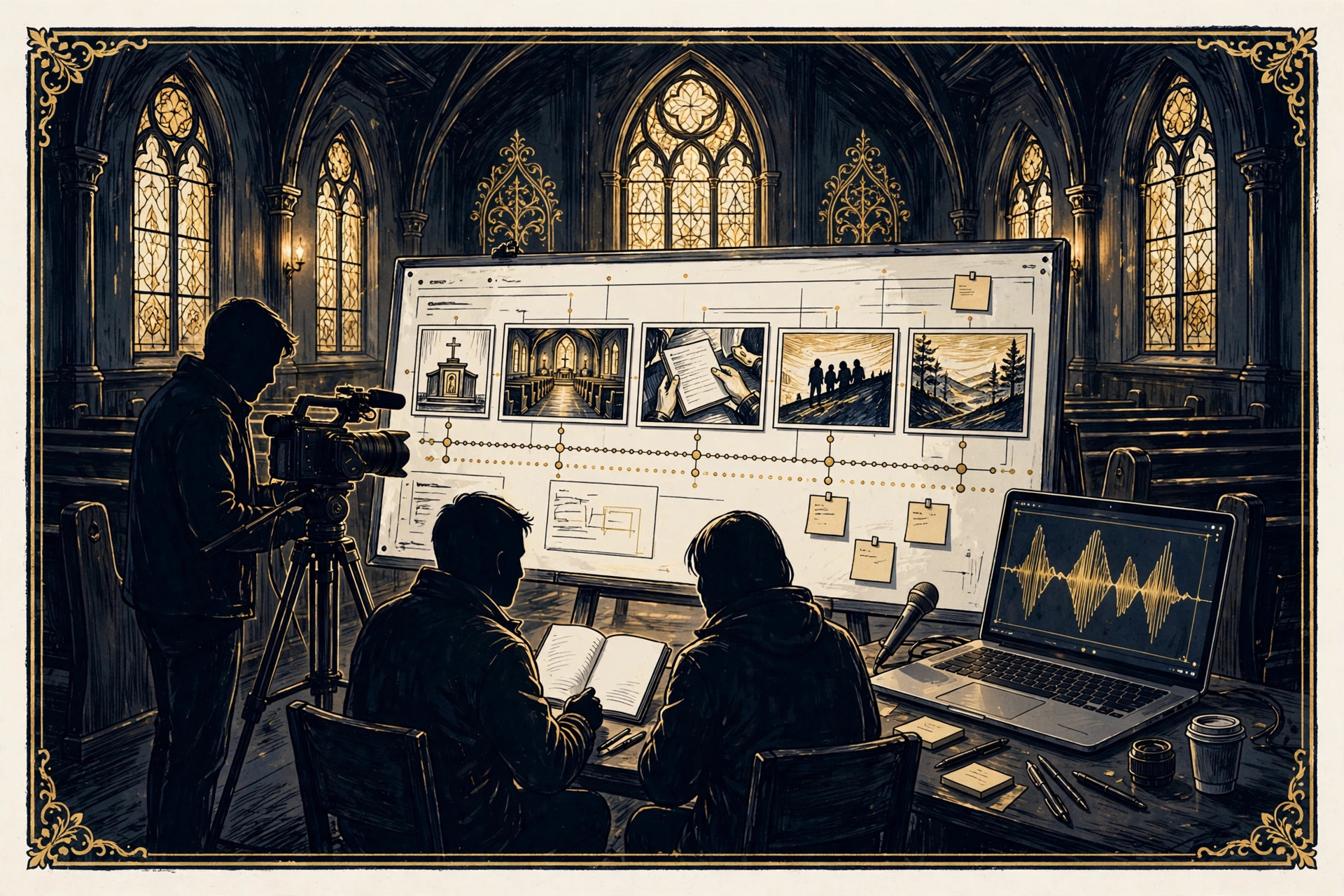
Most AI video studios compete by piling every new model into the same blank canvas. Pray Production Studio takes the opposite route. It starts with a sermon, teaching or Bible story, turns it into a shot plan, and carries the project through generated images, video, voice, music and an editor-ready export.
That is a better pitch than “make anything.” A church media team does not need another prompt box. It needs Sunday’s message cut into scenes before the next Sunday arrives.
PRAY.COM says the system comes from the production workflow behind AI Bible, its short-form scripture video series. The company reports more than 250 million views and a pace of roughly 150 videos a month. Those numbers come from the launch announcement and are not independently audited, but they still explain why this product feels less theoretical than most AI-video launches: the tool was built around a repetitive production line before it was sold as software.
It packages the boring parts
The model access is not the differentiator. PPS lists Google Veo, Kling and Seedance among the generators available inside the studio. Any well-funded aggregator can add those APIs.
The useful layer sits above them: project-level memory, reusable character libraries, automated prompting, scene planning, stock media, voice generation, sound design and exports for Premiere Pro and Final Cut Pro. In other words, it tries to preserve continuity across an entire production rather than return a handful of unrelated eight-second clips.
That matters because consistency is where a one-shot demo becomes production work. A creator can forgive a strange frame. They cannot build a weekly series around a character whose face, clothing and setting reset every time the model runs.
Churches are an unusually clean wedge
The target customer already has the raw material. Churches create an hour of spoken content every week, often record it, and then need clips, children’s material, discussion prompts and social posts to keep the message circulating. The constraint is rarely a shortage of ideas. It is the labour between the sermon and the feed.
This is also a market where the person running communications may be a small staffer or volunteer rather than a full production department. Resi Media arrived at the same problem from live streaming: its Studio AI turns services into clips, transcripts and metadata. Pulpit AI and other church tools turn sermons into newsletters, devotionals and social material. PPS is entering an existing workflow category, not inventing demand from scratch.
The weekly cadence is the strongest part of the fit. SaaS products become habits when the job repeats, the deadline is fixed and the input keeps arriving. Sunday provides all three.
The $19 headline is only the door
PPS says subscriptions start at $19 a month. Its site describes monthly credits and premium-model access, but the launch material does not establish how much finished video a typical plan buys, how often generations need to be redone, or what a full ten-minute production costs after model consumption.
That missing unit economics matters. Generating a coherent sequence is not one prompt. It is many shots, revisions, voice passes and failed outputs. A low entry price can make the product easy to try while credits determine whether it is practical to use every week.
The time claim deserves the same treatment. PRAY.COM says a small team can finish work in a single afternoon and markets a sermon-to-film turnaround of about a day. That is plausible for a short, template-driven piece. It is not evidence that a volunteer can reliably produce a polished cinematic film on Monday without editorial skill. The export to professional editors is a tacit acknowledgement that generation is not the end of the workflow.
The moat is taste, not model access
PRAY.COM’s advantage is a defined customer, a catalogue that trained its process, and a distribution channel into ministries. None of those prevents Canva, Adobe, an AI-video aggregator or a church-software incumbent from copying the feature list.
The defensible part, if there is one, will be workflow judgment: which moments in a sermon deserve scenes, how a visual treatment stays theologically and culturally appropriate, and how much automation a ministry team is willing to trust. The company’s models can be rented by rivals. Its accumulated production decisions are harder to reproduce.
That is the lesson beyond churches. Vertical AI succeeds when it removes decisions from a recurring job, not when it merely places a general model behind a niche landing page. Pray Production Studio has found a credible wedge because it knows what arrives on Sunday, what needs to leave by Monday, and who has to get it done. Whether the economics hold after the first month of credits is the test that comes next.
Sources
- [1] Newsfile — “Churches Can Now Turn a Sunday Sermon into a Cinematic Film by Monday” (Oct 6, 2026)Read source
- [2] Pray Production Studio — product overview and plansRead source
- [3] The Christian Post — “Resi’s Studio AI promises to help churches boost engagement” (Nov 12, 2025)Read source