The pitch: directing instead of prompting
The standard AI video workflow is a loop of waiting. You write a prompt, wait, watch what comes back, rewrite the prompt, and wait again. The feedback loop is measured in renders, and each render is a fresh roll of the dice on everything you did not change.
Enact is Pika's attempt to break that loop. The scene never stops generating. You reach in with the mouse and move an actor while the shot is playing. You tell a character to move closer to the woman he is arguing with, and he does it in the same take. You rehearse, give notes, and when the performance feels right you call "Action" and the system generates a fresh, clean performance from the rewritten rehearsal, starting from the first frame. The camera is live too: per Pika, you steer it with the mouse, panning, dollying in for a close-up, or orbiting around the subjects while the scene plays.
As a description of where this medium could head, it is persuasive. Prompting is a poor substitute for directing. The question is what the demonstration actually rests on.
Three ways to interrupt a take
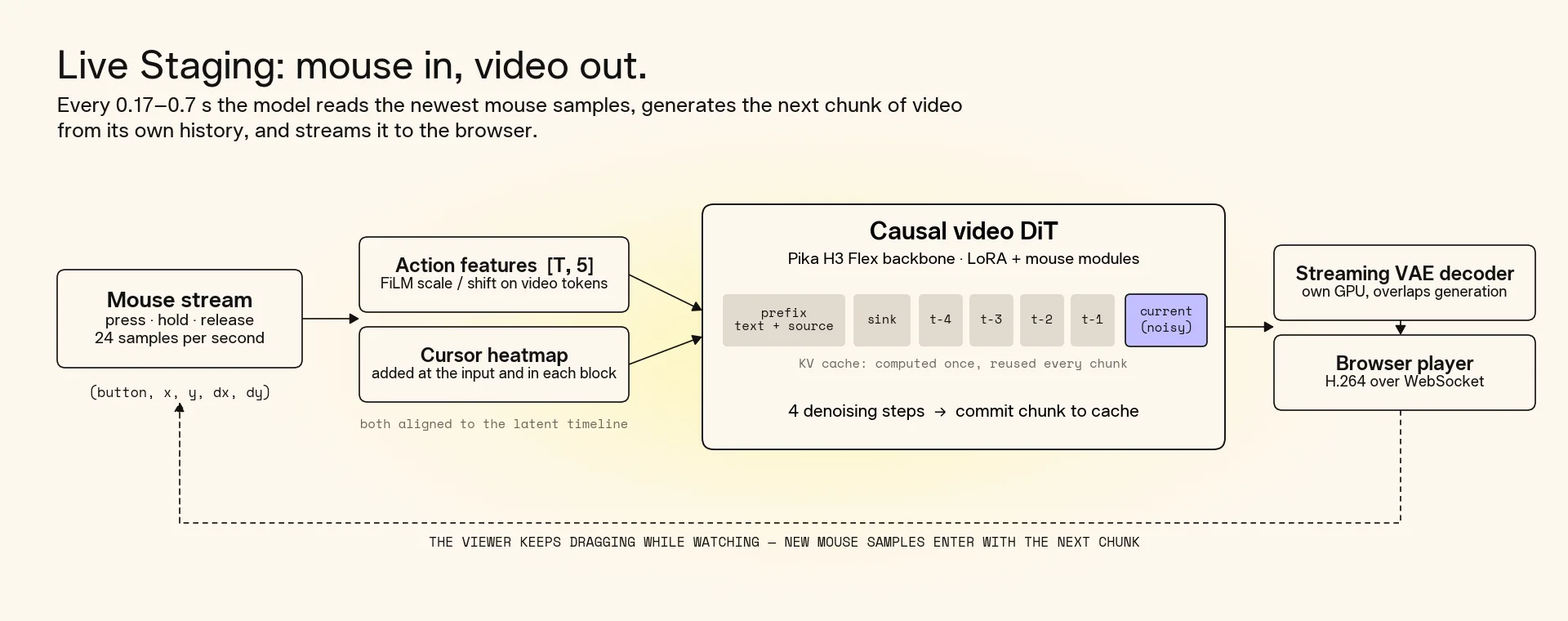
Live Staging is the most concrete of the three modes. Dragging a person across a playing scene sounds like a compositing trick, but Pika's post describes generation, not cut-and-paste: the dragged subject's pose, lighting and shadows are regenerated against the new surroundings, the space it vacated is filled in, and the subject reacts to being carried, shifting weight mid-air before settling. The training data is synthetic by necessity, built from 3D stand-ins animated along drag paths, because no real footage comes with frame-level cursor trajectories attached.
Live Actor Direction puts a script model between the director and the video model. Your note is translated into structured beats (action, dialogue, emotion, gaze, lighting), and the actors answer in character, in their own voices, while the take continues. Pika says each actor keeps session memory of your notes, so direction accumulates instead of restarting. When you call "Action," the script model rewrites the rehearsal exchange into a single uninterrupted performance, generated fresh from the first frame. That is a new generation from the rewritten script, not a guarantee that the exact rehearsed take is reproduced.
Live Camera Control generates the scene from scratch. An appearance image anchors the cast and set, while a lightweight 3D motion proxy, an untextured Blender viewport, guides the camera path. Performance and camera path are separate inputs, which is the filmic idea here: the acting does not have to be recreated to change how it is shot.
What the speed claims rest on
The numbers are specific, and they deserve the same reading as any benchmark: check the hardware and the resolution before the multiplier. Every figure below is Pika's own, from its own tests.
Staging generation runs at 1.8× playback speed "on a single server." The server is not specified; the separate latency figure, a picture response in under 0.4 seconds including decoding, is for the low-latency setting on an H100, a data-center GPU, in a configuration Pika tuned for latency by shrinking chunks to 0.17 seconds.
The camera figures are the most informative in the post, because they state their conditions. The Live Camera Control test ran at 640×480 at 24 frames per second, standard-definition television resolution, on a node of eight B300 GPUs, Nvidia's current top-end data-center parts, generating at 1.50× real-time speed. The engineering is impressive. It also marks how far "real time" currently reaches in Pika's own testing: the stated test is 480p on a full data-center node, and the post reports no test at broadcast resolution or on smaller hardware.
There is a quality cost as well. In The Neuron's interview coverage of the preview, CEO Demi Guo acknowledged that the interactive real-time model is slightly lower in image quality than the non-real-time version. Separately, Pika's post describes the streaming model as distilled from twenty sampling steps down to a few. Whether the step reduction accounts for the quality difference is not something the sources establish; both facts are on the record, and the connection between them is not.
What you can do with it today
As a consumer, nothing yet. Enact is a research preview, unavailable for consumer use, with an enterprise contact address where a signup would normally be. The announcement gives no price, no release date, and no statement about when, or whether, the three modes reach the Pika product that consumers pay for.
That does not make the announcement empty. In the same week, Google began rolling Genie 4 out to eligible Google AI Ultra subscribers, pushing at interactive generation from the world-model side: environments you can act inside while they generate. Two labs showing interactive generation in the same week is worth noticing, without settling where the market is headed.
For creators, the practical read is narrow. Do not plan a production around directing live AI actors in 2027 on the strength of this post. Do notice that Pika built Enact on H3 Flex, an open-weights model whose weights are already public (ALFW covered the release in October). The interaction layer is the research; the base model is downloadable. Pika also describes streaming techniques with wider application: few-step causal chunks, self-forcing distillation, and, in the staging architecture, a sliding cache with re-based positional embeddings that the post says keeps sessions running at constant cost. If those techniques travel with future releases, the gap between this preview and something runnable will close from both ends.
Sources
- [1] Pika, "Research Preview: Pika Enact," pika.art, November 18, 2026Read source
- [2] The Neuron, "WATCH: Pika lets you direct AI actors live," November 18, 2026 (interview with CEO Demi Guo, including the image-quality tradeoff)Read source
- [3] The Rundown AI, "Pika previews Enact for directing AI video in real time," November 19, 2026Read source