
The arithmetic inside "always-on"
The pitch is continuity. The funding is a monthly bucket.
Perplexity's credits guide is unusually plain about what Computer work costs. A quick fact runs 15 to 70 credits. A multi-step research report runs 350 to 950. A data dashboard runs 2,400 to 9,800. An entire app or a multi-day build runs 15,000 credits and up. The guide adds, in its own words, that these are examples, not guarantees, and that parallel agents, large files and frequent automations push a project toward the expensive end. Teammates are, by design, parallel agents running frequent automations.
Set that against the allocation. Max includes 10,000 credits a month. At the upper end of Perplexity's illustrative range, a single dashboard could consume 9,800 of the recurring 10,000 monthly credits, or 98% of the allocation. Its example multi-day build starts at 15,000 credits, already exceeding one month's allowance. These are indicative costs, not fixed prices, and actual consumption depends on the workload and agent configuration. When the credits run out, the guide says active tasks pause (they are not canceled, and they resume when credits arrive), new tasks are blocked, and monthly credits do not roll over into the next cycle. The escape valves are deliberate purchases: manual top-ups, or auto-refill, which is off by default, triggers at 2,500 credits for Max, and runs into a default spending cap of $200 a month that the user can raise to $5,000.
There is an important qualification for new subscribers: Max also includes a one-time 35,000-credit bonus. That makes the initial allocation materially larger than the recurring 10,000-credit monthly allowance, but it does not change the economics after the bonus is exhausted. A buyer evaluating whether a teammate can become part of a regular workflow should budget against the recurring allocation, not the introductory balance. Perplexity's credits guide states that the bonus is one per account and expires in about 30 days.
None of this makes the product incoherent. A teammate assigned to watch one Slack channel and draft replies will live comfortably inside 10,000 credits. But "around the clock", the phrase the coverage reaches for, describes the intention, not the budget. What a subscriber is actually buying is a standing instruction with a meter behind it, and the meter's own price list is the most informative page Perplexity published this week.
A team-shaped product, sold to individuals
The second limit is who can buy it. Teammates are presented as staff: the product page staffs a one-person denim business "like a team of four", with a sales teammate, an operations teammate, a marketing manager and a finance teammate, each with rules for when it acts alone. The CEO's stated ambition, reported by The Verge, is that "every org having hundreds of teammates working for each person".
The launch itself is narrower. The help article's rollout section states that the research preview requires an individual Max subscription, and that it is not a Pro feature. During the research preview, Enterprise Pro and Enterprise Max accounts are not included by default. Enterprise users must ask their administrator to request access; this is a rollout restriction, not evidence that enterprise availability will remain excluded after the preview. A teammate's chat is visible to its owner, and chats shared with others are read-only for them, although people can work with a teammate inside the Slack channels it monitors.
So the team in the launch is a team of agents belonging to one person, not a shared workspace deployment an organization can roll out this week. That may be the right way to preview a product that acts on its own. It also means the comparison the launch invites, with OpenAI's and Anthropic's work agents, is a comparison of individual subscriptions at this price point: $200 a month month-to-month, or $167 a month billed annually, per person.
What a teammate is, in the documentation
Strip the staffing metaphor and the documented object is specific. Creating one is a sidebar action (see the help center screenshot below): a name or role, optional instructions and starting tasks, then a dedicated chat thread where its work is directed and reviewed.
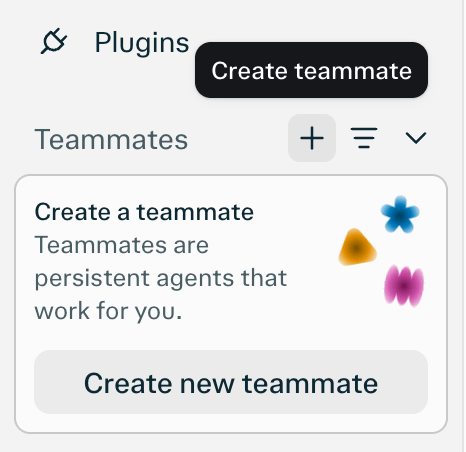
Each teammate runs on a separate computer environment with its own desktop, browser and cookies. Perplexity says these sessions are isolated from one another and that saved credentials are encrypted and cannot be viewed by the teammate. Access follows the permissions of the plugins and Projects the owner has already installed, which cuts both ways: setup is short, and the review the help article recommends, selecting only the repositories a teammate needs when GitHub asks, is the security decision, made once at connection time.
A teammate can start when something changes in Slack, GitHub or Linear, and follow up on its own pull request's review comments. The owner can take over its desktop and browser work when needed. The default model is Claude Opus 5.5, changeable per teammate.
Ten thousand created, one thousand active
The demand evidence offered at launch comes from Perplexity's own internal figures, reported by secondary outlets citing CEO Aravind Srinivas. He said approximately 10,000 teammates had been created in the company's internal workspace during the previous 30 days, equivalent to about 20 times its headcount. He also reported approximately 1,000 active teammates on November 4, the day before launch. The original posts were not independently reviewed for this article.
Both numbers can be true, and they measure different things. Creating a teammate is a few clicks, closer to naming a role than hiring for one. The active figure, a tenth of the created figure on the day before launch, is the one that describes use. Neither figure establishes what the teammates completed, how much they cost to operate, or how many remained in regular use after the initial setup. These are company-reported internal activity figures, not independently verified adoption or productivity results.
How to test it without buying the metaphor
Give a teammate one job with a checkable output: triage one alert channel, or summarize one project's updates every Monday. Both examples are Perplexity's own. Run it for two weeks, then read the Usage page before the teammate's reports: credits spent, against work you would have accepted from a person. Track credits consumed per completed task, not simply credits consumed per day. An inexpensive agent that repeatedly produces work requiring human correction may be more expensive in practice than a higher-credit agent that delivers usable results. If the job survives that audit, give it a second one.
Sources
- [1] Perplexity, "Get started with Perplexity teammates" (help center, updated November 5, 2026; read first-hand at Gate 1: research preview for individual Max subscribers, Enterprise Pro and Enterprise Max not included by default with an administrator-request route, capabilities and multi-agent orchestration, isolated computers, saved credentials encrypted and not viewable by the teammate, default model Claude Opus 5.5, and the article's Figure 1 create-teammate sidebar screenshot)Read source
- [2] Perplexity, "Perplexity Teammates | Agents Designed for Work" (product page, read first-hand at Gate 1 on November 6, 2026: "Available now for Perplexity Max subscribers on web", desktop and mobile coming soon, role vignettes for Sales, Ops, Marketing and Finance presented as vendor illustrations, including the one-person denim business staffed "like a team of four")Read source
- [3] Perplexity, Pricing page (read first-hand at Gate 1 on November 6, 2026: Max at $167/month when billed annually, 10,000 monthly credits, 35,000 bonus credits; the page lists no month-to-month Max price)Read source
- [4] Perplexity, "How credits work on Perplexity" (help center, read first-hand at Gate 1 on November 6, 2026: 100 credits = $1, typical task ranges with the statement that these are examples, not guarantees, monthly credits do not roll over, active tasks pause rather than cancel when credits run out, auto-refill off by default with a 2,500-credit Max trigger and a default $200 monthly spending cap adjustable to $5,000, and the one-time bonus stated as one per account, expiring in about 30 days)Read source
- [5] The Verge, "Perplexity launches its own take on AI agents for work" (November 5, 2026, via secondary reports read November 6; $200/month Max requirement, comparison with OpenAI's Dots and Claude Duet, Srinivas's "hundreds of teammates" remark)Read source
- [6] AI Affairs, "Perplexity launches Teammates agents for ongoing work" (November 6, 2026; Srinivas's announcement timing and internal count: about 10,000 teammates created in 30 days, 20x headcount, about 1,000 active on November 4)Read source