The number that does not fit the shortage story
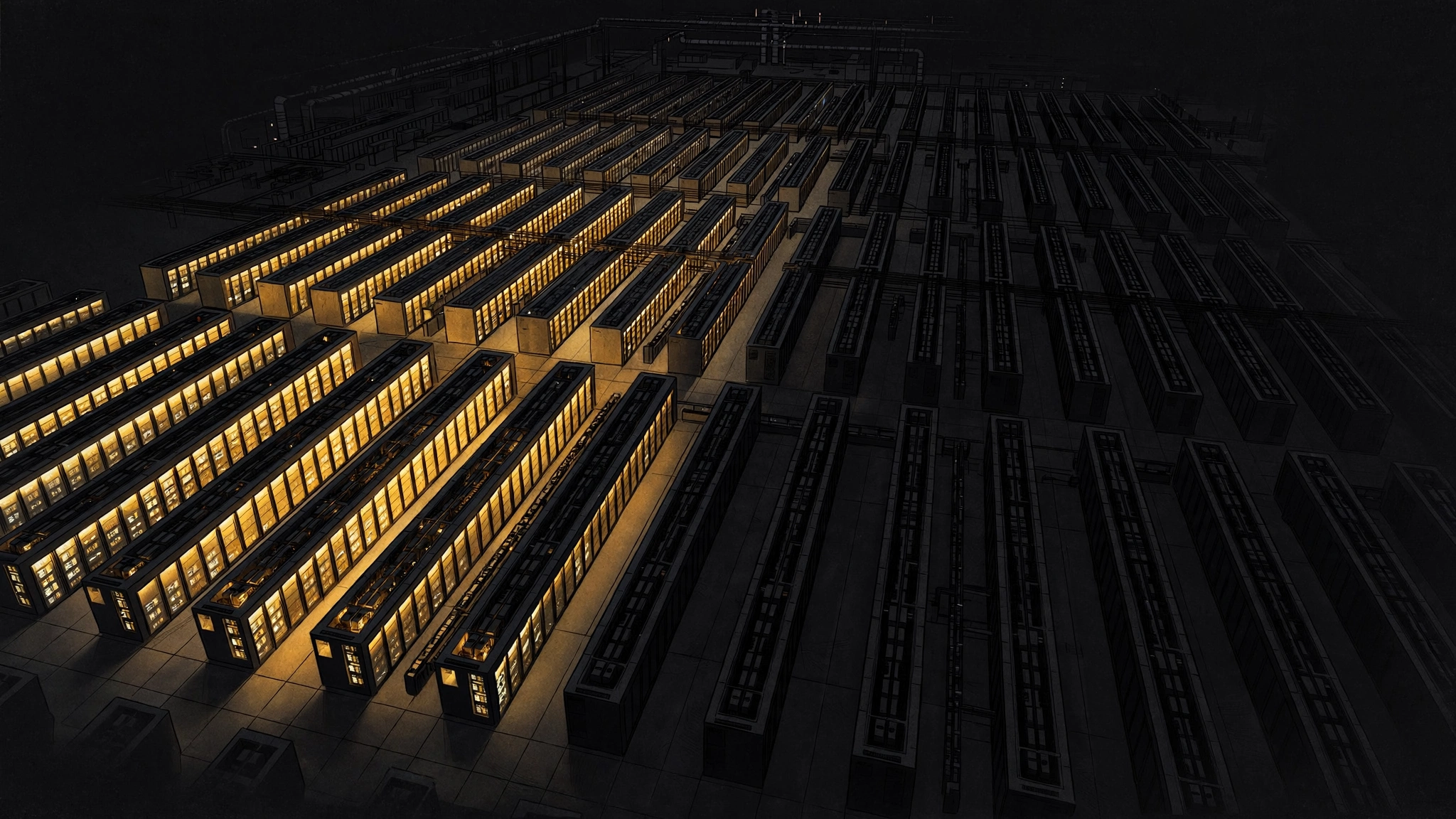
Most AI infrastructure news runs in one direction: demand outrunning supply, operators racing to build, gigawatts announced years ahead of delivery. Octave Klaba gave Reuters the opposite figure on Tuesday. OVHcloud has 250 megawatts of capacity connected. Of that, 140 megawatts is in operation. The remaining 110 megawatts, he said, is ready to take on new business.
The arithmetic is straightforward: 110 MW is 44% of the reported 250 MW connected total, which explains Reuters' "about half" framing. But that percentage describes the relationship between the CEO's reported figures, not a verified utilisation rate. The report does not specify exactly what operational state qualifies the 110 MW as "ready" — powered and fitted out, or connected and buildable — so it cannot establish how much capacity is immediately deployable or economically idle. Treat the figure as a CEO's statement after an earnings report, which is what it is.
The commercial argument is straightforward: capacity that is already connected and available for onboarding may be easier to sell than capacity that still requires construction. But the report does not establish how quickly a new customer could bring a workload online, or provide a like-for-like comparison with a rival's announced future capacity. The 110 MW figure is a potential near-term commercial advantage, not proof of a specific deployment timeline.
One limit on this story should be stated plainly. These figures come from Klaba's statements to Reuters, not from an independently verified capacity-utilisation dataset. OVHcloud's own FY2026 results release, published the same day, confirms the 250 MW connected and 140 MW in operation and says the group has "headroom for growth without needing to build new sites" — but it does not use a 110 MW figure, does not define what "ready" means operationally, and publishes no utilisation breakdown. The 110 MW, the model timeline and the policy comments below rest on the Reuters report alone.
A first model, dated but not described
The same interview gave OVHcloud's model effort a date: early 2027 for its first AI model, built as a mixture of experts, the design that routes each task to specialised sub-models rather than running the whole network every time. That is the full extent of the disclosure. No name, no parameter count, no training data, no price, no benchmark, and no statement of whether the model will be open, hosted only, or sold inside OVHai Workspace.
The sequence Klaba described is worth noticing. The product comes first: OVHai Workspace, a workplace platform running apps such as email and tuned on OVHcloud's own internal data, gets its first pilot shortly. The model follows next year. That is the reverse of the usual launch order, in which a model is announced and the product is assembled around it afterwards. It also means the first test of OVHcloud's AI work will be a workspace tool judged on ordinary usefulness, not a benchmark chart.
Klaba had told Reuters in June that the company was training its own models on Jupiter, which he described as Europe's fastest supercomputer, and framed OVHcloud as a potential European challenger to Mistral. That framing should be held loosely until something ships. Mistral already has released models and commercial API offerings. OVHcloud, on the timetable its CEO gave Reuters, has a forthcoming model, a stated mixture-of-experts architecture and a workspace pilot due first. That is a difference in what has been announced and made available, not yet a like-for-like comparison of model quality or commercial traction.
The spare capacity and the policy argument are the same argument
Klaba used the interview to repeat his criticism of Europe's state-backed compute programmes. Their financing, half from the EU and half from member states, pushes projects toward national initiatives, he said, and has produced a race of national data centre projects, none backed by a customer base to match. Last month, Klaba called national strategies for the EU's planned AI gigafactories "doomed to failure" and argued that a proposed €200 million public commitment to buy AI services over five years was too small to underpin the private investment he believes is needed. That is his assessment of the programme, not an independently established funding requirement.
Place that next to the 110 megawatts. A chief executive with spare connected capacity has a direct commercial interest in arguing that governments should not fund more capacity. That does not make the argument wrong. A project race with no matched customer base is a recognisable failure mode, and the man pointing at it is at least pointing from inside the market rather than from a ministry. It does mean his two headline claims — we have room, and Europe is building rooms nobody needs — should be weighed as one position, not as two independent observations that happen to agree.
What to watch
Three things are worth tracking. Whether the OVHai Workspace pilot appears as promised, and what OVHcloud's internal-data tuning actually produces. Whether the first model arrives in early 2027 with a name, a size and terms — enough technical and commercial detail to evaluate it — or slips. And whether OVHcloud's next earnings disclosures show the 110 MW figure declining as new customers come on board. If a similar amount remains available, the next question is whether that reflects weak demand, newly added capacity or a different definition of "ready". The figure becomes a useful market signal only when it can be compared over time on a consistent basis.
A note on sources
This article relies on Reuters' 20 October 2026 report for the 110 MW figure, the model timeline and Klaba's policy comments. OVHcloud's own FY2026 results release, published the same day, confirms the 250 MW connected and 140 MW in-operation figures and the "headroom for growth" framing, but does not use a 110 MW figure and publishes no utilisation breakdown. Euronext Live carried the same Reuters wire and is not independent corroboration. The 110 MW figure is a statement by OVHcloud's CEO, not independently verified utilisation data.
Sources
- [1] Reuters (Leo Marchandon, Gdansk; editing by Milla Nissi-Prussak), “Half of OVHcloud capacity is available, AI model launching in early 2027, CEO says”, published 20 October 2026 — the 110 MW “ready” figure, the no-construction onboarding pitch, the early-2027 mixture-of-experts model, the OVHai Workspace pilot timing, the June Jupiter remarks, and Klaba's reiterated gigafactory criticism including the €200 million figureRead source
- [2] OVHcloud, FY2026 annual results release, “All 2026 targets achieved, excellence in execution, focus on value creation”, published 20 October 2026 — confirms 250 MW of connected power capacity, of which 140 MW in operation, with “headroom for growth without needing to build new sites”; it does not use a 110 MW figure and publishes no capacity-utilisation breakdownRead source
- [3] Euronext Live, same Reuters wire, published 20 October 2026 — carried the same wire verbatim; not independent corroborationRead source