
The website asks, your computer answers
Most web AI works the same way: a site sends your request to a company's servers, pays for the computation, and sends an answer back. WebAI reverses the direction. A website or extension asks the browser for AI, and a model already on your computer does the work. Opera's three developer APIs cover generating text, classifying content, and finding relationships between pieces of content. Its example uses are small and practical: an extension that sorts your tabs, flags clickbait, or spots job posts that match what you are looking for.
That reversal is the actual news here. Browsers have run local models in experiments before, and Opera itself shipped local-model access in a developer build in 2024. What changed on October 27 is the audience and the interface. The feature is in a mainstream browser's settings, aimed at any developer, with six sample extensions published to copy from. Under Opera's design, developers can add local AI inference without operating their own inference servers or paying a cloud provider per WebAI inference request. Other application infrastructure and costs remain separate. Those costs do not vanish. They move.
The permission is the product
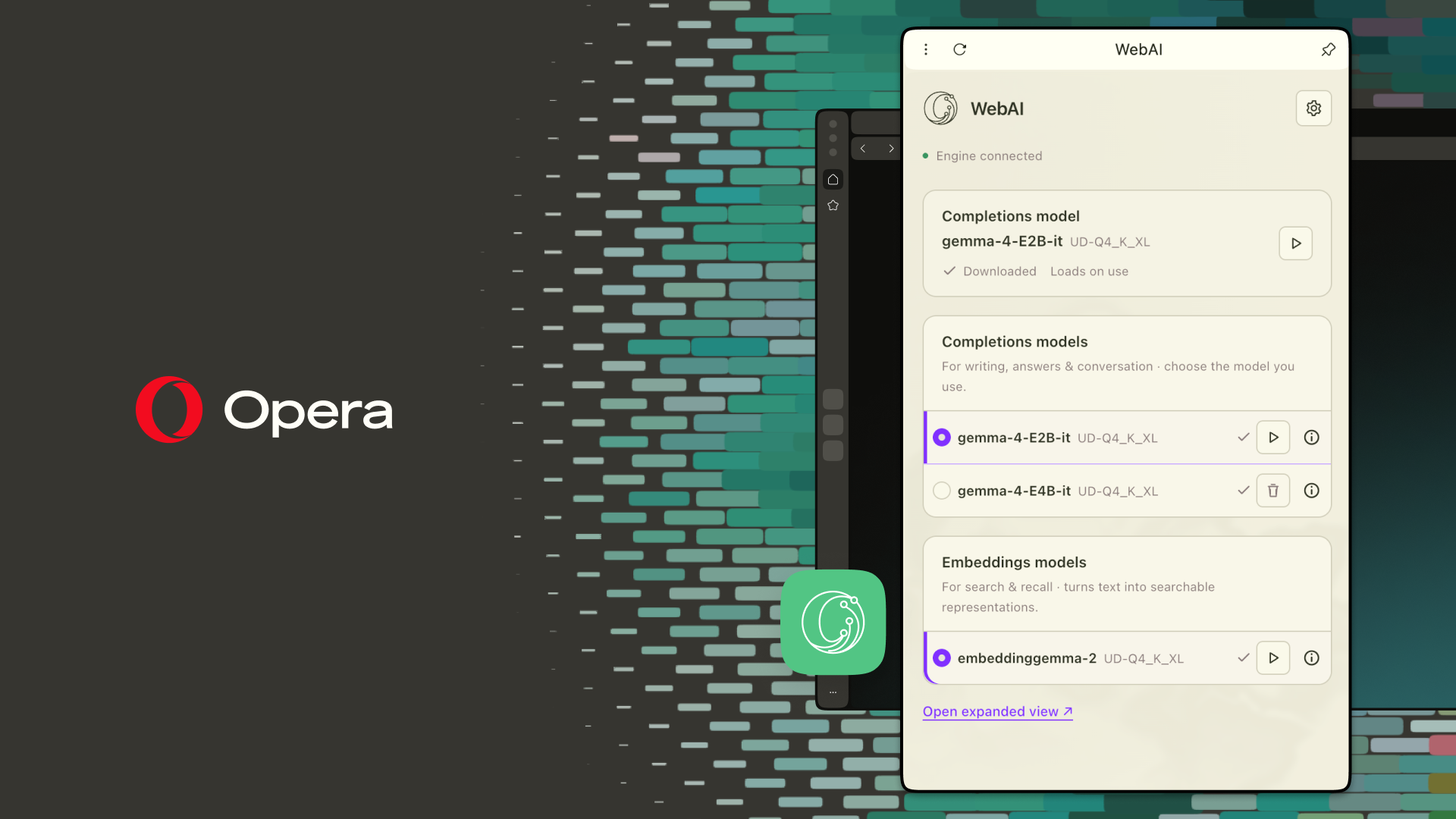
Opera has built the controls the right way round, and they are worth reading as part of the announcement rather than as footnotes. WebAI is off until a user turns it on. Turning it on downloads a local model, which can take a few minutes. After that, each site needs its own permission before it can use the local AI. A user can turn the whole thing off again in settings.
Per-site permission addresses an important part of the risk: a website must receive authorization before accessing WebAI. It does not, by itself, establish limits on resource consumption or guarantee that a permitted site will use the capability responsibly. It also sets the limit of the privacy claim. Opera says WebAI inference runs on the user's device, so the content processed for those local AI tasks does not need to be sent to a cloud inference provider. That does not establish what a permitted website might collect or transmit through its other functionality. The permission click is the decision, and WebAI makes you the one who clicks it.
A proposed standard, on a short list of machines
Two qualifications decide how much of this a reader can use today. The first is status. WebAI is, in Opera's own words, a proposed web standard. Opera says the proposal is backed by companies such as Google and Microsoft. Neither company published a statement with this launch, and no other browser announced support in the material released on October 27. Until one does, WebAI is an Opera feature with a standards ambition attached, and developers who build on it are building for Opera users.
The second is reach. The preview runs on 64-bit Windows PCs and on Macs with Apple silicon. Intel Macs, Linux and Windows on Arm are out. Opera's launch materials conflict on availability. The press release says Opera One receives the preview first, with GX and Neon to follow; the developer blog's introduction says the preview is available across all three, although its setup instructions cover only Opera One. Readers seeking to try the feature immediately should follow the documented Opera One setup path until Opera clarifies the other browsers' status. And Opera gives no minimum specification beyond the platform list, only a warning that speed depends on your hardware. A model that runs acceptably on a recent laptop and slowly on an older one is the same feature with two different values, and Opera has not published the line between them.
Sources
- [1] Opera, "Opera adds local AI to its browsers," Opera Newsroom, October 27, 2026 (local AI shipping, WebAI as a proposed standard, Gemma and Apple on-device models, opt-in and site-specific permissions, supported platforms, Kolondra quote, 2024 developer-build history; read in full first-hand this run)Read source
- [2] Opera, "WebAI: Local AI for the web, now in Opera," Opera developer blog, October 27, 2026 (Prompt, Decision and Semantic Embeddings APIs, how-to steps and model download, six example extensions, platform exclusions, hardware-dependence note; read in full first-hand this run)Read source
- [3] TechCrunch, "Opera introduces a new web standard to let users deploy AI locally in their browser," October 27, 2026 (independent launch coverage; open-weight restrictions and hardware trade-off; cross-check only)Read source
- [4] Digital Trends, "Opera wants websites to run AI on your laptop instead of sending your data to the cloud," October 27, 2026 (disabled by default, per-site permission, no disclosed minimum performance requirements beyond supported platforms; cross-check only)Read source