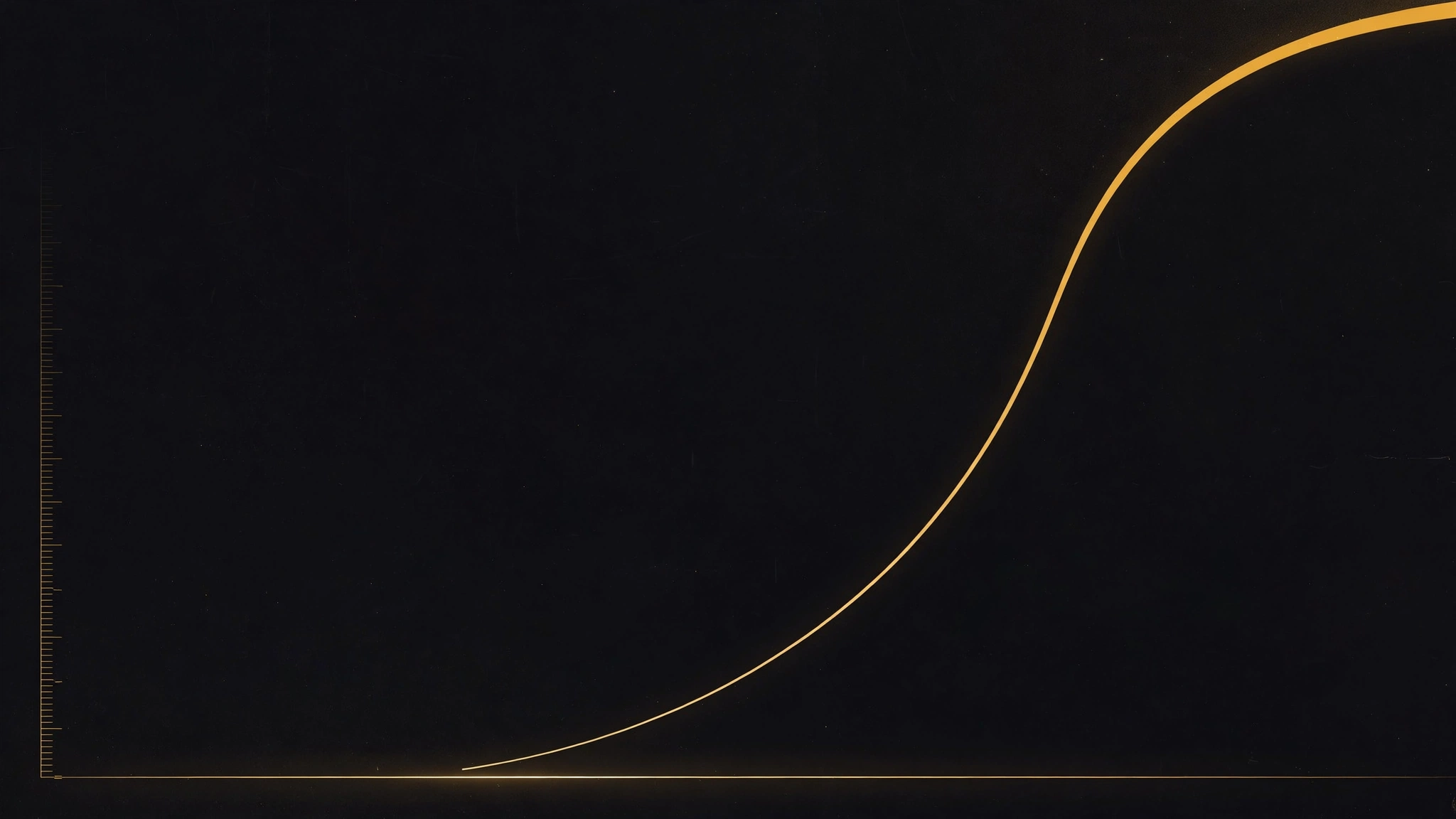
Selected readings from a number OpenAI tracks internally
Perplexity measures how well a model predicts the next token on text it has not seen. Lower is better, and OpenAI tracks the logarithm of it, also called cross-entropy loss, on a held-out dataset. Pachocki's post walks selected readings down the company's own history. At about 0.99, GPT-3.5 could hold a fluent conversation and became the basis for the original ChatGPT. At about 0.91, GPT-4 could use chain-of-thought reasoning productively, which the post says motivated the subsequent targeted elicitation of that capability and the creation of modern reasoning models. Below 0.8, he writes, transformative capabilities appeared in cybersecurity and mathematics. At about 0.76, a model started producing groundbreaking results on open problems the lab had been posing to its systems for more than a year.
His argument is that this one pretraining number has stayed informative while task benchmarks saturate and get replaced. Readers should note whose dataset the readings come from: it is OpenAI's own held-out set, reported by OpenAI, and the capability labels attached to each reading are Pachocki's account of OpenAI's own models.
The proposal, stated precisely
Pachocki asks frontier developers to do three things together: establish shared norms for evaluating very capable models and red-teaming their safety cases by the time they are first used, adopt shared transparency standards, and accept common limits on development, measured by perplexity and other measurements tracked across labs, with a defined milestone that must be reached before anyone goes past the first limit. The milestone he names as an example is a successor to chain-of-thought monitors.
What the post does not contain matters as much. It does not set the numerical value of the first limit. The 0.68 to 0.70 window is where Pachocki expects the next transformative capabilities to appear; he does not designate it as a cap, and he says he does not know what those capabilities will be and that labs may not be testing for them today. The post names no enforcement mechanism, reports no participating lab other than OpenAI, and does not say OpenAI has itself adopted a limit. Altman amplified the post on X, calling it, as TechCrunch reported, the most important thing OpenAI has published in a while. Amplification is not adoption, and no rival lab had publicly committed to the framework at the time of writing.
The weaknesses are in the post itself
To Pachocki's credit, the post lists the problems with its own metric. Labs train on different data mixtures and evaluate on different datasets, so a perplexity reading from one lab is not directly comparable to another's. Perplexity does not correspond to any task anyone cares about; it is a proxy, valued because new capabilities have tended to emerge as it falls. It misses gains made outside pretraining, including chain-of-thought reasoning itself. And its floor is unknown: nobody knows the inherent entropy of the data, so nobody knows how much room is left on the scale.
That last point is where the practical difficulty sits. Pachocki notes that as the floor approaches, smaller gains in perplexity will correspond to larger leaps in capability. Choosing a threshold therefore means choosing a number on a scale whose remaining length is unknown, measured on datasets that differ between labs, for a metric that does not directly measure any specific capability. Those are the problems a shared limit would have to solve before the number itself could be argued about.
What to watch
The test of this proposal is not the essay. It is whether another frontier lab publishes its own perplexity readings on a comparable basis, and whether any lab states a number it will not cross. Until one of those happens, the proposal is one company's chief scientist suggesting a shared unit of measurement for an industry, and a framework for limits that have not been set.
Sources
- [1] OpenAI, "Perplexity and Intelligence," Jakub Pachocki, November 22, 2026Read source
- [2] Reuters, "OpenAI scientist proposes industry AI limits tied to model intelligence metric," November 22, 2026 — via 947thebeast.comRead source
- [3] TechCrunch, "OpenAI's chief scientist has thoughts on how to limit AI development," November 22, 2026 (Altman characterization of the post)Read source