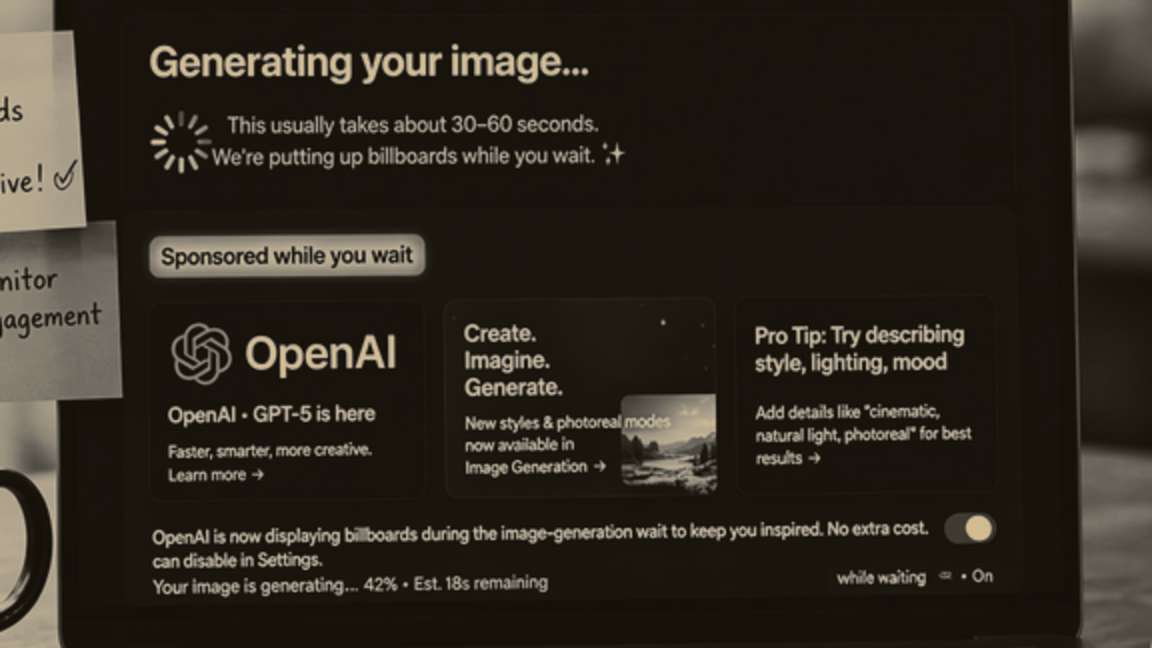
The wait is the placement
Image generation gives OpenAI something text chat usually does not: a captive pause. The company says its new visual ad format will first appear while ChatGPT is making an image. Its example shows the generation progress above and a large, clickable ad already loaded beneath it. OpenAI says the ad will be clearly labelled, remain separate from the finished image, and not affect ChatGPT's answers.
That distinction matters. Putting a sponsored product into the image would corrupt the output. Putting an ad beside a progress bar leaves the output alone while monetising the few seconds before it arrives. The unit looks less like native AI advertising than a digital billboard beside a queue.
One screen, two customers
OpenAI's pitch to users is discovery: visual ads can show product inspiration, usage, or an experience a service makes possible. Its pitch to advertisers is reach. The company says ChatGPT serves 1.2 billion people each week and calls advertising a way to reach a market much larger than subscriptions alone.
The placement is unusually well chosen for attention. A person waiting for an image has already committed to staying on the page, is watching for progress, and has just supplied a prompt rich with intent. OpenAI says conversations remain private from advertisers, and its placement guardrails keep ads away from emotionally vulnerable, sensitive, or otherwise unsuitable contexts. Even with those limits, the surrounding prompt gives OpenAI a powerful decision about when an ad belongs. The company does not need to sell the conversation to sell access to the moment.
The measurement stack is the bigger tell
The ad format arrived with a long list of infrastructure partners. Hightouch, Tealium, and LiveRamp can send conversion data into ChatGPT Ads. AppsFlyer, Triple Whale, Adjust, Branch, Kochava, and others support attribution. DoubleVerify and Integral Ad Science are being brought in for brand-suitability pilots.
That list is less flashy than a new ad card, but it says more. OpenAI is not running a decorative experiment. It is assembling the plumbing that lets a marketing team buy, measure, defend, and expand a channel. The company even published early partner figures for acquisition costs, incremental purchases, and new visitors. Those numbers come from the partners themselves, not an independent audit, but their inclusion tells advertisers exactly how OpenAI wants the format judged.
The line OpenAI is trying to hold
The company keeps repeating three promises: answers stay independent, conversations stay private, and users remain in control. The first two are necessary. The third will be tested by how often the ads appear, which plans see them, and whether a user can turn them off without paying.
For now, the visual format is limited to a US test later this month with an initial group of advertisers. The narrow rollout should not obscure the product decision. OpenAI has found a new surface inside ChatGPT that does not require changing the answer at all. Every slow generation now contains inventory.
Sources
- [1] OpenAI — “Building advertising for the way people use AI” (Oct 2026)Read source
- [2] BleepingComputer — “OpenAI will show visual ads in ChatGPT while you generate images” (Oct 5, 2026)Read source
- [3] Search Engine Roundtable — “OpenAI Testing Visual ChatGPT Ad Format” (Oct 5, 2026)Read source