
What launched, in plain terms
Think of the profile half as the listing a business maintains on a search engine, moved inside a chatbot. A company finds itself in Business Hub, proves it is authorized to manage the listing, and can then submit and maintain the information on its profile, including product feeds. OpenAI says profiles may also contain information from other sources, so a claimed profile is not the only input ChatGPT draws on.
The verification has two layers, according to OpenAI's setup guidance as reported by VentureBeat. OpenAI can verify the business itself through a phone number, email address, website domain or Shopify account. The person managing the listing then completes a separate identity check through Persona before publishing changes, connecting a feed, viewing analytics or creating an agent. The blue check appears after that identity check is approved.
Two products, two different gates
The profile and the agent are being rolled out on different terms, and the narrower one is the more interesting one.
Profiles are broad: any eligible business located where ChatGPT is available can apply, without an Enterprise agreement or an ads account. One exception is already visible: according to Unite.AI's account of OpenAI's FAQ, local stores and restaurants can currently claim only an existing US listing.
Agents are narrow: eligible US ecommerce and online-service businesses with a website, at launch. Even then, verification alone does not guarantee an agent. Under OpenAI's Business Agents Policy, as summarized by Unite.AI, the company also considers the business category and the intended use before publication, and the agent must make clear that it is an AI representing the business, not a human, an independent adviser or an OpenAI-endorsed service.
What the check does not certify
This is the section worth reading before a marketing team books the work.
OpenAI's Businesses in ChatGPT profile policy states that profiles may include information from other sources, and that OpenAI "does not verify every detail or resolve every factual dispute." Businesses remain responsible for what they submit. The verification concerns authority to manage the profile. It does not validate every factual detail on it.
Placement is separate, and OpenAI is unusually direct about it. Claiming does not guarantee higher placement or more sales, and ChatGPT continues to make independent recommendations and comparisons. Benji Shomair, OpenAI's VP of monetization, told Digiday that claiming "should not have an impact on how frequently it appears." He also said clearer information could help ChatGPT surface a business in more relevant conversations. Those are two different claims — one about frequency, one about relevance — and the second is the reason most businesses will still claim a profile.
What businesses actually get back
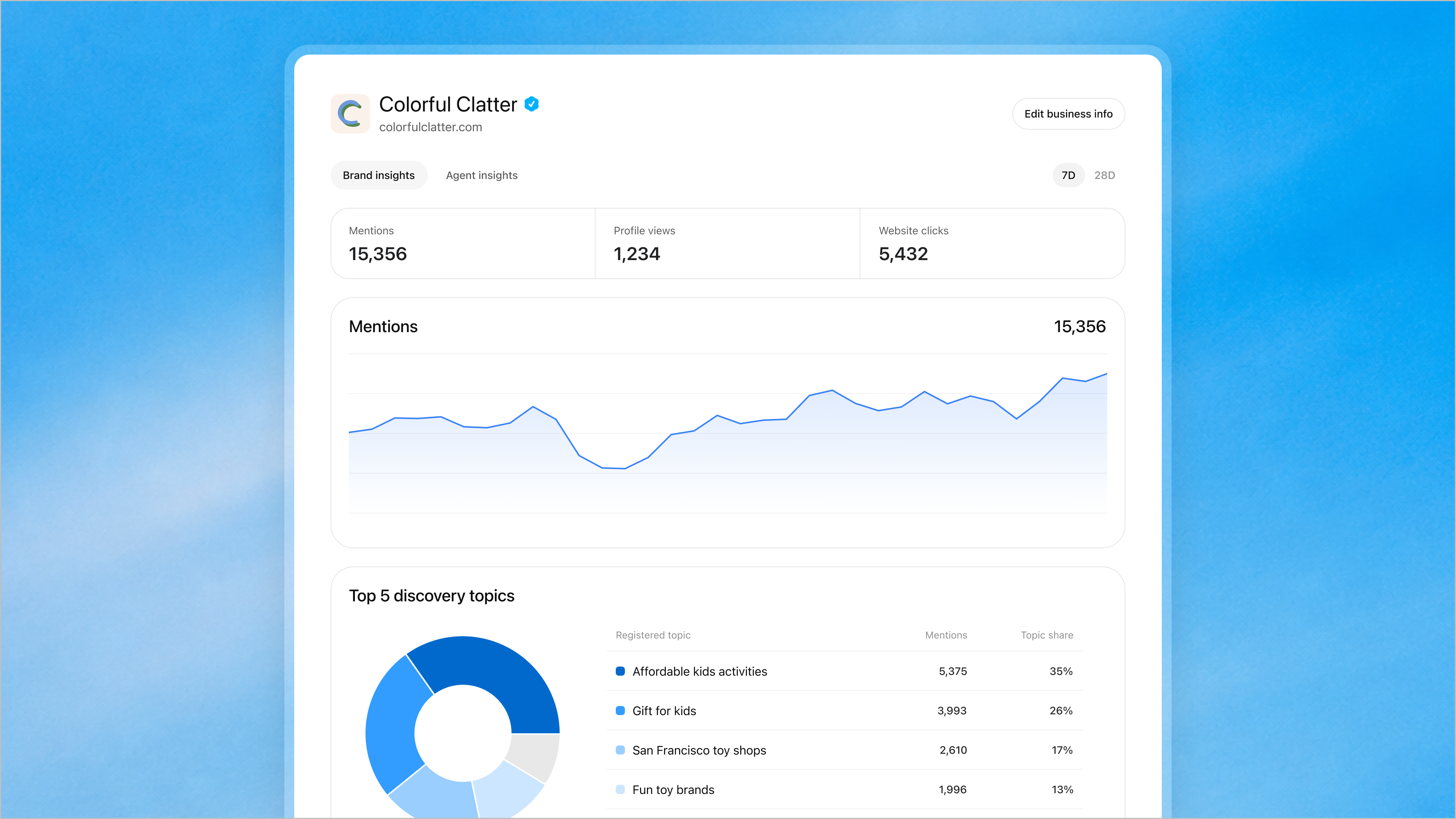
The dashboard is the new part, because the counts are OpenAI's own. Until now, brands have estimated their visibility inside ChatGPT with third-party tools that model the data from outside; Digiday quotes an agency CEO describing his team's reliance on tools such as Peec AI, Otterly and Semrush to estimate it. Business Hub reports mentions and website clicks, plus discovery topics, the common themes in conversations where the business's website was cited.
The counts come with definitions that change how they should be read. For an online business, a mention counts when ChatGPT references its website. Just naming the brand does not count. For a local business, a mention counts when ChatGPT shows the location. A website click is a click on a link from a supported ChatGPT surface, not a completed visit and not a purchase. Low-volume counts may be withheld for privacy, there is no share-of-voice figure in this beta, and businesses do not see individual prompts or chats. OpenAI declined to say over what period mentions are tracked; Digiday reports that an advertising executive with access to Insights described chart views covering the past seven or 28 days. That is a user's account of the interface, not an OpenAI reporting specification.
One agent, organic access and paid promotion
Business Agents are free at launch, on Digiday's account of OpenAI's press briefing, and a future paid model was not ruled out. The same agent is also the one a business can pay to promote. Shomair described the Business Agent as "the organic experience" and the sponsored agent as "the paid experience," adding that "the agent that sits behind it should be the same." One agent, two doors into it: a profile a user opens on their own, or a labeled ad.
Two limits define the offer. Businesses cannot bring their own agent; "We aren't allowing folks to bring their own agents," Shomair said. The agent is built from the instructions and product feed the business supplies, inside OpenAI's system. And when a shopper is ready to pay, the agent hands them to the business's own website, because, as Shomair put it, "it's up to the business on how they want to close the transaction."
Context matters here. TechCrunch notes that OpenAI previously tried to turn ChatGPT into a shopping destination with a commission-based checkout, and retired that effort in March. Businesses in ChatGPT connects businesses to ChatGPT users without putting OpenAI's checkout in the middle.
OpenAI says it plans to expand both products to more markets and business categories over time. It has given no dates, no eligibility list beyond the launch categories, and no pricing beyond free for now, as of November 10, 2026.
Sources
- [1] OpenAI, "Introducing Businesses in ChatGPT" (official announcement, Nov 10, 2026)Read source
- [2] OpenAI, Businesses in ChatGPT profile policyRead source
- [3] TechCrunch, "OpenAI rolls out new business profiles, making ChatGPT just a little bit more like Google" (Nov 10, 2026)Read source
- [4] VentureBeat, "OpenAI lets you claim your business in ChatGPT and set up a custom agentic AI customer sales rep" (Nov 10, 2026)Read source
- [5] Digiday, "OpenAI gives brands free ChatGPT agents alongside paid ads" (Nov 10, 2026)Read source
- [6] Unite.AI, "OpenAI Launches Business Hub and Business Agents in ChatGPT" (Nov 10, 2026; summary of OpenAI's FAQ and Business Agents Policy)Read source