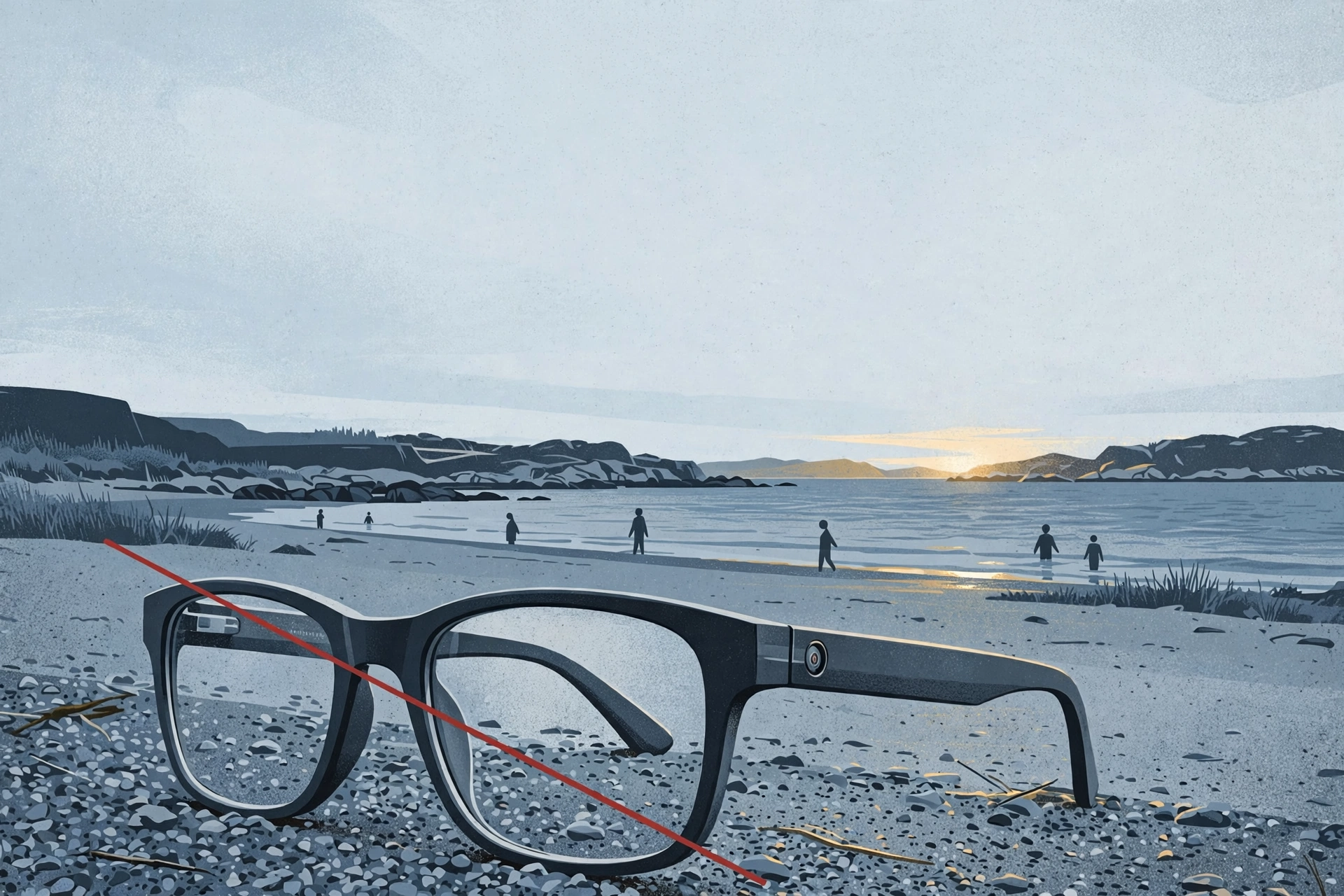
A proposal, not a beach ban yet
Norway's government announced on October 5 that it will send parliament a temporary, place-specific restriction on AI glasses while an expert group works on permanent rules for body-worn technology. The list under consideration is broad: parks, bathing beaches, museums, shopping centres and public events; schools, kindergartens, playgrounds and youth clubs; doctors’ offices, swimming pools, gyms and places with changing rooms or showers. Universities may also be included.
That is the proposal stage, not law. The government has not published the bill, a start date, penalties or a final list of covered locations. It says the work is a priority and that legislation will go to the Storting as soon as possible. The temporary measure is meant to buy time, not settle the category.
The privacy problem is ordinary recording
The government's case does not depend on a futuristic AI capability. It is about a camera and microphone sitting at eye level inside frames that look increasingly like ordinary glasses. A phone raised toward someone is a social signal. A person looking in their direction is not.
That difference matters most where people cannot reasonably opt out: a child at school, a patient in a clinic, a swimmer beside a changing room, or anyone sharing a public beach. A recording light can help, but only if bystanders see it, understand it and trust that it has not been disabled or obscured. The useful policy question is not whether the device can summarize a conversation. It is whether a person nearby can tell when they have become input.
“AI glasses” is not a legal category
The announcement leaves the central definition open. Officials say they will examine at least three possibilities: glasses with cameras and audio recording; glasses that combine a camera with AI functions; or a wider class of body-worn technology with cameras, microphones and/or AI.
Those are materially different rules. A narrow definition tied to “AI” branding invites manufacturers to move processing to a paired phone or cloud service and argue that the frames themselves are only a camera. A feature-based definition catches more devices, but then the label no longer describes glasses: camera pendants, earbuds with microphones, helmet cameras and accessibility wearables begin to enter the same bucket.
The clean line is capture, not intelligence. If the harm is covert collection, the law should turn on what a device can record, whether people receive a meaningful signal, and what happens to the data after capture. AI can make the footage more searchable and useful, but it does not create the consent problem.
Place-based rules solve one problem and create another
Starting with schools, clinics, pools and changing facilities is defensible because expectations are clearer and operators can enforce entry rules. Beaches and parks are harder. They are open spaces full of phones, action cameras, security cameras and people wearing prescription glasses. Asking staff or police to distinguish ordinary frames from connected ones by sight is not a serious enforcement design.
The government could instead require recording-capable wearables to provide a visible, non-defeatable indicator and make the wearer responsible for proving the device is disabled in restricted places. That still leaves edge cases, but it targets the behaviour that creates the risk. A location list without a device test will produce arguments at the gate and inconsistent enforcement inside.
Accessibility cannot be an afterthought
Norway says exemptions will protect vulnerable groups and socially beneficial uses. That clause matters. The same hardware can read text aloud, identify objects, provide live captions, translate speech or help a wearer navigate. A blanket rule based on appearance would remove useful assistance along with covert recording.
The exemption should not depend on someone disclosing a diagnosis to a shop employee or lifeguard. A better design would separate local assistance from outward recording: permit clearly signalled, privacy-preserving functions while restricting capture, storage or transmission of identifiable bystanders. If the technology cannot make that distinction reliably, that is a product limitation, not a reason to make disabled users carry the burden.
The first draft has to name the thing
Norway is early enough to avoid the usual regulatory mistake: writing a rule around today's product names, then watching the hardware move on. Its own announcement already recognizes that glasses may be only one form factor in a larger body-worn category. The expert group should use that opening.
A workable temporary law needs four things before the political headline means much: a capability-based definition, a clear test for restricted use, enforceable signalling requirements, and exceptions that preserve legitimate assistive functions without becoming a general loophole. Until the bill supplies them, Norway has identified the right privacy problem and left the hard part blank.
Sources
- [1] Reuters via BusinessWorld — “Norway to propose temporary ban on AI glasses in some public places” (Oct 5, 2026)Read source
- [2] eWeek — “Norway Plans Temporary AI Glasses Ban Over Privacy Risks” (Oct 2026)Read source
- [3] Unite.AI — “Norway to Propose Temporary Ban on AI Glasses in Selected Places” (Oct 2026)Read source