
NVIDIA has published the training half of Nemotron 3.5 Parse. In a Hugging Face post dated November 26, 2026, the company released three datasets used to train the 0.631B document parser it released in October: 9.98 million rendered charts, 1 million rendered HTML tables and 7.9 million synthetic multilingual document pages, about 18.9 million image-and-annotation pairs in total. It also shared the fine-tuning recipe behind the model, the paired-data generation, supervised fine-tuning and GRPO reinforcement learning stages, so a team can adapt the parser to its own document types.
The useful part of this release is real. Document parsing is the unglamorous layer under most retrieval and agent pipelines, and training data for it is rarely published at this scale. What needs care is the pair of numbers NVIDIA's materials lead with, because they do not describe the same run.
Two headlines, two configurations
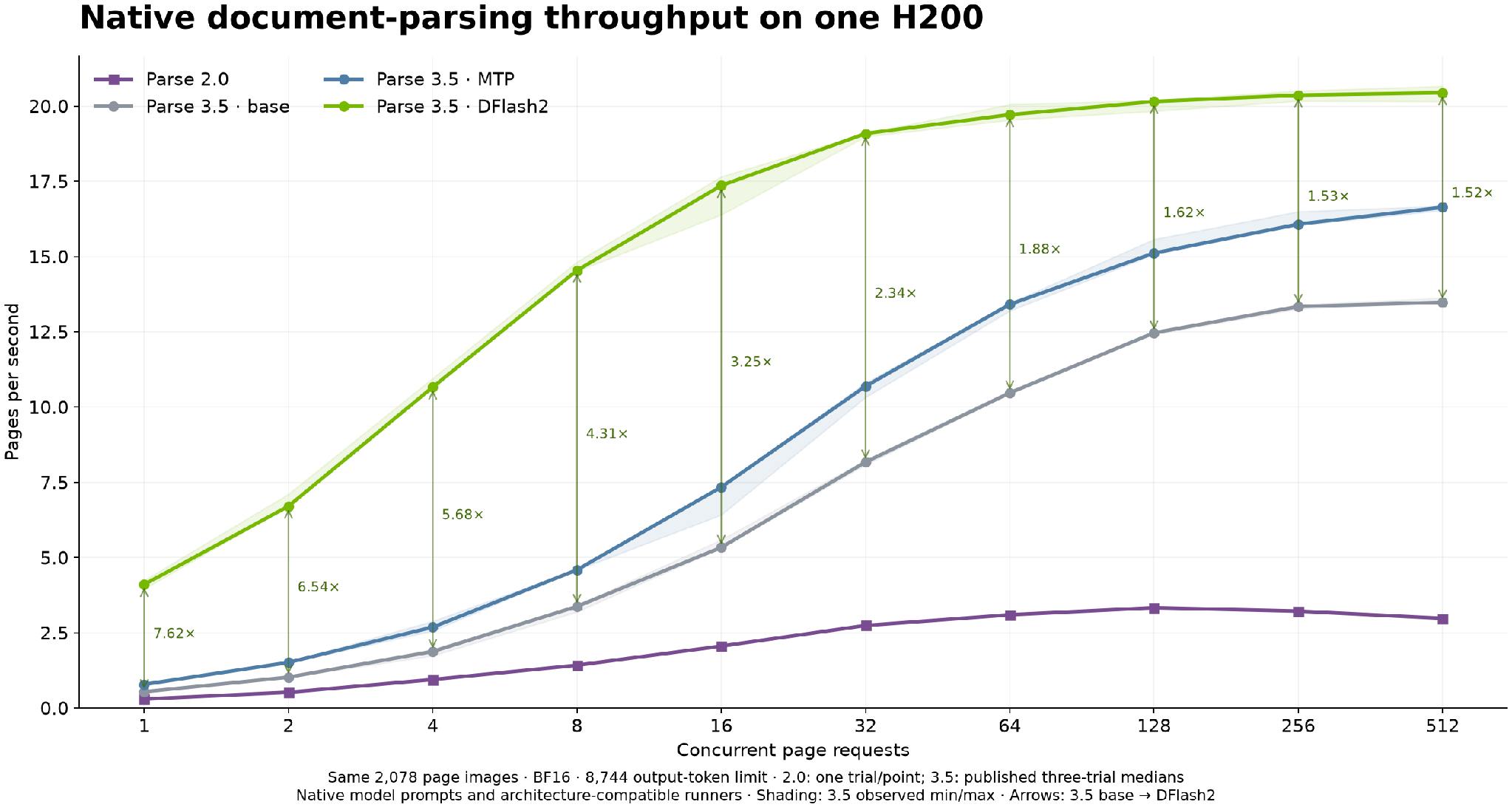
The card advertises a ParseBench score of 75.20, described as the highest overall score among the systems in NVIDIA's reported comparison, and the blog's throughput figures reach 20.44 pages per second with the DFlash2 speculator. NVIDIA's own pass table, further down the same card, separates them. The 75.20 score belongs to triple-pass parsing, which runs a full-page parse, a separate detection pass, then re-parses the union of their table and chart regions, and in the card's test it runs at 13.49 pages/s. Single-pass parsing scores 72.74 in that test, at 18.57 pages/s. Double pass sits between them on both measures, 74.92 at 14.60 pages/s.
Neither number is invented. They are answers to different questions, printed close enough together to be read as one specification. Inside the card's own test, the 75.20 configuration's 13.49 pages/s is 27.4% below the single-pass rate of 18.57 pages/s, for 2.46 more points. A team sizing on the speed figure should expect the 72.74 configuration, not the headline score.
The speed multiplier has the same shape. In NVIDIA's native benchmark on one H200, DFlash2 raised throughput 7.62 times at concurrency 1, a single stream of pages. At concurrency 512, the gain was 1.52 times, from 13.48 to 20.44 pages/s. The blog also discloses, in its figure note, that the older Parse 2.0 curve uses one trial per point while Parse 3.5 shows medians of three. None of this is hidden. All of it sits below the headline.
What the training evidence does and does not show
Every one of the 18.9 million released examples is synthetic: rendered charts, rendered tables, generated pages. That is a defensible way to train a parser, and NVIDIA says so plainly. It also bounds what the release proves. The training comparison in the post, an overall score rising from 66.24 after supervised fine-tuning to 71.38 after GRPO, with loop-flagged outputs falling from 126 pages to 29, is labeled by NVIDIA itself as development checkpoints, separate from the final released model. The recipe's worked example is narrower still: a synthetic dental form, where sampled first-attempt success rose from 0.00% for the base model to 95.85% after fine-tuning and 96.58% after reinforcement learning, measured on 256 held-out forms from the same synthetic generator.
So the recipe demonstrably teaches the model a new synthetic document family. Whether the same gains transfer to a company's own noisy scans, skewed photographs and decades-old forms is the question the release cannot answer, and NVIDIA, to its credit, does not claim otherwise in the text. The datasets and recipe are the deliverable. The transfer test belongs to whoever deploys the parser.
One timing point for readers catching up: the DFlash2 speculator is presented inside this release, but the model card dates its native availability to November 4, 2026. What is new on November 26 is the data and the recipe, not the speed component.
Sources
- [1] NVIDIA (Ryan Chesler, Marek Wawrzos, Steve Han), "Building on Nemotron 3.5 Parse: Open Data, Fine-Tuning, and Faster Inference", Hugging Face, November 26, 2026Read source
- [2] NVIDIA, Nemotron 3.5 Parse model card, Hugging FaceRead source