What was actually announced
Strip the announcement down to what is checkable and it is short. One screening. One room, the Yallamundi Rooms at the Sydney Opera House. One evening, December 7, from 6 to 9 PM, placed deliberately on the opening night of NeurIPS 2026. Entry is by approved request only, through an event page that says "Invitation only. Final agenda to follow." Around the screening there is a panel on real-time worlds and audience-driven storytelling and a Q&A with both teams.
MiniMax's own wording for the work is "cinema that rewrites and reanimates itself in response to its audience." The screening is scheduled for December 7, during NeurIPS 2026 in Sydney. That places MiniMax's real-time video-generation claim alongside a major machine-learning research conference, although the private event's attendee list has not been disclosed.
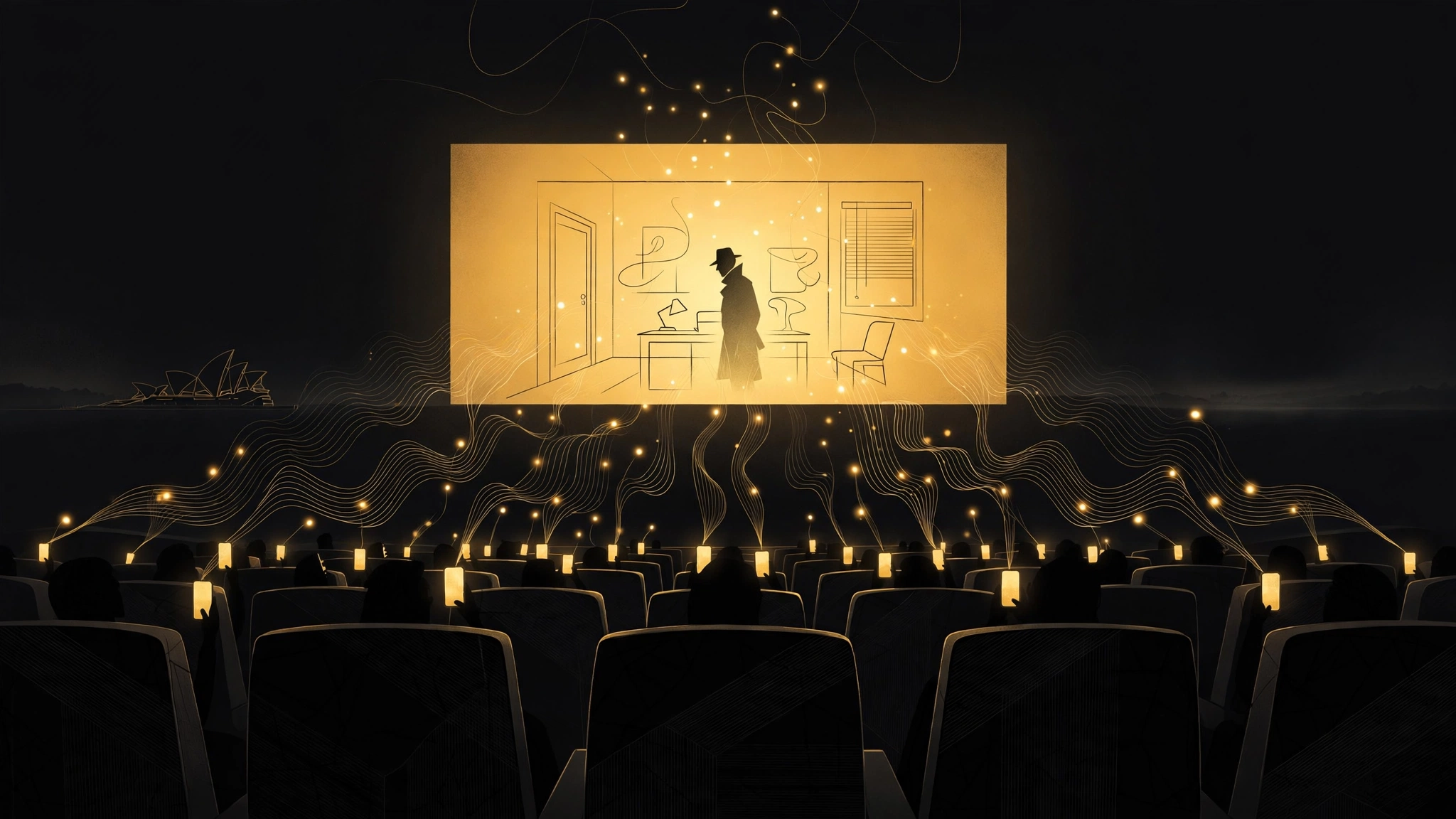
How the show works when you sit in it
Whispers has a track record, which helps, because attended screenings leave a more useful record than announcements do. A reporter who sat through the Raleigh stop of Pickford's American cinema tour last July described a murder mystery whose setup is loaded in advance: a victim, some suspects, a detective named Marcus Kent who announces early that he hears whispers in his head. The whispers are the room. Each attendee scans a QR code and joins a chat column running beside the picture, posting observations and theories and liking other people's, which appears to raise the chance the program acts on them.
GrepBeat's firsthand account of the Raleigh screening provides the clearest description of the mechanics. Attendees submitted observations and suggestions through their phones, while the detective responded within a story framework developed by human writers. Woven Magazine separately describes the broader audience-driven format, but does not establish that every interaction worked identically at each screening. Some of what Kent does is built in: a suggestion arrives and he follows one chain of evidence rather than another. Some of it is genuinely improvised by the crowd. In Raleigh, the audience invented a secret corridor that did not exist, and Kent spent time musing about it anyway. Pickford's own team told that audience the AI in these stories is built to listen, respond and choose a direction, rather than to invent the narrative on its own. The voices are performed by human actors. Depending on how the room investigates, the killer confesses, or does not. The Raleigh screening described by GrepBeat ran a little under 90 minutes. The Sydney event is scheduled for three hours, including a panel and Q&A, but its screening runtime has not been specified.
That record makes the Sydney version more interesting, not less. The event page adds a specific technical commitment the tour coverage does not: at the Opera House, guests steer the story "as video is generated in real time using MiniMax's video model." Live direction of a character is one thing. Live generation of the picture itself is a different and harder claim, and it is the claim MiniMax has attached its name to.
The unnamed model
Here is what the announcement and the event page, read together, do not contain. No model name. No version. No latency figure, although latency is the whole engineering problem in a room full of people waiting for a character to react. No account of how much of the screen is generated on the night and how much was prepared beforehand, although the attended record shows a pre-loaded setup, written story elements and performed voices. No cost, no failure mode, no word on what happens when two hundred people suggest two hundred different things at once.
MiniMax markets named video-generation models elsewhere, but neither this announcement nor the event page identifies the model intended for the Sydney screening. Pickford has indicated that more information is forthcoming, but the announcement provides no timetable for technical disclosures. Until those details appear, the specific model and its role in the screening remain unknown. Either way, the gap is the story. A claim of real-time generated cinema will eventually be graded on the details that are currently missing. December 7 may provide the first public-facing demonstration of the specific real-time video-generation claim attached to this screening. Whether the organizers disclose enough technical detail to evaluate that claim remains an open question.
Sources
- [1] MiniMax (@MiniMax_AI), X post announcing the Sydney Opera House screening, October 27, 2026, 2:23 PM PDT (announcement wording, December 7 date, private screening, quoted Pickford post and poster details including the Yallamundi Rooms and the 6–9 PM timing; read in full this run)Read source
- [2] Pickford / MiniMax, "Whispers: An Interactive Screening," Luma event page (private event listing, approval-required registration, invitation-only note, venue address, opening-night-of-NeurIPS billing, running order, the real-time generation wording, Emmy Innovation finalist line, host list; read this run)Read source
- [3] Pickford post republished on MiniMax's LinkedIn page (announcement text, "One room. One investigation," Monday December 7, 6–9 PM, invitation request and approval wording; read in full this run)Read source
- [4] GrepBeat, "LA-Based Pickford Screens AI-Driven Film Experience in Raleigh," July 23, 2026 (first-hand attended account of a Whispers screening: QR chat column, likes, pre-loaded setup, built-in versus audience-sparked reactions, the invented secret corridor, running time, and Pickford staff on human writers supplying story elements)Read source
- [5] Sundance Collab, "Whispers: An Interactive Murder Mystery Experience" catalogue page (Bernie Su as creator and showrunner, Pickford background)Read source
- [6] Woven Magazine, "Bernie Su Whispers: AI Cinema by an Asian American Emmy Winner" (interaction model, human voice cast performing the characters, branching outcomes including a killer who may not confess)Read source