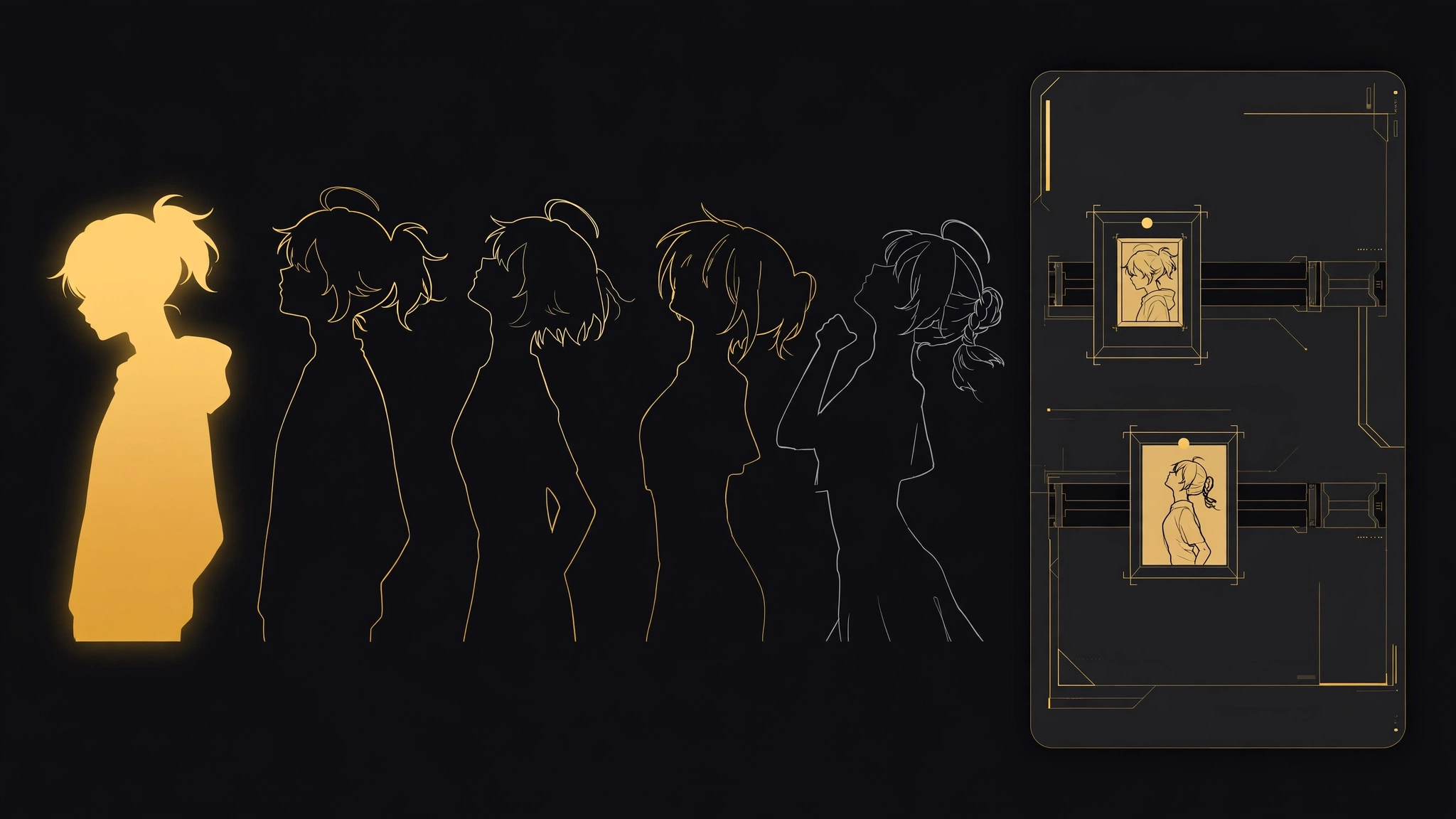
Consistency moved into the editor
Niji 6 had a character reference feature, known as cref, that let users hold a character steady across generations. Niji 7 dropped it, and the official post acknowledges that users have asked for it back since. Niji 8 answers with an edit feature rather than a reference slot, and it is not cref itself returning: the workflow is image editing. You finish a generation, press the quick edit button at the bottom right, attach more pictures, and describe the change in plain words. The blog's preferred form uses two images: a character sheet and a background, combined with an instruction such as "take the character from image 1 and put it into image 2, lying down." One image is enough for smaller work, such as adding a hair bun, and the post warns that output quality depends heavily on input quality, so blurry or pixelated references will show in the result.
The same post says style references and moodboards were also improved, in service of the same goal. Taken together, the direction is clear: consistency in Niji 8 runs through the images you feed back in, supported by the improved style tools, rather than through the prompt you repeat. The team says it held back the launch until characters could be reproduced through means like the edit function, which is a fair measure of how central the change is.
The trade the release makes openly
The blog is unusually direct about the cost. Where Niji 7 kept a character the same "as long as you type in the same words," Niji 8, in the post's capitalized phrasing, will NOT do this. The same prompt now returns a wider variety of characters, closer to how Niji 6 behaved. The team describes the design philosophy as Niji 7 aesthetics combined with Niji 6 variety, and adds a rule that will change how existing prompt libraries behave: prompt length is read as intent, so a short prompt gets wide variety and a long, detailed prompt gets less.
For a new project, that is a reasonable bargain: explore first, then lock the chosen character through the editor. For an ongoing series built on Niji 7's repeat-the-words behavior, it is a deliberate breaking change. A character sheet discipline now has to replace a wording discipline, mid-project.
What the announcement does not show
The post calls Niji 8 "the fastest and most coherent niji model yet" and recommends its HD feature as "very beautiful" and "so so fast." It publishes no timings, no resolution figures and no benchmark scores to support either claim. The prompt-following evidence offered is the team's own demonstration: a multi-object scene (a woman with short lime-green hair packing a white sundress into a teal suitcase, a pink flamingo inner tube behind her) and a simple three-panel comic page produced from a single prompt. Both are first-party demonstrations of what the team wants prompt following to mean here. Neither is a measurement.
Access is the ordinary Midjourney route, Discord or the web interface. The launch post gives no separate Niji 8 price.
The practical reading
If you make anime art or comics on Midjourney, test Niji 8 on a side project first: generate a character, save a clean character sheet, and run the two-image edit workflow before committing a series to it. If your current series depends on repeated prompt wording under Niji 7, treat the upgrade the way you would treat a renderer change, because that is what it is. The consistency tool people asked for since Niji 6 is back, in a new form. The habit that replaced it is gone.
Sources
- [1] Niji Journey (Midjourney / Spellbrush), "Welcome to Niji 8!", official blog post, November 24, 2026Read source
- [2] The Neuron, "Everything That Happened in AI Today," November 25, 2026 (secondary corroboration of launch timing only)