
What "twice as fast" actually measures
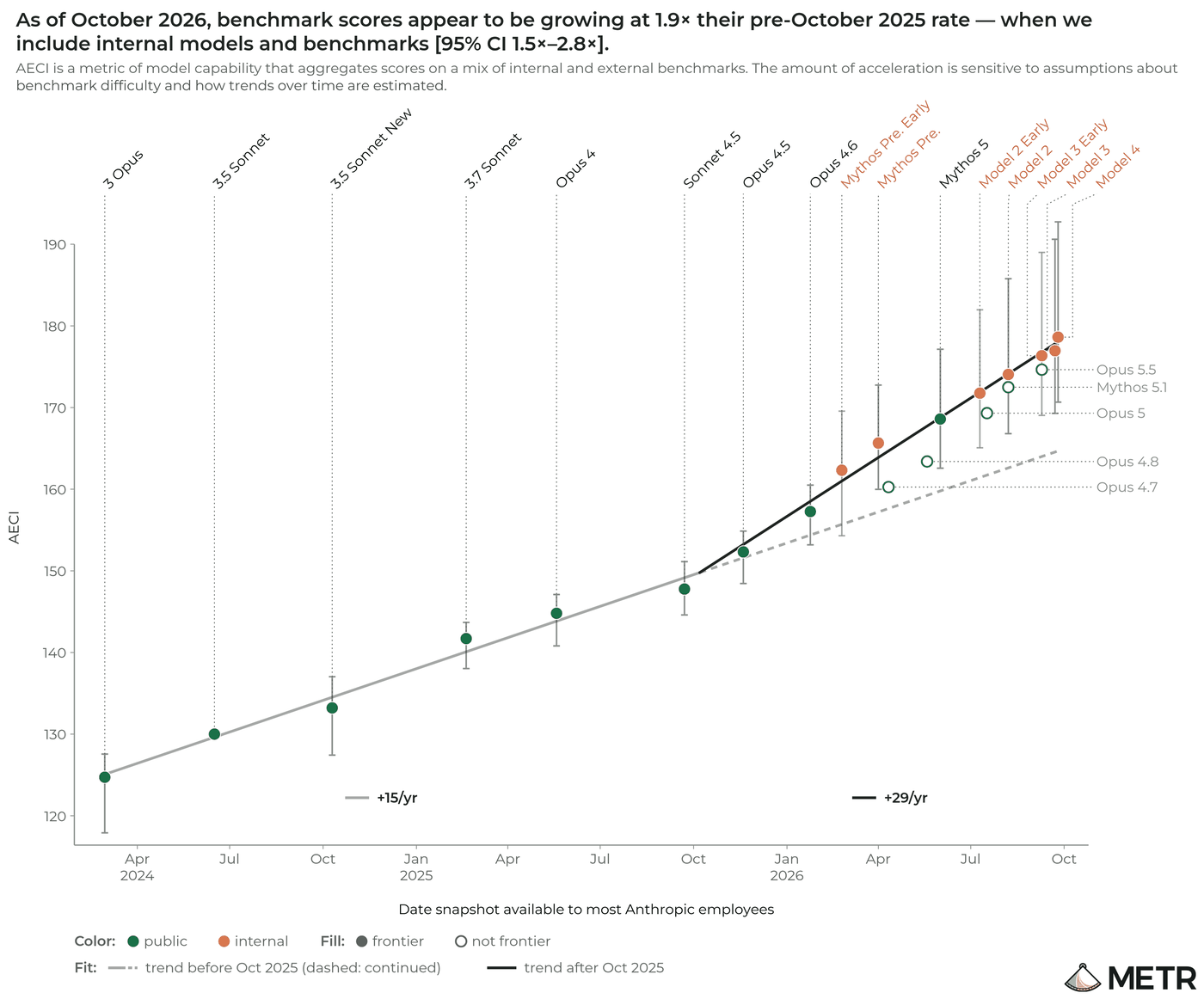
The claim rests on a benchmark index, and the index has soft edges. AECI aggregates scores across a mix of internal and external benchmarks, and METR is open that the result moves with modeling choices: change the assumptions about benchmark difficulty or how trends are fitted and the acceleration estimate lands anywhere from 1.1x to 2.9x. METR also lists the ways the number could be too high. The gains may be concentrated in tasks with clean grading rather than open-ended research work. Anthropic may be overfitting to its own benchmark distribution. And the baseline may flatter the comparison, because Anthropic's 2023–2025 growth rate may have been unusually low for reasons that have nothing to do with AI assistance.
None of that makes the finding empty. An outside evaluator with access to unreleased model scores, compute data and researcher interviews concluded that Anthropic's capability-development trajectory has likely changed. That conclusion is notable precisely because METR is assessing observed internal evidence rather than repeating Anthropic's public forecasts.
The honest version of the headline needs both sets of qualifications: METR's subjective estimate is around 2x, with the team saying it would not be surprised by 1.3x or 3x; its AECI estimate is 1.9x (95% confidence interval: 1.5–2.8x), with alternative modeling choices ranging from 1.1x to 2.9x. Both estimates concern well-specified tasks, not AI research as a whole.
The 80 percent is a guess, and METR says so
The second headline number needs its label kept on. METR guesses that a majority of the current acceleration, perhaps approximately 80%, is attributable to AI use in Anthropic's R&D. The estimate carries substantial uncertainty, and METR did not find decisive evidence or consensus among Anthropic staff about the causes of the acceleration. The supporting picture is primarily assistance, not autonomous research. METR says AI is not yet making highly significant, fully autonomous contributions to the most important parts of model training. Researchers nevertheless described signs that this could change soon, with substantial variation in maturity across different areas.
Two more qualifications sit underneath. The acceleration in late 2025, where the trend first bends, was likely influenced by non-AI factors, and the detail on those factors was redacted. The most eye-catching supporting statistic comes with METR's own warning label. Anthropic staff self-reported speedups reaching 12x in October 2026 Slack polls. METR calls these polls "only very loose evidence," noting that the responses reflect low-effort consideration and that individual productivity uplift is not equivalent to a lab-wide acceleration rate.
The part of the audit readers cannot check
This report's most unusual feature is stated on its first page. METR could request access to information it considered relevant, but Anthropic could unilaterally approve or reject those requests. Separately, Anthropic held unilateral rights to redact non-public information from the published report. It exercised those rights on what METR describes as a majority of the evidence it found most informative for its conclusions, including detailed attribution estimates, algorithmic-progress breakdowns, bottleneck analysis and forecasts for future models. Anthropic's stated reason was removing confidential information that could accelerate other developers. METR's response, in its own words, is that the report does not achieve transparency about evidence, and the public has to rely on METR's judgment much more than would be ideal.
The boundaries showed up in the scope as well as the text. The original contracted scope included verifying how Anthropic allocated compute between capabilities and safety work. Anthropic changed the scope midway, removing that verification component before METR reached any substantive conclusions about compute allocation. METR says Anthropic wanted to keep the engagement focused on risk assessment for the time being and indicated it would revisit compute verification later.
Set against that, the access was real: benchmark scores for internal models that have not been released, compute figures, roughly 15 staff interviews, and a full report of about 100 pages behind the public summary. This is more visibility than any frontier lab usually grants an outside evaluator. It is still visibility on the lab's terms.
No bottleneck found is a weaker claim than it sounds
METR did not identify convincing evidence of bottlenecks in algorithmic progress, training compute, experiment compute or data that would prevent further progress over the next 12 months. But it says its understanding changed several times as more information arrived, and it is not confident in its current assessment. Some of the bottleneck analysis was also redacted. From that absence of identified bottlenecks, METR draws a risk judgment: further progress could compound into still faster acceleration.
An absence of identified brakes, recorded by a team that kept revising its view, is a reason to keep watching the slope. It is not proof that the slope steepens.
For readers, the practical test is replication. If AI-assisted R&D is genuinely doubling a frontier lab's pace, the same effect should become visible in release cadence and benchmark movement at other labs over the coming quarters, in public data nobody can redact. Until then, the strongest claim the evidence supports is narrower than the headlines forming around it.
Sources
- [1] METR (primary), "Independent Assessment of AI R&D Acceleration at Anthropic in October 2026", metr.org, November 5, 2026 (read first-hand in full at Gate 1: assessment August 12 to October 29, 2026 at 2.5 full-time equivalents; subjective estimate of around 2x on well-specified tasks against the March 2024 to October 2025 rate, with 1.3x or 3x unsurprising; AECI acceleration of 1.9x since October 2025, 95% confidence interval 1.5–2.8x, trend steepening from about 15 to about 29 points per year, robustness range 1.1x to 2.9x; acceleration confidently not due to training-compute scaling; AI attribution stated as a guess of a majority, perhaps about 80%, with substantial uncertainty, no decisive evidence and no consensus among Anthropic staff; late-2025 acceleration likely influenced by non-AI factors whose details were redacted; Slack polls described as only very loose evidence reflecting low-effort consideration, self-reported uplift reaching 12x in October 2026; no convincing bottlenecks identified for the next 12 months, with low confidence after several revisions and some bottleneck analysis redacted; Anthropic's unilateral rights to approve or reject information requests and to redact non-public information, exercised on a majority of the evidence METR found most informative, with the stated aim of removing confidential information that could accelerate other AI developers; the report's own statement that it does not achieve transparency about evidence; the contracted compute-allocation verification removed from scope midway, which Anthropic said was to keep the engagement focused on risk assessment for the time being, with a revisit indicated; no employee-like access intended, and no samples from non-public models requested or received; comparison with the Haiku 5.5 system card's 1.7x, the difference attributed mainly to newer unreleased internal models)Read source
- [2] Reuters, "Anthropic's models improving nearly twice as fast with help from AI, study finds", November 5, 2026, read via 98.5 The River syndication (1.9x benchmark improvement since October 2025; about 80% AI attribution with METR's uncertainty caution; no convincing bottlenecks over the next year)Read source
- [3] Unite.AI, "METR Estimates Anthropic's Model Capability Growth Has Nearly Doubled", November 5, 2026 (read via search extract: AECI dating by internal availability, robustness sensitivity, redaction of detailed attribution, algorithmic-progress, bottleneck and forecast material)Read source
- [4] Tampa Bay 28 / Scripps, "Anthropic is reportedly rapidly accelerating AI development amid slowdown calls", November 5, 2026 (Reuters-based, read via search extract: context on Anthropic commentary during the assessment period)Read source