Four systems, two chips
Google is unusually clear about what this launch is not. A new chip, its post says, means laying out billions of transistors in a multi-year manufacturing process. A system is how compute, networking, storage, packaging and security are assembled around a chip. By that definition, today brought two systems and no new chip.
That distinction is the honest core of the announcement. The portfolio count is four systems in a single year, a first for Google. The silicon count underneath it is two chips, announced in April, now presented as four systems. Chip generations and system capabilities are separate things, and Google, to its credit, explained the difference in its own post.
The April baseline matters for the same reason. Google says TPU 8t offers up to 2.7 times the training performance of the previous generation, while TPU 8i offers 80% better inference price performance. Those figures belong to the April systems. Today's post gives no equivalent generational figures for 8tx or 8i Max.
Two configurations, two different problems
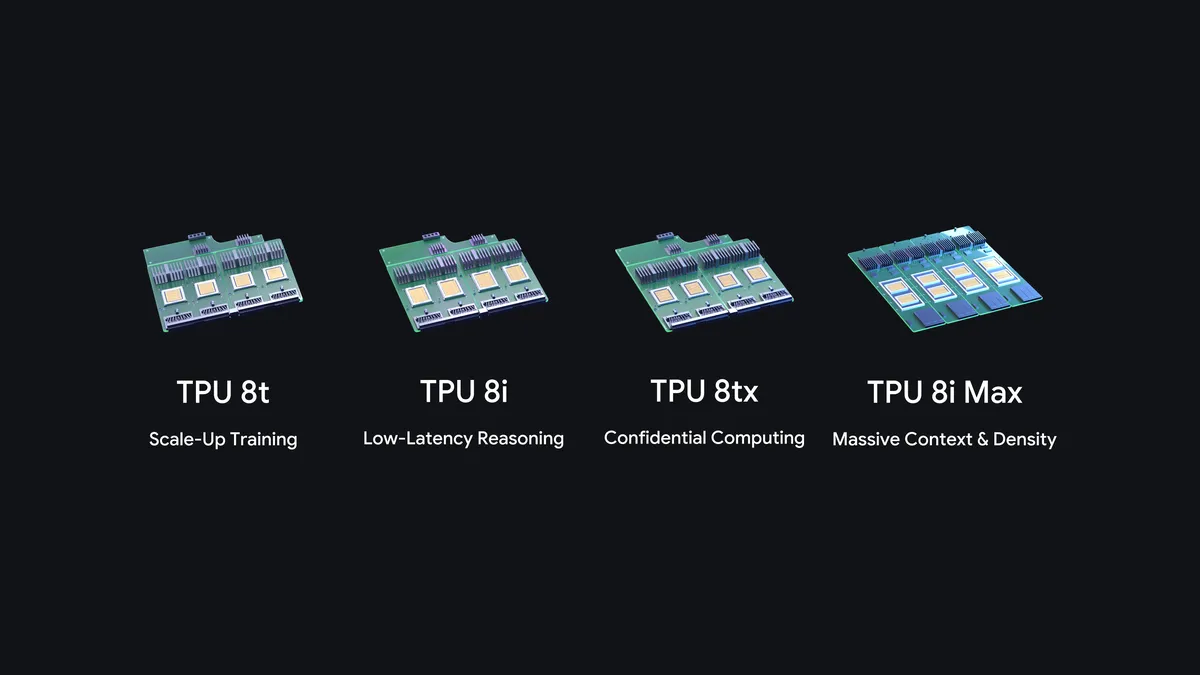
TPU 8tx is the security configuration. Data is normally encrypted in storage and in transit, then decrypted in memory while it is processed. Google says 8tx keeps sensitive data and model weights protected and isolated during active use, using the TPU 8t silicon with AMD EPYC hosts. Google presents consolidation as the benefit: a regulated team can run confidential inference, fine-tune on private data, distill a larger model and run reinforcement learning on one system, without moving sensitive data between separate clusters.
TPU 8i Max is the density configuration. Google took two TPU 8i chips and combined them on a single package. Google positions the package for massive context windows and the highest compute density per rack, with double the compute, double the SRAM and double the HBM bandwidth of TPU 8i. The post gives no absolute HBM capacity, no SRAM total and no compute figure for the Max package, so there is nothing here to set against a competing accelerator's spec sheet yet.
The numbers that are missing
Three absences decide how much of this a buyer can act on today.
First, price: the announcement gives none, for either system. Second, availability: the announcement gives no date, and availability is not specified in the post; reports based on Bloomberg's coverage put both systems in 2027. Third, independent measurement: the latency and density claims are Google's own, and the post supplies no third-party result for either new system. It does cite state-of-the-art price-performance marks for its existing TPU software stack on the InferenceX and AgentX benchmarks. Those results are about the stack on current hardware, not about either system announced today.
Other announcements in the same post included software that is available now. Cloud Pathways and GKE dynamic slicing are generally available, with Google claiming up to 5x faster job startup and up to 4.5x faster fault recovery from dynamic slicing.
What to watch
Three publications would let buyers judge this launch: a product page with absolute specifications for 8i Max, an availability date for either system, and pricing. Until they appear, "four systems in one year" is a packaging achievement. It may prove to be a good one. The announcements illustrate Google's use of system-level changes to address different workloads without introducing another chip design. But a configuration is not a chip, and Google, to its credit, just explained why in its own launch post.
Sources
- [1] Google, "Introducing TPU 8tx and TPU 8i Max", November 9, 2026 — primary source; all system descriptions, the chip-versus-system distinction, the latency and doubling claims, the customer count, and the software availability notes.Read source
- [2] Unite.AI, "Google Adds TPU 8Tx and TPU 8I Max to Eighth-Generation Lineup", November 9, 2026 — secondary summary (its TPU 8i baseline figures are not used as 8i Max specifications).Read source
- [3] FinanceFeeds, reporting Bloomberg's framing, November 9, 2026 — secondary market summary.Read source
- [4] AIStockWire, reporting Bloomberg, November 9, 2026 — the attributed 2027 timing, which Google's own post does not state.Read source