
How the check works
The enforcement point is Agent Gateway, and that is a real deployment condition, not a toggle inside the agent. An organization has to route all of the agent's egress traffic through the gateway. When the model answers with a tool call, the gateway sends the proposed call to the policy engine first. Only if the call passes both checks does the response reach the agent unchanged.
Policies are natural-language constraints attached to an agent. They can cover every tool or a single tool, and they can name a tool's parameters, so "accept refund requests only where the amount is $80 or less" and "the agent may summarize resumes, but it must not send offer or rejection decisions" are both valid policies in Google's examples. They are created in the Cloud console or with a gcloud beta command, and legal or compliance staff can change them without a code deploy. That is the genuinely useful part of the design: the people who write disclosure rules can write these in the same words.
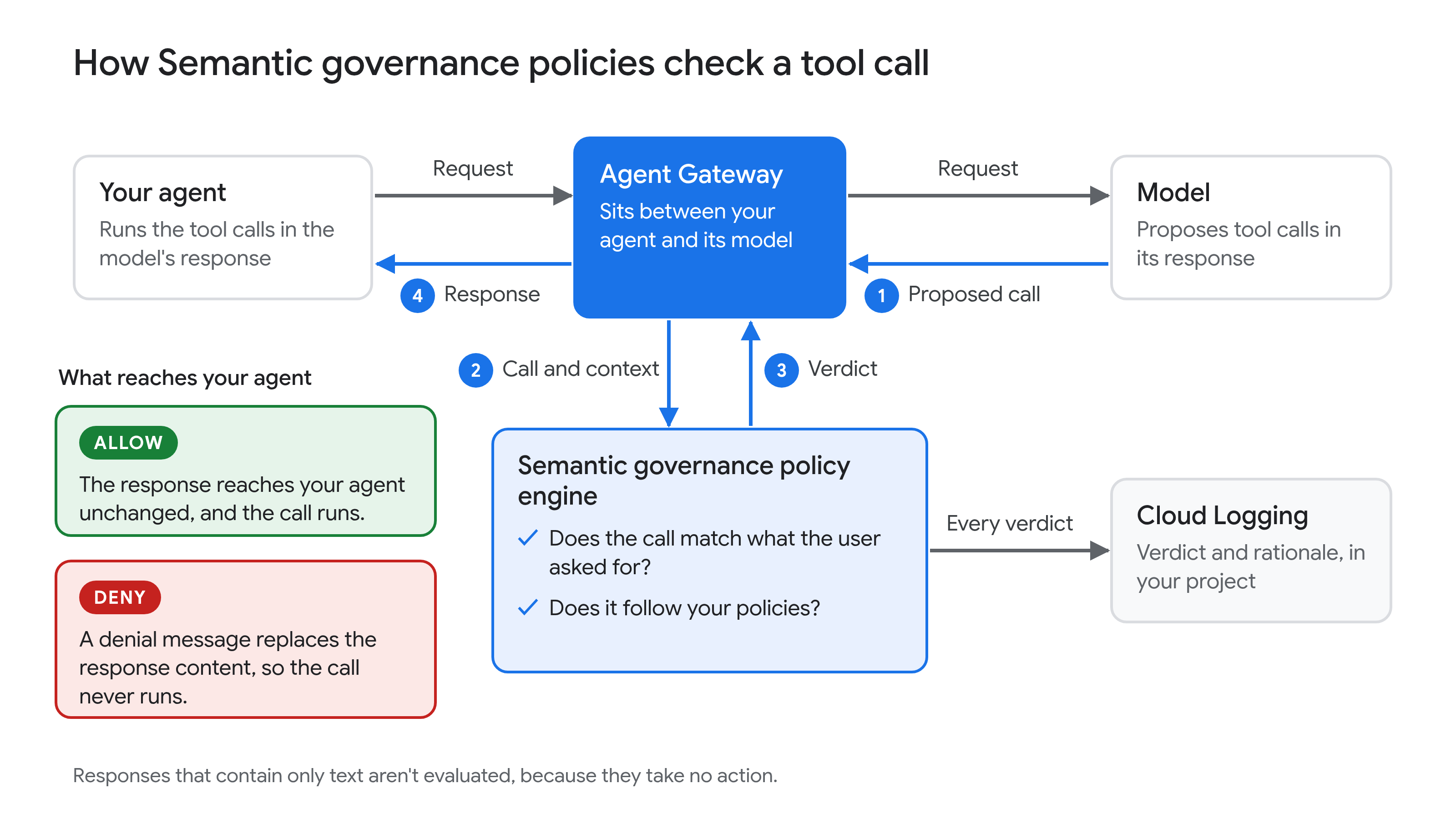
One operational detail deserves attention. The judge is instructed to deny calls to tools that have no description, because it judges from descriptions. For teams with undocumented internal tools, that instruction alone will produce denials unrelated to any policy.
The limits are printed in the same post
Google does not hide the weaknesses, so read them at full weight.
First, the judge is probabilistic. Google states that verdicts may vary, and recommends running policies in dry run mode, logging what would be denied, before switching to enforcement. A control whose answer can change on the same input is a screening layer, not a permission system, and Google frames it that way: it complements disclosure controls and legal review rather than replacing them.
Second, two kinds of output skip the check entirely. Responses that contain only text are not evaluated, on the reasonable ground that they take no action. Streamed model responses are also not evaluated, with no equivalent justification offered. An agent setup that streams is, on the post's own terms, outside this control.
Third, there is no score. The post ends by promising a follow-up on how the policies held up against prompt injection on AgentDojo, a public agent-security benchmark. Until that appears, the launch post offers no measured catch rate or false-positive rate — only the worked examples above. The companion Anomaly Detection post reports its own test sessions literally: 10 of 40 sessions flagged for an inventory agent running on Amazon Nova Lite through Bedrock, and all four out-of-role sessions flagged in a six-session Foundry test. Those are Google's own staged examples too, and Anomaly Detection runs asynchronously; it does not serve as the inline enforcement check described here.
What this changes in practice
For teams already on Google's agent platform, the practical sequence is the one Google gives: connect the policy engine, leave it in dry run, write the two or three rules that carry real consequences (money out, data out, deletions), read the logged rationales, then enforce. The audit trail is a concrete benefit here: every verdict lands in Cloud Logging with the judge's reasoning and token usage.
For teams elsewhere, the honest reading is narrower. The inline check exists only behind Agent Gateway, and the monitor reviews only agents whose telemetry reaches a Google Cloud project — including agents that live on AWS and Azure.
Sources
- [1] Google Developers Blog, "Check what your AI agents do before they do it, with Semantic governance policies," November 20, 2026Read source
- [2] Google Developers Blog, "Agent Anomaly Detection: Safeguarding agents across other clouds," November 20, 2026Read source