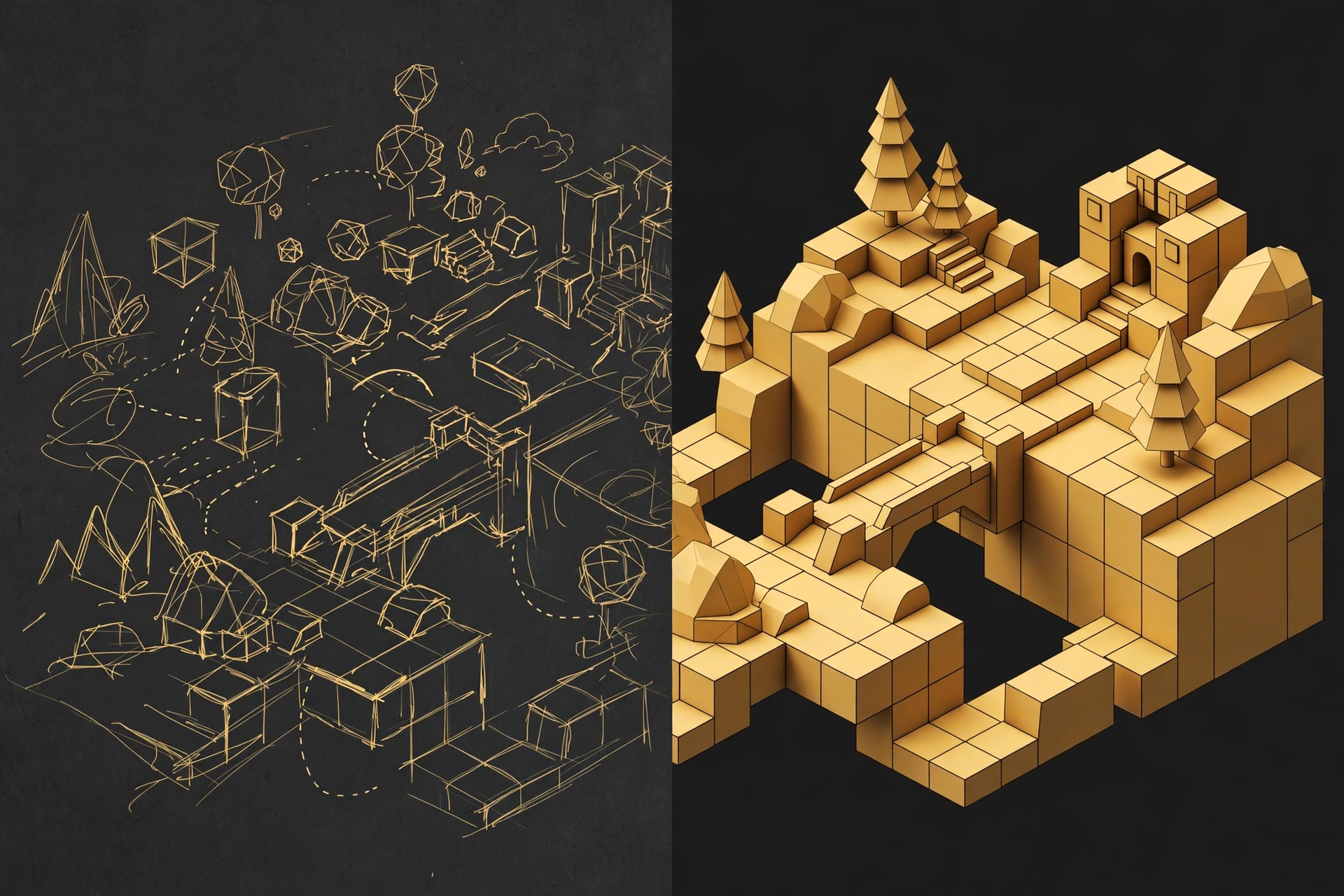
Google has launched Playground, an experimental browser platform that turns a text description into a playable game. The obvious reading is that Google has moved into territory Unity spent two decades building. Unity's response is more interesting than a defensive product announcement: it is becoming Google's partner.
Unity Spark, due to enter closed beta later this year, will sit inside Playground as an expanded creation route. The pair are effectively dividing the workflow. Google supplies the conversational front door and the consumer network. Unity supplies the structured engine, editable assets and production habits that prompt-generated games still lack.
Playground is a creation product, not another model demo
Playground opens to adults in the United States with no coding required. A creator can begin from a blank canvas, remix a starter or use guided help, then ask the system to change physics, rules, characters or environments. The result can be tested immediately in the browser.
That short loop is the product. Google is not asking a new creator to install an engine, understand a scene graph or wait through a build before learning whether the idea is fun. Describe, play, revise. The platform uses Google's own model stack, including Gemini for the conversation and generation systems such as Nano Banana and Lyria for visual and audio parts.
Finished games can remain private, be shared by link or be published to an Explore gallery. Selected genres add multiplayer and leaderboards. A Play Games profile brings handles, follows and ratings into the same system, giving Google both a creation tool and a distribution surface. Playground is free to use, while Google One membership tiers raise weekly creation limits.
The rough edges are visible in the launch terms. Access starts with US adults rather than a broad global rollout. Published games pass safety screening and can be removed under Google's community rules. And there is no evidence yet that a conversational loop can reliably produce the systems, balance and maintainability expected from a commercial game.
Unity chose the funnel instead of the fortress
A prompt-to-game platform looks like an engine threat. If a player can describe a game and immediately receive one, the value of a professional editor appears to shrink. Unity could have answered by dismissing the output as toys or by forcing creators into its existing desktop workflow.
Instead, it is building Unity Spark for Playground. Spark is designed as a browser-based creation experience with no prior Unity knowledge required. It will use artist-created assets from the Unity Asset Store, provide a more capable web editor, and run on Unity's runtime. Games made with Spark will be publishable through Playground.
That is a practical admission about where the market may form. Prompting can expand the top of the funnel faster than Unity can teach millions of newcomers a conventional engine. If Playground becomes the place those users begin, Unity would rather own the path from a generated sketch to a more controllable game than defend the old starting point.
It is also a sensible answer to the limits of world models. Earlier this year, Google's Project Genie demonstrations unsettled gaming stocks because they generated short interactive worlds from prompts. Unity argued that such outputs were not enough for consistent, repeatable games. A durable title still needs explicit physics, gameplay logic, networking, monetization and operations. Spark turns that critique into a product position: use generation to find the idea, then use an engine to make the idea behave.
The partnership solves two different weaknesses
Google knows how to put an experimental product in front of a large audience, connect it to identity and social features, and subsidize heavy model use through a subscription ladder. Its weak point is the distance between an impressive generated scene and a game people can keep developing.
Unity has the opposite profile. It owns mature authoring and runtime technology, a large asset ecosystem and decades of production knowledge. Its friction is the editor itself: powerful, but intimidating to someone who only has an idea. Playground can supply the demand Unity has struggled to reach; Unity can supply the structure Google's instant creations lack.
The partnership also lowers the risk for Unity. It does not have to outspend Google on foundation models or build a consumer discovery network from scratch. It can remain the system that makes an AI-generated game editable, repeatable and publishable. That is a narrower role than owning the whole creation stack, but a valuable one if prompts become the default entry point.
The missing proof is iteration, not generation
The demos will naturally focus on the first prompt because that is the visible magic. The real test is the tenth revision. Can a creator change one mechanic without breaking three others? Can the project keep a coherent art direction, survive multiplayer, and remain understandable after weeks of edits? Can an experienced developer move from Spark into the deeper Unity workflow without rebuilding the game?
Google and Unity have announced the bridge, not demonstrated that it carries production traffic. Playground is available now, but Spark remains in testing and the companies have not published enough detail about export, ownership, pricing or interoperability to judge the full workflow.
Still, Unity made the right strategic move. Prompt-to-game tools do not eliminate engines; they make the blank canvas less important. The company that owns the editor can either resent that change or become the place where generated ideas acquire rules, memory and reliability. Unity chose the second option before Google could make the first option feel inevitable.
Sources
- [1] PocketGamer.biz — “Google launches Playground for prompt-based game creation” (October 7, 2026)Read source
- [2] The Decoder — “Google bets Gemini can turn casual players into game developers with new Playground feature” (October 7, 2026)Read source
- [3] GamesBeat — “Google Playground and Unity Spark will enable creators to easily generate 3D games” (October 7, 2026)Read source
- [4] Game Developer — “Unity unveils prompting AI tool Unity Spark for Google Playground” (October 7, 2026)Read source
- [5] MobileGamer.biz — “Unity boss Bromberg moves to calm markets as Google’s Genie causes gaming stock slide” (January 2026)Read source