A launch with a short guest list
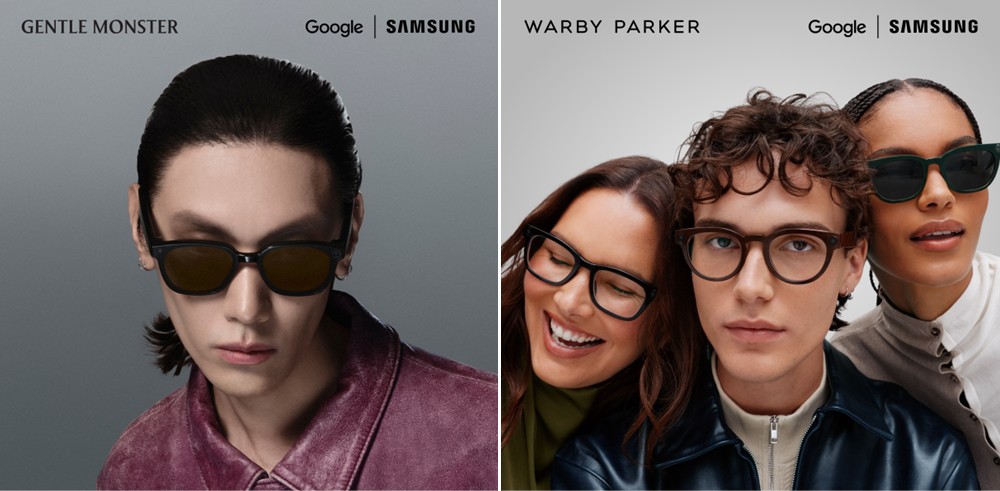
Google's return to glasses is, on paper, the broad one. Four companies share the product: Samsung built the hardware, Google supplies Gemini and the Android XR software, and Warby Parker and Gentle Monster supply the frames people might actually wear. The US launch starts December 10: Warby Parker frames start at $395, while Gentle Monster models are listed at $449 to $489, and Gentle Monster also sells in South Korea. Pre-orders opened today, November 12.
Then read the compatibility table at the bottom of Samsung's release. The glasses are listed as supported with Galaxy S, S FE, Z Fold, Z Flip and Fold Ultra phones on One UI 9.0 or later. They are listed with Pixel 7 and later phones on the September 2026 Android 17 update or later. And they are listed with iPhones: Samsung's table says iPhone 13 and later with at least 6GB RAM on iOS 26.6 or later, while Google's own blog phrases the floor as "iPhone 13 Pro and above" — buyers should check their exact model against both wordings. That is the whole list. Owners of Motorola, OnePlus, Xiaomi, Oppo or Honor phones are not on Samsung's published launch-compatibility list, while iPhone owners are. WIRED reports, as relayed in secondary coverage, that a Google spokesperson said the company will explain its plans for wider phone support in 2027. That is not a compatibility commitment and carries no brands or dates.
The phone list is the launch
Compatibility lists are usually the dullest part of a hardware release. Here they decide who the product is for. Smart glasses are an accessory, and an accessory officially supported only inside two Android brands and Apple's constrains who can use the announced features without changing devices. Whatever the intent, the effect is a bundle. Samsung's specification table even reserves a feature by brand: Gemini is the assistant on every supported phone, but Bixby appears as a second assistant only with Galaxy phones, per Samsung's own footnote.
None of this makes the hardware weak. At about 41 grams the frames are light, the case extends battery to a claimed 72 hours in total, and the camera shoots 3K video. It does mean the supported market on day one is much narrower than "Android and iPhone users," which is how the launch will mostly be described.
What the glasses actually do
No display is listed in the launch specifications, so the announced assistant interaction runs through voice and audio, alongside the camera. Saying "Hey Gemini" or tapping the frame asks questions about what the camera sees, gets turn-by-turn Maps directions read aloud, and translates speech across more than 70 languages, per Google. Gemini's Guided Vision gives spoken descriptions for people who are blind or have low vision, and an Aira integration streams the camera feed to a trained human interpreter. Samsung's examples are workmanlike in a good way: photograph a whiteboard, have Gemini summarize it, save the summary to Samsung Notes.
The privacy design is more specific than the usual paragraph. Google says camera visuals used for Gemini answers are not saved in Gemini History and are not used to train models or target ads, and that bystanders' faces are automatically redacted from those visuals before processing. A recording light must be visible for gallery capture, and Samsung says capture is designed to stop if that light is covered or not working. Those are checkable claims of two different kinds: the visible recording safeguards can be evaluated on a retail unit, while the backend data-handling commitments cannot — they rest on Google's word until someone audits them.
What to do with a pre-order window
The pre-order runs for four weeks, and the launch coverage the desk reviewed contains no independent mixed-use battery evaluation: how the nine-hour claim holds up under camera use will only be settled by units in the wild. If your phone is on the list, the honest comparison is against the frames you would otherwise buy from one of these two brands, at the prescription and lens options you actually need. If your phone is not on the list, there is nothing to pre-order: the relayed 2027 support-plan comment has no brands or dates attached to it yet, and a promise to explain later is not compatibility.
Sources
- [1] Google, "See our intelligent eyewear lineup and pre-order your pair", blog.google, November 12, 2026Read source
- [2] Samsung Newsroom, "Samsung Announces December Release for Intelligent Eyewear", November 12, 2026Read source
- [3] 9to5Google, "Google launches Intelligent Eyewear glasses: $395, pre-order now", November 12, 2026Read source
- [4] WIRED's launch coverage, as reported in secondary coverage on November 12, 2026, for the display-version testing and the 2027 wider-support comment attributed to a Google spokesperson