
What Google launched in India
Dreambeans is one of Google's more unusual consumer AI experiments. Rather than waiting for a prompt, it uses a user's permission to connect selected Google services — Gmail, Calendar, Photos, Search, YouTube and Gemini — and proactively assembles a daily set of illustrated stories about the user's interests, plans and memories. The illustrations are generated with Nano Banana 2, and TechCrunch reports that Google recently added animation built on its Veo video model to select stories.
On Monday, that experiment left its home market for the first time. Google expanded Dreambeans to India on Android and iOS, with story generation in 13 Indian languages, including Hindi, Punjabi, Tamil, Telugu and Bengali, alongside English. Google product manager Gozde Oznur told reporters Google picked India for two reasons: strong interest from Indian users who wanted access, and a high overlap of people there using Gemini, Gmail and Google Photos together. India is the world's second-largest internet market, as TechCrunch notes, which makes it the natural place to test whether a product built on connected Google accounts can find a larger audience.
One limit travels with the launch. A user can select only one language at a time, and stories cannot mix languages. That may be restrictive for multilingual users who regularly switch between English and an Indian language in everyday communication. Oznur acknowledged the current limitation without announcing a timetable for changing it.
The numbers it leaves behind
Google has published no download or usage figure for Dreambeans. The only numbers available are Sensor Tower estimates shared with TechCrunch, and they describe a small product getting smaller. Nearly 55,000 U.S. downloads since the June debut. About 63% of those arrived in September, when Google opened the app to every eligible U.S. adult after a summer limited to AI Ultra subscribers. October then fell 84% month over month, to about 5,500 downloads.
The comparison Sensor Tower supplied is unflattering and needs handling with care. In the first 30 days after Dreambeans opened to all U.S. adults, it recorded an estimated 29,000 downloads. Meta's Muse recorded 7.4 million in its first 30 days, ChatGPT 2.8 million, Grok Bot 362,000 and Claude 155,000. Dreambeans is a narrow, single-purpose experiment, not a general assistant, so the gap measures scale rather than quality. Even with that allowance, the order of magnitude is the story: Claude recorded about 5.3 times as many first-30-day downloads, ChatGPT about 97 times as many, and Meta's Muse about 255 times as many. These are Sensor Tower estimates, not Google's figures, and the comparison does not establish which product users prefer or retain.
That is the context the India expansion arrives in. A launch in a new market can mean a product is working, or it can mean the home market has given its answer and the search for users moves elsewhere. September's opening removed the subscription gate and produced a substantial download spike. But the October decline suggests that wider access alone was not enough to sustain that initial interest. Sensor Tower's figures measure downloads, not active users, retention or the reasons people stopped installing the app.
What the app asks for in return
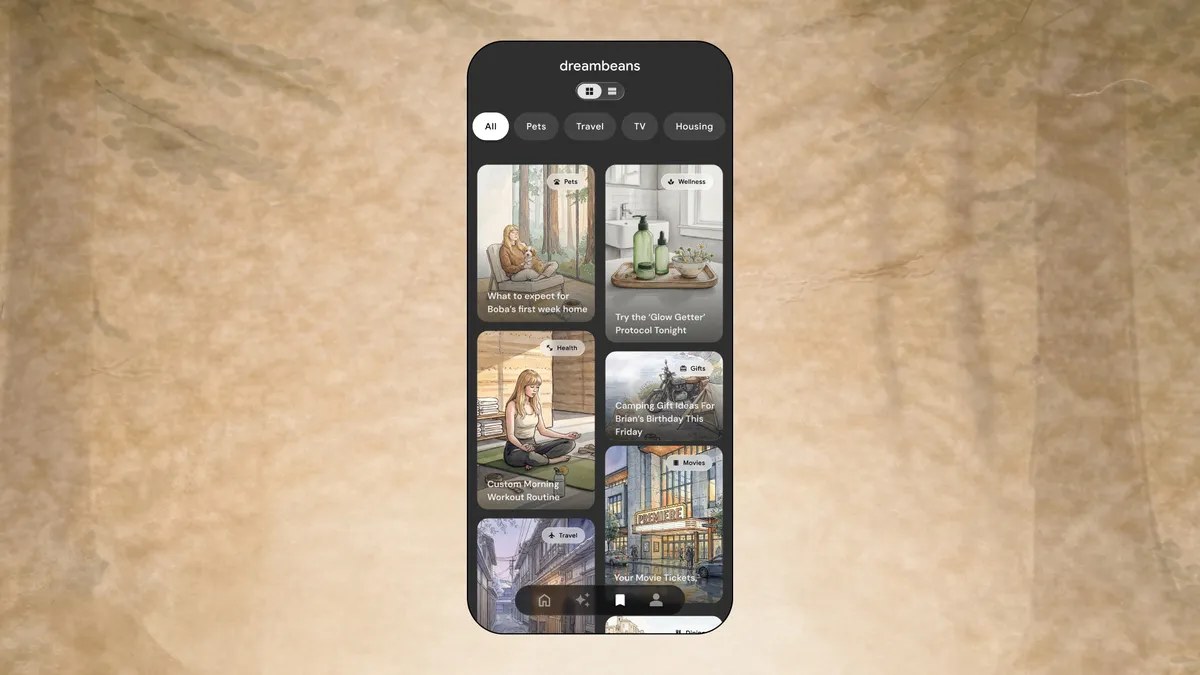
Dreambeans requires at least one connected Google service to function, and Google's launch post is plain that it "works best when they are all enabled." That sentence is the product. The stories improve as the access widens: an inbox for deliveries and bookings, a calendar for plans, a photo library for memories, search and viewing history for interests.
The controls are real, and they were the part of the briefing Oznur spent time on, according to TechCrunch. Users choose which services to connect. Users can disconnect services and delete their Dreambeans data within the app. According to Google's product briefing, deleting information from a connected Google service also removes it from Dreambeans' personalization. These controls should not be confused with deleting the original information from every Google service or storage system. Users can tell the app to avoid subjects, including business information. The app is limited to personal accounts, and stories are visible only to the account holder.
There is a harder edge that Google did not hide. A system that rebuilds stories from a photo library and an inbox can surface memories a user did not ask to revisit. Oznur acknowledged that Dreambeans could generate stories involving people who have died, and pointed to subject controls similar to the ones Google Photos offers for memories. That is an honest admission, and it underlines what the product is: a machine that reads a life back to its owner, including the parts the owner was not expecting to read that morning.
The documentation has not fully caught up with the product. Google's Labs support page, as checked on November 2, still describes the original AI Ultra subscription and waitlist requirements, while the Dreambeans product page describes broader U.S. access. This appears to be documentation lag rather than evidence that the newer access terms have been withdrawn.
Oznur said Google is exploring ways to make Dreambeans more actionable, moving from stories and recommendations toward helping users act on them. That direction would raise the stakes of every number above. An app that merely illustrates your life can fail quietly. An app that acts on what it reads in your inbox needs a larger, more trusting user base than 55,000 downloads, most of them from a single month.
Sources
- [1] Jagmeet Singh, "Google takes Dreambeans to India in bid to bring AI-generated personal stories to the masses," TechCrunch, November 3, 2026, 03:30 UTC (read first-hand — India expansion on Monday, November 2, on Android and iOS; 13 local languages including Hindi, Punjabi, Tamil, Telugu and Bengali alongside English; one language at a time, no mixing; first market outside the U.S., less than two months after the app opened to all eligible U.S. users aged 18+; Oznur's reasons for choosing India and her description of the privacy controls, the deleted-data behavior, the personal-accounts limit and the risk of stories involving people who have died; Veo-based animation recently added to select stories; Google exploring more actionable features; all Sensor Tower download estimates)Read source
- [2] Gozde Oznur, "Meet Dreambeans, an app that connects you with what matters," Google blog, June 3, 2026 (read first-hand — Labs experiment; Personal Intelligence and Nano Banana 2; connects Gmail, Calendar, Photos, YouTube and Search history; finite daily story collections; requires at least one connected app and works best with all enabled; choices in Dreambeans do not affect Personal Intelligence settings in other products; June rollout for eligible Google AI Ultra subscribers 18+ in the U.S.; source of the mid-article image)Read source
- [3] Dreambeans product page and FAQ, Google Labs, read November 2, 2026 (read first-hand — currently available to all users 18+ in the U.S.; personal Google account required; at least one connected app required, with Gemini, Gmail, Calendar, Photos, YouTube or Search selectable; first collection takes up to a day; connected-app choices can be changed and data deleted from the profile menu)Read source
- [4] Dreambeans "Get started" support page, Google Labs Help, checked November 2-3, 2026 (still describes access as requiring a Google AI Ultra subscription and a waitlist form, and support in English only; cited only for the documentation-lag observation in the text)Read source