
A model with nothing to say
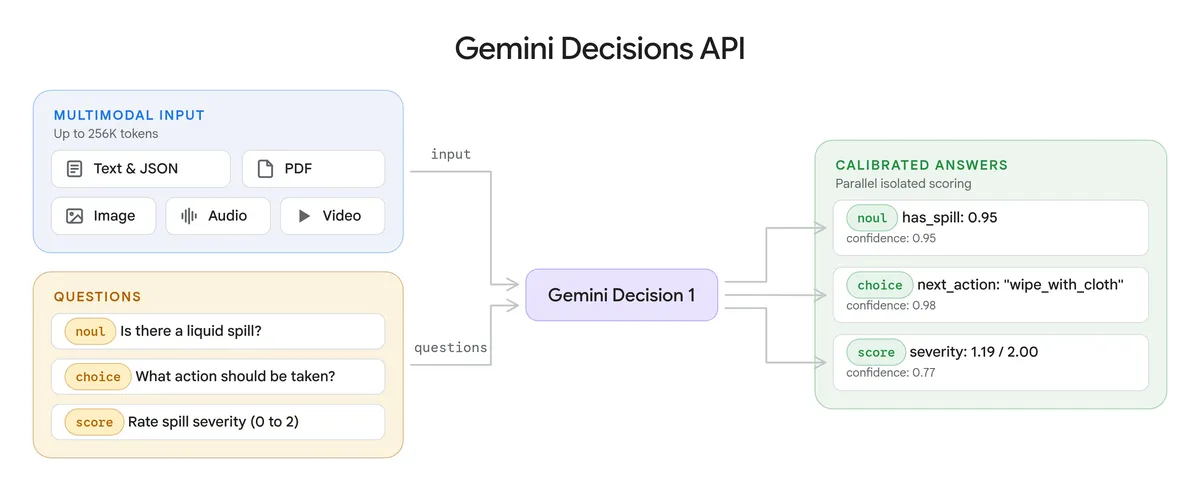
Most model launches add a better writer. This one removes writing altogether. Gemini Decision 1 takes one piece of material — a scanned form with damage photos and call notes, in Google's claims example, or a counter photo with a text note, in its code sample — and answers closed questions about it. Yes or no, with a probability. One choice out of as many as 255, with probabilities for each. Or a rubric score, with the weighted result and the probability of each level.
That restriction is the product. A large share of what production software asks a generative model to do is not drafting. It is routing a ticket, checking whether a required disclosure appears in a recording, deciding whether a proposed tool call should proceed, grading whether a retrieved passage answers a question. Those calls currently pay for generated text that the application then has to parse back into a value it can act on. A single forward pass that returns the value and a confidence score, and lets the code send low-confidence cases to a person, is a cleaner fit — if the scores can be trusted.
Read the speed claim with its test conditions
The headline numbers are 1,000 questions, a 262,144-token request limit and 150–250 milliseconds. They do not belong to the same test. Google states the latency figure for multimodal inputs and contexts up to 16K tokens, and says it stayed nearly flat as requests went from one question to 100. Nothing in the launch post measures a request carrying the full token limit, or the full 1,000-question checklist, or a long video at full resolution, which developers can lower to control token cost.
That does not make the figure useless. A 16K-token record with dozens of checks is a realistic workload, and 50–100 ms of model compute for it is fast. It does mean the three numbers should not be combined into a promise Google did not make. Teams whose material is a 200-page PDF or an hour of audio should expect to measure their own end-to-end time, including upload, before they design around a quarter of a second.
"Leads across the suite" and ninth place are both on the record
Google's post says Decision 1 "leads across the suite" on benchmarks spanning agent routing, reasoning, ranking and multimodal understanding, with the lowest calibration error. The fuller reading is narrower. On the tests all four compared models ran, it led five of seven. Jev beat it on a browser-task benchmark and on When2Call, which tests tool-use decisions — a task this API is explicitly sold for. VentureBeat also reports that the two media tests, MMAU and Video-MME, compare Decision 1 only with Flash-Lite; they do not establish a lead over every model in the broader comparison. Its calibration error of 0.0250, roughly half Jev's 0.0494, is a real strength in Google's comparison — a confidence score only earns its place in code if the probabilities track how often the model is right, and Google reports the lowest error on its suite. Developers still need to test whether the returned probabilities are calibrated on their own cases.
Then there is the independent table. VentureBeat's November 11 reading of Artificial Analysis's Decision Index v2.1, which combines six evaluations including document review and tool calling, places Decision 1 ninth of 18 at launch, at 65.98. Jev 1.14 sits just ahead of it at 66.23 in the tabulated leaders, and Drex Max v1.1 leads at 72.62. One detail in that suite matters more than the overall rank for checklist-style work: on AA-Paperclip, which asks 15 questions about each document, Gemini returned every answer right on 33% of documents, against 35.5% for Jev and 63% for Drex Max, per VentureBeat's reading of the index. Per-question accuracy and all-questions-correct are different products. A workflow that needs the whole checklist right will feel the second number, not the first.
The cost advantage depends on the comparison
Against Gemini 3.5 Flash-Lite answering through the Interactions API, Decision 1 is, as Google says, nearly five times cheaper on the shared benchmark suite: $0.88 against $4.14 in VentureBeat's reading of the workload. That comparison is against Google's own generative model.
Against the models built for this job, the price picture tightens. TypeSafe lists Jev 1.14 at $0.042 per million input tokens, less than half Google's $0.10, and Jev cost $0.68 on that same shared workload, less than Decision 1's $0.88. OpenAI's Decisions API, generally available since October 22, runs on GPT-6 Luna; OpenAI's pricing page lists that model at $0.10 per million uncached input tokens with cache reads at $0.01 per million, and VentureBeat reports the endpoint charges nothing for output and allows up to 400 questions per request. The cache matters for teams that resend the same policy manual or catalog in separate requests — the reusable prefix needs at least 1,024 matching tokens — while Google bills the shared input in full again on each new request and its launch material announces no caching option. Amazon's Strands Decider, by contrast, publishes weights under Apache 2.0 for teams that would rather run the decision step inside their own network, at text-only scope.
What Gemini adds for its price is the input breadth. Text, images, audio, video and PDFs in one shared pass, under a 262,144-token request limit, is a wider door than the text-first rivals open. For a checklist over a call recording and a scanned form, that breadth may be worth more than a lower per-token rate on text alone. Teams handling text-only routing should compare successful-task cost and error behavior against their existing alternatives rather than assume either way.
What would settle it
Google already runs this API where its own teams can watch the outcomes: routing Notebook queries between model tiers, picking an emoji from more than 200 options, screening MCP tool behavior in Search. Those examples show where Google trusts it first. They do not establish acceptable error rates or consequences for other deployments — an MCP safety decision, in particular, can have consequential downstream effects when it is wrong.
The test that decides wider adoption is not another vendor suite. It is a team's own labeled cases, including the rare ones, run at the p95 latency they actually ship at, priced per correctly handled case after the human reviews are counted. Decision 1 gives developers a competitively priced way to run that test today, with a free tier to start. It has not yet given them an independent reason to assume it wins it.
Sources
- [1] Google (Min Choi and Felix Yu, Google DeepMind), "Gemini Decisions API: Fast multimodal decisions" (official announcement, November 11, 2026)Read source
- [2] VentureBeat, "Google's Gemini Decision 1 model scores up to 1,000 questions in one API call" (November 11, 2026; reporting Google's launch benchmarks, the API guide, and Artificial Analysis Decision Index v2.1)Read source
- [3] OpenAI API pricing (GPT-6 Luna input and cached-input rates, checked November 11, 2026)Read source
- [4] MarkTechPost, "Google Launches Gemini Decisions API With Gemini Decision 1 at $0.10/M Tokens" (published November 11, 2026; corroborating endpoint, SDK and limit details)Read source