
A fourth model in the family
Gemini 4 Neon is the fourth member of Google's element-named Gemini 4 family, and it fills the gap the family had left open. Carbon takes the hardest, longest projects. Hydrogen handles fast everyday work. Neon is built for work that is complex but frequent: multi-file coding, analytical reasoning, spreadsheet and document analysis, and long agent runs that a team expects to repeat many times a day.
The specification is not a cut-down one. Neon keeps the family's 1 million-token context window, accepts spreadsheets, PDFs, charts, audio and video as inputs, and offers four thinking levels, with high as the default and xhigh at the top, so a team can trade intelligence against token spend per task. Google also says Tasks in the Gemini app can now run on Neon.
The scores, with the settings attached
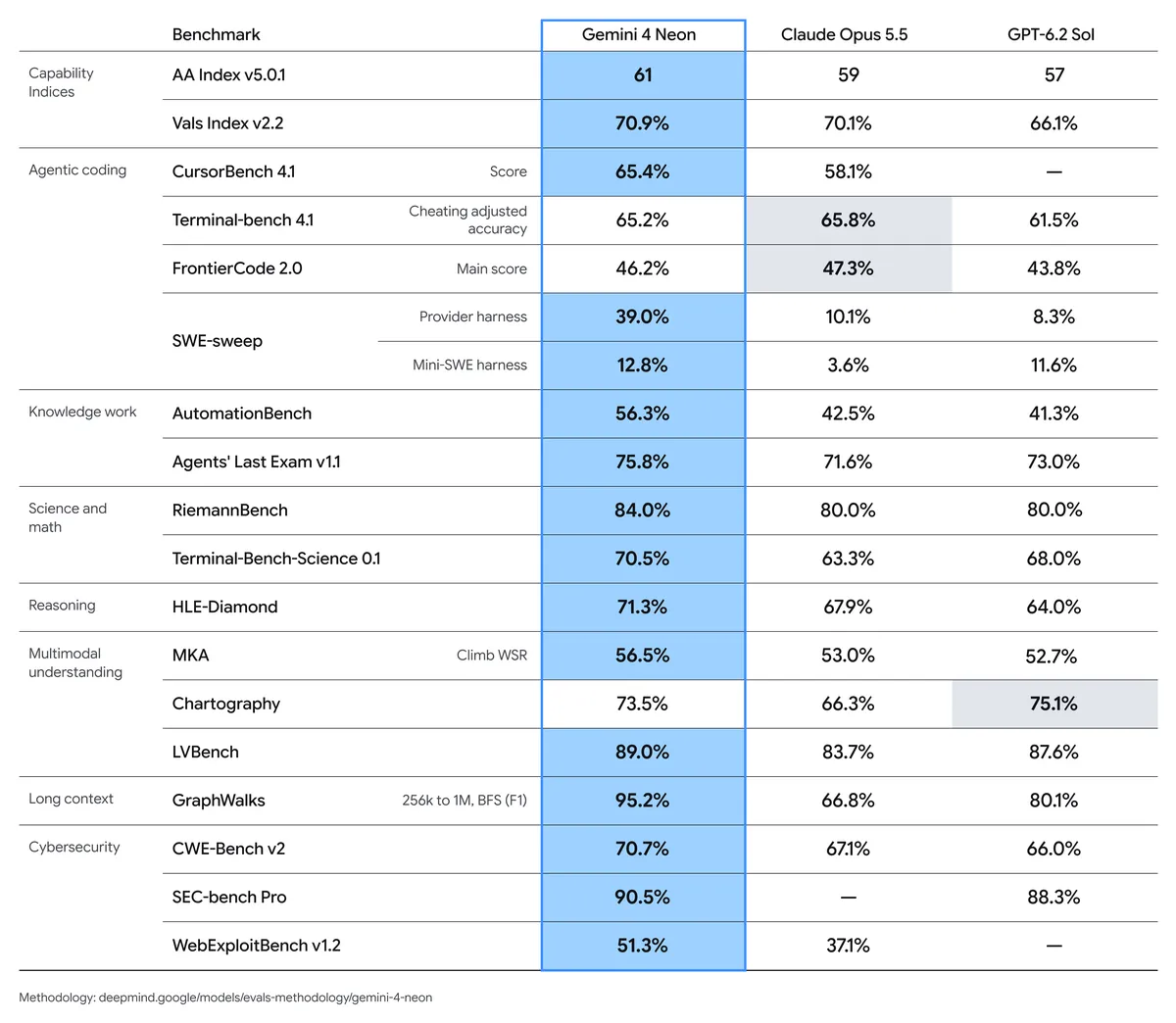
Google's headline number is 61 on the Artificial Analysis Intelligence Index, third overall, behind only larger and slower models. Two qualifications belong next to it. The 61 was recorded at the xhigh thinking level. And the efficiency claim quoted most often, a cost per task 32% lower than Carbon, was measured at the default high level. Both numbers can be true at once, but they are not the same configuration, and a buyer comparing models should not merge them into one.
The supporting results, all Google-reported: Neon ranks first on the Artificial Analysis Coding Agent Index at 58.6, second on the Agent Arena Index's steerability ranking with 1,336 points drawn from more than 4,200 real agent sessions, and second on the Vals Index at 70.9%, with first places on its legal research and tax agent benchmarks. On one coding measure the setup around the model changes the result sharply: Google reports 12.8% on SWE-sweep on the mini-SWE harness and 39.0% inside Antigravity. The two figures describe two tested systems, and the gap between them is part of what a buyer is actually choosing.
The price that changes on November 30
Neon's standard rates are $3 per million input tokens and $15 per million output tokens, twice the per-token price of Hydrogen per 9to5Google's coverage. Google presents Neon as the efficient alternative to Carbon, and its cost-per-task figure at the default high setting supports that at the task level. On standard per-token rates today, it does not. Carbon and Argon are on promotional pricing of $2 input and $10 output until November 30, 2026, per 9to5Google's launch coverage. At those rates Neon's standard rates are 50% higher per token than the flagship's promotional ones.
The comparison inverts on a fixed date. When the promotion ends, Carbon rises to $4 and $20, and Neon's standard rates become 25% lower per token without moving at all. Anyone budgeting a migration this month should therefore price two different worlds: Neon as the premium option on token rates until November 30 (prices as of November 18, 2026), and Neon as the discount option after it. A launch framed on efficiency deserves to have that date printed next to the claim.
Who gets it, and what it replaces
Neon is available now in the Gemini API paid tier in Google AI Studio and Android Studio, in Gemini for business through the API and the model dropdown, in Google Antigravity for paid AI Pro and Ultra subscribers, and in the Gemini app for Pro and Ultra subscribers. A separate cyber-defense variant, which Google says produces more secure code than Carbon on its AutoBaxBench tests, reaches members of the Fairwind Program over the next few days rather than at launch.
The arrival also closes two doors. According to 9to5Google's launch coverage, Neon replaces Argon in the lineup, and Gemini 3.1 Pro goes away in the Gemini app. Subscribers who built habits or prompts around either model are being moved, whether or not the new model was the one they were waiting for.
Sources
- [1] Google, "Introducing Gemini 4 Neon," November 18, 2026 — the primary source, read first-hand in full: the 61 at xhigh, the $3/$15 pricing, the index rankings, the cost-per-task figure and its setting, the availability list, the cyber variant.Read source
- [2] 9to5Google, "Gemini 4 Neon launches," November 18, 2026 — the Carbon/Argon promotional pricing schedule ($2/$10 until November 30, then $4/$20), the Argon replacement and the Gemini 3.1 Pro removal, and the Hydrogen price comparison.Read source