The headline and the body disagree, politely
Foundry Robotics' announcement has a confident title: $100 million to build "America's First Autonomous Factory for Assembly." Read the body of the same release and a second cast of characters keeps appearing. The factory combines "AI-powered robotic cells with experienced manufacturing experts." The team paragraph lists robotics researchers and AI engineers, and then "experienced manufacturing experts" again, improving the technology "directly on the factory floor."
That is not a gotcha. Flexible assembly of complex hardware — fastening, precise placement, cabling across products that change week to week — is exactly where full autonomy is hardest, and a company that staffed its floor only with robots would be making the weaker claim. The more defensible reading is that Foundry is describing an adaptive manufacturing system, not a human-free factory. Its release says FoundryOS connects robotic cells, factory operations and the cloud, with production data feeding back into its models. It does not establish that the facility can operate without human supervision or intervention. The distinction matters: autonomous assembly cells and an autonomous factory are not necessarily the same thing.
What the $100 million is actually buying
The more interesting decision is the business model. Foundry does not sell robots, and it does not retrofit other companies' plants. It owns and operates the factory, and customers buy assembled hardware on a manufacturing-as-a-service basis. The pitch targets a real bottleneck its founders know from both sides: defense and industrial teams can design hardware faster than domestic capacity can assemble it, and a traditional line is built around one product, takes months to deploy, and is expensive to reconfigure.
The founders' backgrounds are part of the evidence investors are pricing. CEO Adarsh Kulkarni built legged robots at Ghost Robotics before running Scale AI's robotics business. Emmanuel Lamacchia ran Tesla's Model Y program — manufacturing at a scale of roughly 1.5 million cars a year, per the release. Tectonic reports that Foundry raised a $20 million seed round in January 2026, ahead of the $100 million Series A announced in October. Separately, the company says its manufacturing footprint has expanded twentyfold to 130,000 square feet in Emeryville. Neither funding announcement establishes a valuation.
Five customers, and then the numbers stop
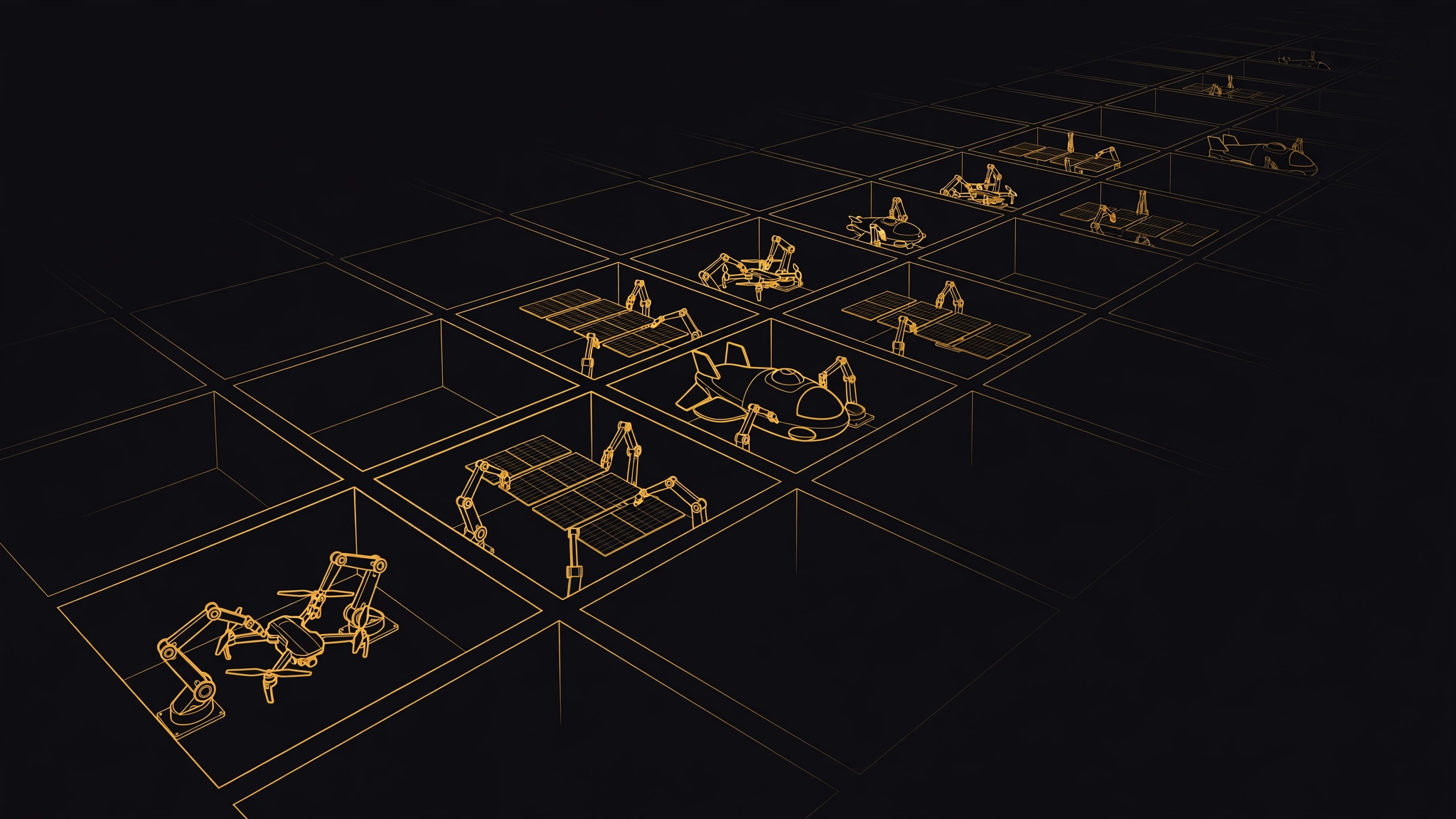
Kulkarni told Tectonic the factory is already assembling robotic dogs, unmanned underwater vehicles, quadcopters and satellite subsystems for five paying customers. HII, the largest shipbuilder in the United States, is Foundry's first publicly announced customer. Duane Fotheringham, president of HII Unmanned Systems, is quoted in the release describing domestic production capacity as "a national constraint." That is a meaningful endorsement from a named customer, but the announcement does not disclose the contract's value, order volume or production schedule. Kulkarni added that demand is distributed — no single customer using most of the facility.
After that, the record goes quiet in a specific way. Neither the release nor the interview coverage discloses how many units the factory has shipped, what a customer pays, how long a changeover between products actually takes, or what the defect rate looks like against a conventional line. The "design to production in weeks" line is the company's own framing, with no product type or complexity attached to it. Even the company's timeline is unresolved. Foundry's release boilerplate says it was founded in 2026, while Tectonic describes it as launched the previous year and reports a $20 million seed round in January 2026. Neither source explains the discrepancy, so the company's founding date remains unclear.
None of that makes the raise vapor. Five paying customers and a publicly identified defense customer are meaningful operating signals for an early-stage manufacturing company. But they do not establish how much production capacity is being used, how much revenue the facility generates, or whether the model can scale economically across different products. It does mean the public case for the $100 million raise rests primarily on the founding team's background, the factory expansion and the company's customer claims, rather than independently measurable production results. The valuation and the investors' underwriting assumptions have not been disclosed. The figures that would settle the argument — units shipped, changeover times, cost per assembly against a staffed line — are precisely the figures a manufacturing-as-a-service company will eventually have to show customers, if not the public. When Foundry publishes its first production numbers, that will be the story. Until then, this is a well-funded bet that assembly data compounds: that every product built makes the next one cheaper to start. It is a plausible bet. It is not yet a demonstrated one.
Sources
- [1] Foundry Robotics, "Foundry Robotics Raises $100 Million Series A to Build America's First Autonomous Factory for Assembly", BusinessWire, October 28, 2026 (primary — read first-hand: round size and investors, 130,000 sq ft and twentyfold expansion, product list, manufacturing-as-a-service model, FoundryOS description, cells-plus-experts wording, design-to-production "in weeks" claim, HII endorsement quote, founder backgrounds, "Founded in 2026" boilerplate)Read source
- [2] Tectonic, "Foundry Robotics Raises $100M Series A", October 29, 2026 (interview with CEO Adarsh Kulkarni, read first-hand: $20M seed in January, "launched last year", five paying customers including HII as first publicly announced, products in production, distributed demand, FoundryOS and end-effector detail)Read source
- [3] RobotsBeat, "Foundry Robotics Raises $100M for Autonomous Assembly Factory", October 2026 (independent summary of the release, noting the "autonomous" wording should not be read as a claim of no technicians or human oversight, and that production volumes per category are not disclosed)Read source
- [4] Intelligent CIO North America, "Foundry Robotics raises US$100 million to build AI-powered autonomous factory in US", October 30, 2026 (notes the company has not disclosed production volumes, customer contract values or independently verified productivity improvements)Read source