The claim and the baseline
NVIDIA's post is a deployment tutorial, not a model launch. FLUX 3 Image Klein already exists; ALFW covered its open-weights release in October, when the interesting claim was that the distilled checkpoint could fit on a consumer card with 8GB of memory. This post asks a different question: how fast can the same model run inside NVIDIA's own TensorRT LLM VisualGen runtime, on NVIDIA's newest datacenter hardware, after every optimization in the stack is switched on?
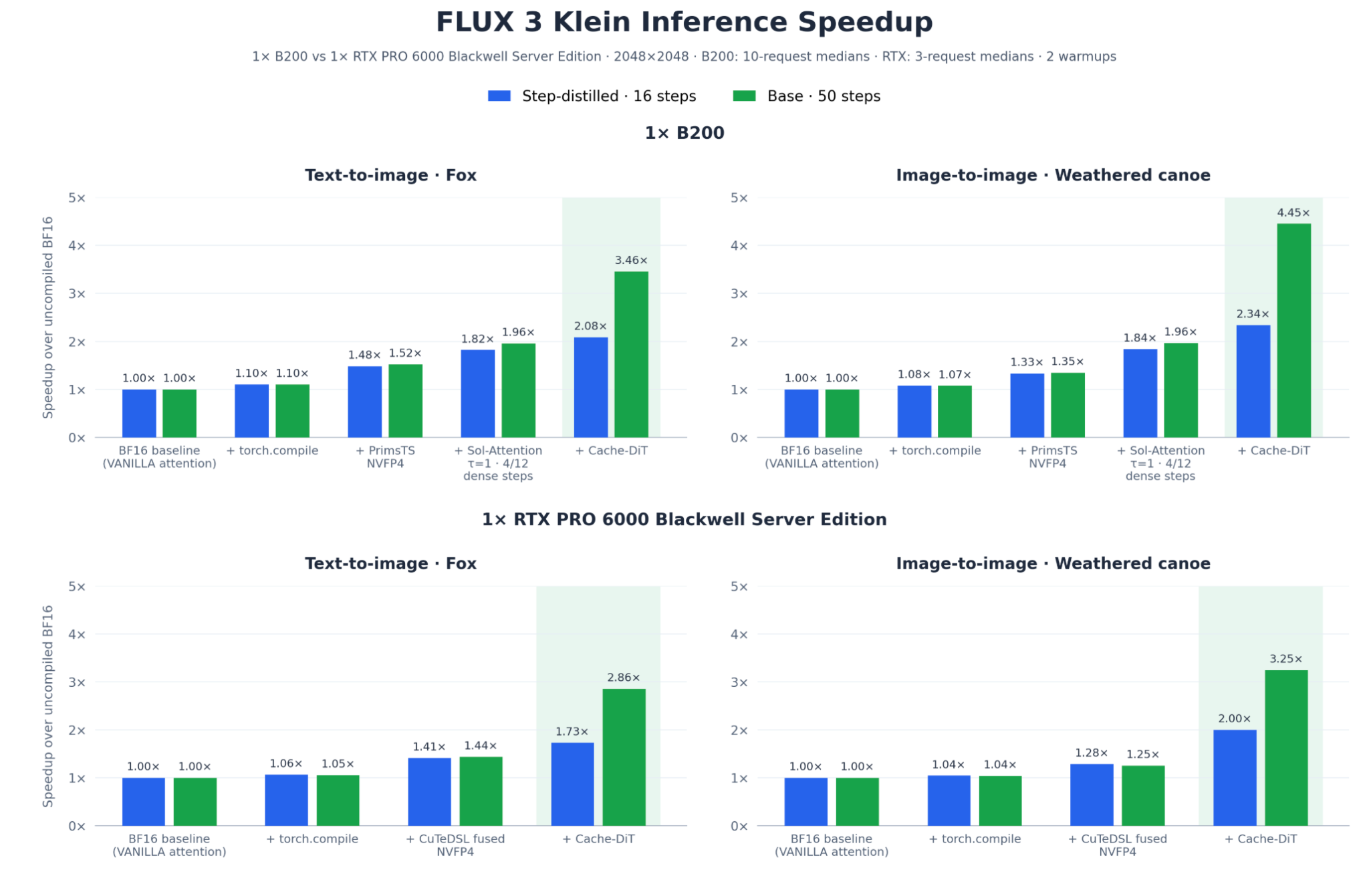
The answer in the headline is up to 3.46x faster text-to-image generation and up to 4.45x faster image-to-image generation. The sentence that gives those numbers their meaning sits in the post's conclusion: the comparison is with uncompiled BF16 vanilla inference. That is the model run without compilation, at full BF16 precision, with standard attention. A deployment that already uses compilation or optimized attention would start from a stronger baseline, so its incremental gain from this stack could be smaller. NVIDIA's comparison measures the full optimization path against an intentionally plain starting configuration, not against an independently tuned production deployment.
None of this makes the tutorial useless. It does mean the 4.45x belongs in the category of best-case engineering headroom, not expected improvement on an existing setup.
The absolute numbers are less dramatic
Read as latencies instead of ratios, the results describe a large model working hard at a large size. At 2048×2048 on one B200, the fully optimized Base model takes 6.46 seconds for a text-to-image generation and 12.28 seconds for an image edit. Those are respectable numbers for 50 denoising steps at 4 megapixels on a single GPU. They are not the instant generation the ratio alone might suggest.
The stage-by-stage figures also show where the time goes. In NVIDIA's Table 1 pipeline breakdown, run in a compiled NVFP4 configuration with vanilla attention, denoising accounts for 96.8% of Base text-to-image time and 97.8% of image-to-image time. That is why most of the tutorial targets the diffusion transformer: NVFP4 quantization, fused GEMM kernels, FP8 or sparse attention, and Cache-DiT, which reuses transformer outputs across steps instead of recomputing them.
Scaling out works, within limits. On eight B200s in a DGX system, median text-to-image latency falls from 14.90 seconds to 3.00 seconds for Base and from 2.73 seconds to 1.08 seconds for the distilled model. NVIDIA notes that roughly half of the eight-GPU distilled run's time sits outside denoising, which caps what more GPUs can buy.
The fast model gains the least, and the picture changes
The faster variant to evaluate is the distilled Klein, configured for 16 steps without guidance. It starts from a shorter generation process, and the same optimization stack improves it by up to 2.34x end-to-end on the single-B200 setup. NVIDIA does not split that figure into text-to-image and image-to-image results in its reported comparison.
In NVIDIA's Table 1 pipeline breakdown, the distilled model completes a 2048×2048 text-to-image run in 2.71 seconds. The slowest configuration has the most headroom, so it produces the largest ratio. That ordering is normal in optimization work, and it is also why leading with the Base number flatters the result.
There is a second cost, and NVIDIA reports it honestly. Quantized attention and step caching do not produce the same image faster; they produce a different image faster. The post measures the difference with LPIPS, a perceptual distance between outputs. Against the vanilla-attention output at 2048×2048, the quantized-attention options score 0.072 to 0.161. Cache-DiT is measured against its own uncached output instead: 0.038 for Base and 0.036 for the distilled model at 1024×1024, and 0.033 and 0.022 at 2048×2048. What it shows is that the optimized outputs are not identical to their comparison baselines and have measurable perceptual differences. Anyone evaluating the speedup should consider those differences alongside latency rather than assuming the faster configuration preserves the same output. Whether that distance matters depends on the job. For draft generation it will not. For an editing workflow where a client approved a specific output, it might.
The practical angle
For a team already serving FLUX models on Blackwell hardware, the useful part of this post is not the ratio. It is the packaged configuration: which YAML settings combine NVFP4 with compilation and VC-Attention, what repair budget NVIDIA chose for quantized attention, and where Cache-DiT's threshold was set before the output moved too far. Those are copyable decisions, with NVIDIA's measurements attached.
For everyone else, the hardware line is the filter. The setup is a prebuilt container from a TensorRT LLM feature branch, the NVFP4 speedups require Blackwell, and the tested cards are a B200 and an RTX PRO 6000 Server Edition. The October story, Klein running locally on a modest consumer GPU, gets nothing from this post. The two claims sit side by side in the model's life: small enough for an 8GB card at one end, and a 4.45x speedup that requires a datacenter GPU at the other. Both are true. They are not the same product experience, and readers budgeting for one should not plan around the other.
Sources
- [1] NVIDIA Developer Blog, “Speed Up Image Generation with FLUX 3 Image Klein on NVIDIA Blackwell GPUs”, published November 6, 2026 at 22:20 UTC (read in full first-hand; headline speedups and the uncompiled BF16 VANILLA baseline, Table 1 pipeline latencies and methodology, NVFP4 gains, quantized-attention and Cache-DiT LPIPS scores with their separate comparison baselines, multi-GPU scaling, RTX PRO 6000 range, prerequisites and conclusion)Read source
- [2] ALFW, “FLUX 3 Image Klein Fits an 8GB Card. The Rest of the Setup Is Bigger.”, October 15, 2026 (our own earlier coverage of the open-weights release, used only for the consumer-card contrast)Read source