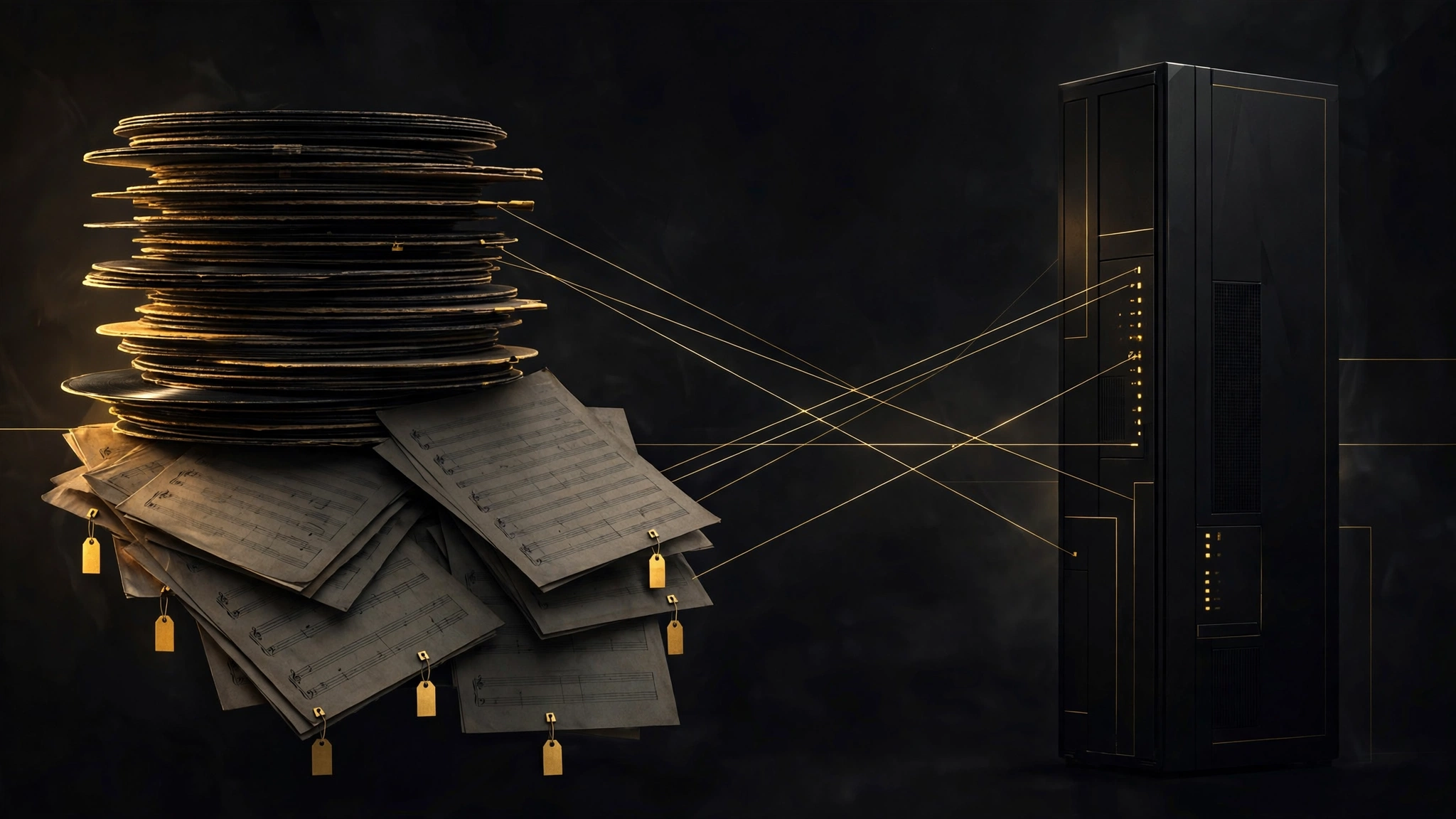
Anthropic spent this week collecting music lawsuits priced by the item. On Friday, October 23, ABG EPE IP LLC — part of Authentic Brands Group, which controls much of Elvis Presley's intellectual property — sued Anthropic in federal court in California together with other holders of rights in his music, including Raleigh Music Publishing, Abilene Music and Aberbach family trusts. The complaint (case 5:26-cv-12473) says Anthropic infringed 274 of Presley's songs by training Claude on them without permission, from "Can't Help Falling in Love" to "(You're The) Devil in Disguise". Billboard, which reported the filing first, called it the most prominent legal action so far brought on behalf of a single musician.
Start with the arithmetic, because the arithmetic is the headline
The figure travelling with this story is $41 million. It is built, not measured: 274 songs multiplied by $150,000. Under 17 U.S.C. § 504(c), $150,000 per work is the potential statutory-damages ceiling where willful infringement is established, subject to applicable statutory requirements. Plaintiffs can request that amount, but a court determines liability and any award. The Elvis plaintiffs request the ceiling rate on every song, and their complaint adds two DMCA claims on top: $685,000 for circumvention of access controls and $6.85 million for removing copyright management information — about $48.6 million sought in that case in all.
Reservoir Media, which sued two days earlier over the lyrics of 853 compositions, ran the same per-work copyright calculation to $127.95 million, then added DMCA claims of its own — $21,325,000 for removal of copyright management information and $2,132,500 for circumvention — reaching a pleaded total of $151,407,500, about $151.4 million. Add the two cases' full requests together and the week totals about $200 million (ALFW's arithmetic: $151.4 million plus $48.6 million). None of it is a liability figure. Statutory damages are set by a court, per work, after liability is established, and the range runs far below the maximum.
What the multiplication establishes is the plaintiffs' opening position, and their chosen unit: not a catalog licence, but a price per song. The lawsuits illustrate how rights holders are quantifying their infringement claims work by work. They do not establish a lawful market price for AI training or resolve whether the challenged uses qualify for fair use. Reservoir's own filing makes the strategy explicit in its parallel case against Suno, arguing that Suno's licensing deals with Warner Music Group, BMG and Believe show Suno "has all but admitted that there is a functioning market for licensing music" — that is Reservoir's position, advanced in its own complaint. A market with prices is what these suits are trying to prove.
The sharpest exhibit is a sentence attributed to the model
The complaints' most quoted passage is not a lyric. In Reservoir's complaint (paragraph 4), the plaintiffs say Claude "has created infringing output of copyrighted material of virtually every song from every catalog available on the internet, including the Works", and that when recently asked to recreate specific songs "for a modern audience", Claude did so and replied: "These renders keep landing very close to the originals: same structure, same hooks reused with light rewording, and full sets of verses/choruses/bridges. That's edging past 'inspired by' into reproducing the copyrighted song, even when the words are swapped out." Rolling Stone's report of the Elvis filing quotes the same exchange from that complaint.
Read that the way a court will have to. It is a plaintiff-selected exhibit: output the plaintiffs say they elicited, quoted in a filing Anthropic has not yet answered in either case. It is not an admission by Anthropic, and ALFW has not tested it. But as litigation craft it is effective, because it answers the defence Anthropic has relied on since publishers first sued it in October 2023: that its safeguards keep copyrighted lyrics out of its outputs. The plaintiffs' reply is to put the product's own words in the exhibit list. Their lead lawyer, Richard Busch, opens the Elvis complaint with the same charge as Reservoir's: enforcing rights against a defendant that "has built its entire business model based on copyright infringement at a scale never seen before".
Same lawyer, second bill, and a calendar problem
Busch is the connective tissue. He leads the Elvis case and signed Reservoir's October 21 filings — against Anthropic, and against Suno, where the pleaded total is about $186.4 million across 1,050 compositions. That Suno case is separate, and its total is not part of the Anthropic figures above. Busch also represented Marvin Gaye's estate in the "Blurred Lines" litigation. Two sets of plaintiffs with no announced coordination beyond shared counsel have, in the same week, attached the music industry's per-work price tags to a single AI company.
The complaints arrive amid reporting that Anthropic is preparing for a possible public listing. Any prospectus may bring renewed attention to unresolved copyright claims, but there is no evidence the plaintiffs timed these suits around an IPO. Anthropic confidentially submitted a draft registration statement on June 1, and suits of this size take months to prepare. When a prospectus does become public, investors will find music litigation among the risk factors alongside the older publisher suits: Universal Music Publishing, Concord and ABKCO in October 2023, and Sony Music Publishing and Warner Chappell in August.
Anthropic told Billboard of the Reservoir case: "We disagree with the allegations and intend to defend this case vigorously." Billboard reported no response to its request for comment on the Elvis case on Saturday. Anthropic's standing position in the earlier cases is that training on copyrighted material can be protected under US fair use. That remains a contested defence, not a resolved one: the training, output and DMCA theories in these complaints are separate claims, and no court has decided them here.
The practical question is narrower than the headline. If courts or settlements price training data per work, the cost lands on every model trained on unlicensed catalogs, and on the tools built on them. If the fair-use defence holds, the per-song numbers become a record of what plaintiffs asked for and did not get. Until a court decides, treat $41.1 million and $151.4 million as what they are: two opening bids, filed two days apart, by plaintiffs who want the industry to start paying by the song.
Elvis-related rights holders and an independent publisher are quantifying alleged infringement work by work. Their requested statutory damages are not established licence prices for training AI.
Sources
- [1] Reservoir Media Management, Inc. et al. v. Anthropic PBC — complaint (N.D. Cal., case 5:26-cv-12308, filed October 21, 2026), read directly by ALFW via CourtListener: Busch as counsel, 853 works in Exhibit A, the paragraph 4 passage quoting Claude, and the pleaded $127,950,000 / $21,325,000 / $2,132,500Read source
- [2] MadRobot (October 24, 2026) — read the Elvis complaint (ABG EPE IP LLC et al. v. Anthropic PBC, N.D. Cal., case 5:26-cv-12473): plaintiffs, 274 songs, $41.1 million copyright ask plus $685,000 circumvention and $6.85 million CMI-removal claimsRead source
- [3] MadRobot (October 22, 2026) — read Reservoir's complaints against Anthropic and Suno via CourtListener: 853 and 1,050 works, about $151 million and $186 million sought, the licensing-market argument in the Suno complaintRead source
- [4] FourWeekMBA (updated October 25, 2026) — read the Reservoir complaint and Billboard's reports of October 22 and 24: Anthropic's response given to Billboard, Billboard's assessment of the Elvis case, and the $41 million figure Rolling Stone later reportedRead source
- [5] NME (October 25, 2026, by Max Pilley) — the Elvis filing as reported from Billboard, the plaintiff structure and song list, and the background of the October 2023 and August publisher suitsRead source
- [6] Rolling Stone (October 24, 2026), as relayed by Far Out (October 25, 2026) — the $150,000-per-song figure and the complaint passages quoted from the Elvis filingRead source
- [7] Music Ally (October 23, 2026) — Reservoir's twin suits against Anthropic and Suno, the work counts, Richard S. Busch of Adams & Reese as Reservoir's counsel, and the licensing-market argumentRead source